

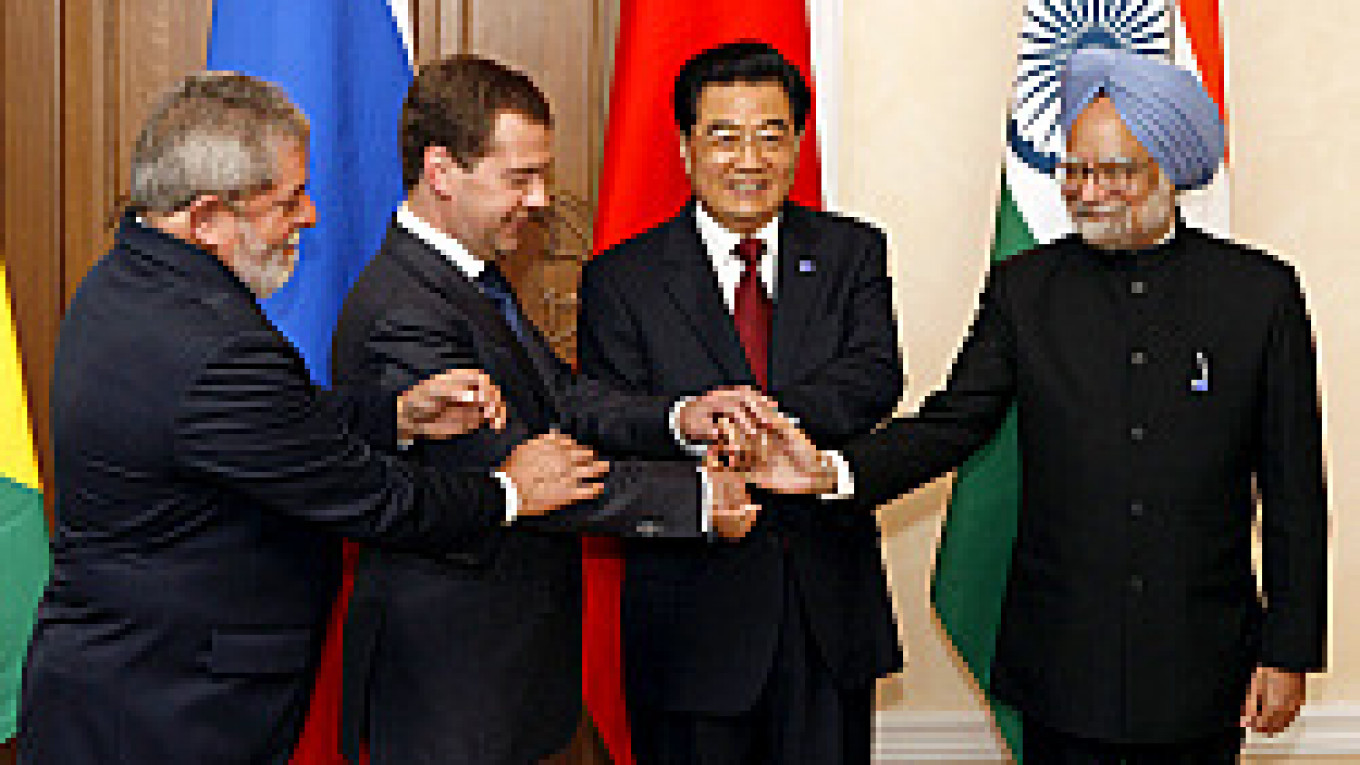
The four BRIC countries — which make up 15 percent of the global economy and hold nearly 40 percent of the world's currency reserves — expressed interest in working more closely together economically, although the cooperation at the Yekaterinburg summit was mostly confined to symbolic gestures.
Leaders discussed investing their reserves into one another's bonds, swapping reserve currencies and increasing the role of Special Drawing Rights, an international reserve asset. But discussions about the creation of a supranational currency and lessening global reliance on the U.S. dollar — two favorite Kremlin topics as of late — were confined to a meeting of the Shanghai Cooperation Organization that took place earlier in the day in the Urals city.
In his opening comments, Medvedev said it was "obvious" that the BRIC leaders needed to find "nonstandard decisions" to common economic problems.
"Life is difficult. Strategic partners must meet more often and seek broader trade and economic relations," Medvedev told Brazilian President Luiz Inacio Lula da Silva earlier in the day.
A joint BRIC statement issued before the summit called for a greater role for developing nations in global financial institutions and the United Nations.
"We are committed to advance the reform of international financial institutions so as to reflect changes in the world economy," the statement said. "The emerging and developing economies must have a greater voice and representation in international financial institutions."
The statement also said the senior leadership of international financial institutions should be selected "through an open, transparent and merit-based selection process."
At the end of the summit, Medvedev said developing countries must "create the conditions for a fairer world order." The other leaders sat next to him and did not offer any comments.
Medvedev reserved his more fiery rhetoric for the Shanghai Cooperation Organization summit, showing that Russia remained eager to play the role of a power broker among emerging economies and a critic of the current world financial system — which it views as unfairly dominated by the United States.
Despite recent comments by Finance Minister Alexei Kudrin in support of the dollar, Medvedev continued his verbal assault on the U.S. currency, urging leaders to find a way to diversify the world's reserve currencies. "The existing set of reserve currencies, including the U.S. dollar, have failed to perform their functions," Medvedev said.
"There cannot be a successful global currency system if the financial instruments it uses are denominated in only one currency," he said. "This is the case today, and that currency is the dollar."
Earlier this month, Medvedev said the dollar was not in "a spectacular position" and cast doubt on its future as a global reserve currency.
Kudrin, meanwhile, said Saturday that the dollar's financial indicators were fine and expressed confidence in its strength.
Kremlin economic aide Arkady Dvorkovich sought to reconcile the two viewpoints Tuesday, telling reporters in Yekaterinburg that "shocks" on the currency markets were to be avoided and that "nobody wants to bring the dollar down."
"We are not looking to exclude the dollar," Dvorkovich said. "But the world economy will grow, and that growing pie should be divided in a fairer way."
Dvorkovich also said the International Monetary Fund should include the ruble, the Chinese yuan and gold in the basket of currencies that make up Special Drawing Rights.
But the idea of replacing the dollar found little traction with at least one BRIC member. China, which holds $2 trillion in foreign currency reserves, did not offer any comment in support of the proposal.
Analysts said that while the BRIC summit was limited to mostly to kind words, the grouping was still at its infancy and could gain significant economic and political clout in the future.
"The statements might have been mostly symbolic, but that doesn't mean they will be by 2020," said Elina Rybakova, chief economist at Citibank.
"They have set some very good goals to work toward," she said.
Medvedev sought to emphasize ties with fellow BRIC leaders.
He reminded Indian Prime Minister Manmohan Singh at a meeting after the summit that the Soviet Union had helped India to industrialize and develop its carbon potential and also came to the rescue in 1971, when then-U.S. President Richard Nixon sent a fleet into Indian territorial waters during the war between India and Pakistan.
Medvedev then waxed poetic, saying business and human ties between the two countries represented "thousands, millions of invisible strings."
The next BRIC gathering is scheduled to take place in Brazil next year.
A Message from The Moscow Times:
Dear readers,
We are facing unprecedented challenges. Russia's Prosecutor General's Office has designated The Moscow Times as an "undesirable" organization, criminalizing our work and putting our staff at risk of prosecution. This follows our earlier unjust labeling as a "foreign agent."
These actions are direct attempts to silence independent journalism in Russia. The authorities claim our work "discredits the decisions of the Russian leadership." We see things differently: we strive to provide accurate, unbiased reporting on Russia.
We, the journalists of The Moscow Times, refuse to be silenced. But to continue our work, we need your help.
Your support, no matter how small, makes a world of difference. If you can, please support us monthly starting from just $2. It's quick to set up, and every contribution makes a significant impact.
By supporting The Moscow Times, you're defending open, independent journalism in the face of repression. Thank you for standing with us.

Remind me later.