

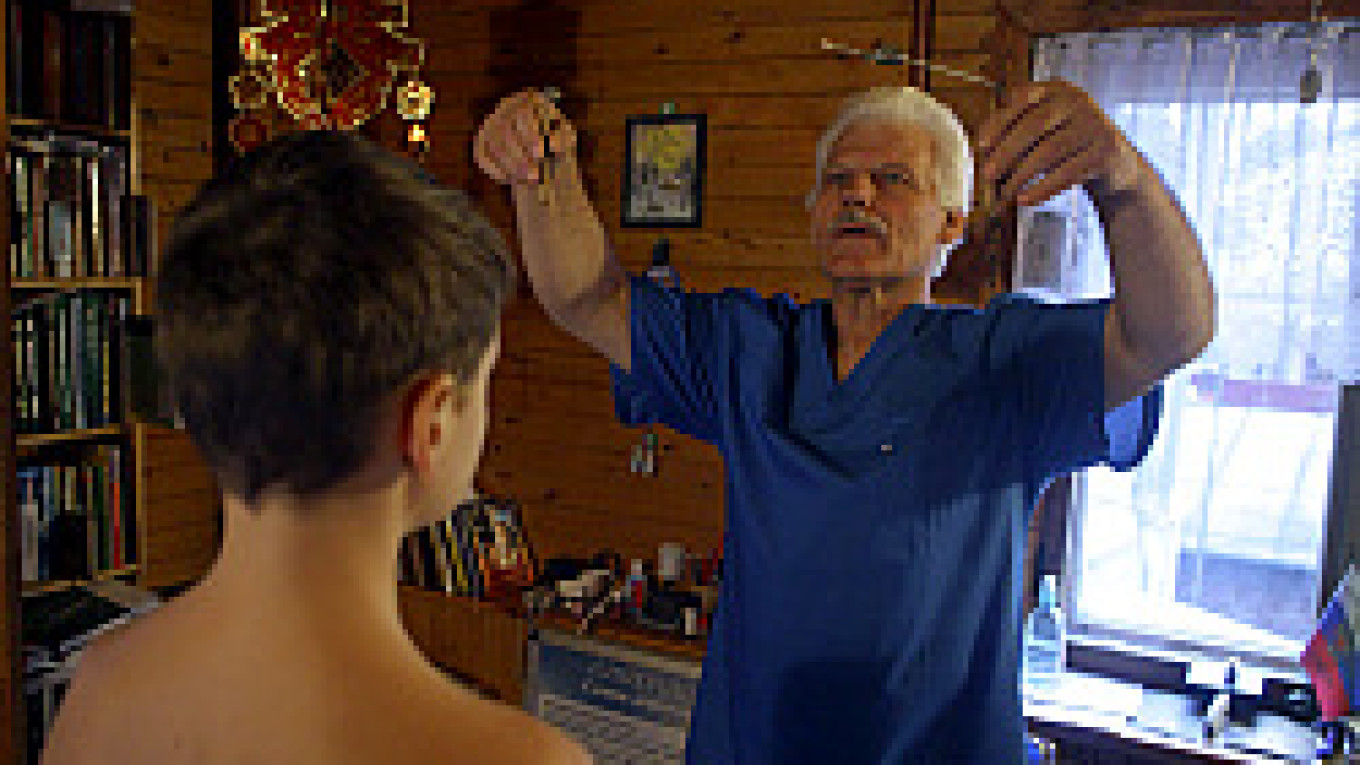
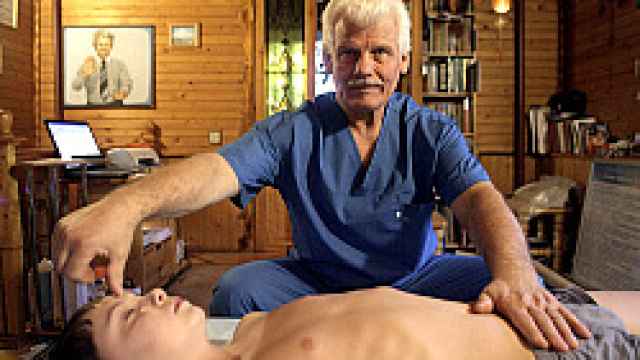
Many laugh at such ideas and might call him a quack. But the 63-year-old healer, who practices out of an office in the village of Malakhovka, 20 kilometers southeast of Moscow, holds a license from the Russian government.
For the past two years, the Federal Health Service has been issuing licenses to practitioners of what it calls "traditional medicine," meaning anything from the use of herbal treatments to the manipulation of "auras." His claims buttressed by officialdom, Fadkin charges patients 3,500 rubles ($150) per session.
And he says business is very good.
"Every day I learn something new," he said, smiling as he gestures to what he says is an invisible aura surrounding him ?€” "because all the information I need is out there, in the vast energy field surrounding us."
So far, 130 healers, including Fadkin, have passed the service's voluntary testing program, which promoters in the government say can determine whether someone has the inherent ability to cure. The program is limited to Moscow, but a Moscow City Duma deputy is pushing to extend it nationwide and make it mandatory.
Skeptics scoff at the notion that such testing is meaningful and criticize the government for lending credibility to those claiming paranormal powers. "I think that this entire system is a result of ignorance and corruption," said Eduard Kruglyakov, a laser physicist and member of the Russian Academy of Sciences. "Science has certain rules that must be followed, and this system of certification hasn't passed any serious scientific tests."
 Mikhail Metzel / AP |  |
| |
"This kind of healing has nothing to do with science or medicine," he said.
The program includes a background check, a scan of electrical activity in the brain and a committee review of the results. The agency charges applicants 10,000 rubles ($430) for the tests.
Andrei Karpeyev, director of the Federal Scientific Clinical Center for Traditional Methods of Diagnostics and Healing, which administers the tests, insists that folk medicine, including psychic healing, is backed by scientific studies. While he acknowledges that some of the criteria for determining who has healing powers are subjective, he claims the tests are able to weed out "charlatans." He said there are perhaps 100,000 people in Russia offering to use magic, psychic or other extra-sensory methods to cure illnesses, read minds or cast spells.
Faith in magic and the occult lingered for centuries in Russia, long after the Renaissance, with its emphasis on rationalism and empiricism, weakened similar beliefs in Western Europe.
Russia is among a small number of nations where traditional healers are licensed at any level. In Indonesia, local governments certify those claiming to use magical charms or psychic powers for healing. And in India, the government licenses healers who use yoga and homeopathy, although not people who claim extra-sensory powers.
Albina Domolazova, 70, paid 3,600 rubles ($155) to an unlicensed clairvoyant to cure her son of drug addiction. When the woman recommended Domolazova toss chunks of beef to black dogs and then light a candle in seven churches, she dutifully obeyed.
 Mikhail Metzel / AP | |
| |
Every year, thousands of Russians claim to have been defrauded by people calling themselves clairvoyants, occultists, and self-styled witches, who advertise in the Russian media.
In July, a Moscow court handed an 11-year prison sentence to Grigory Grabovoi, a cult leader who promised to resurrect children killed in the Beslan school siege in 2004. He reportedly charged grieving relatives some 40,000 rubles ($1,700). In response to cases like Grabovoi's, legislators in the State Duma have proposed a law banning traditional healers from advertising.
But Lyudmila Stebenkova, a United Russia deputy in the Moscow City Duma, said the answer is to weed out the false healers from the true ones. She wants to expand the testing and licensing system to the rest of the country and make it mandatory. "The measures we're proposing will protect Russia's population from fraudsters," she said.
A Message from The Moscow Times:
Dear readers,
We are facing unprecedented challenges. Russia's Prosecutor General's Office has designated The Moscow Times as an "undesirable" organization, criminalizing our work and putting our staff at risk of prosecution. This follows our earlier unjust labeling as a "foreign agent."
These actions are direct attempts to silence independent journalism in Russia. The authorities claim our work "discredits the decisions of the Russian leadership." We see things differently: we strive to provide accurate, unbiased reporting on Russia.
We, the journalists of The Moscow Times, refuse to be silenced. But to continue our work, we need your help.
Your support, no matter how small, makes a world of difference. If you can, please support us monthly starting from just $2. It's quick to set up, and every contribution makes a significant impact.
By supporting The Moscow Times, you're defending open, independent journalism in the face of repression. Thank you for standing with us.

Remind me later.