

Russian sailors are being attacked and held hostage. A Russian missile frigate is guarding cargo ships in the area. Even the main "mother ships" being used by the pirates to launch their attacks are believed to be of Russian origin.
The Russian Navy dispatched the warship Neustrashimy to the Gulf of Aden off the coast of Somalia after a group of pirates seized a Ukrainian ship carrying 33 T-72 tanks and other weaponry on Sept. 25.
The Russian captain of the Ukrainian MV Faina has since died of a heart attack, but the 20 other crew members -- 17 Ukrainians, two Russians and one Latvian -- are still being held aboard the ship for ransom.
The Neustrashimy, which means Intrepid, has not approached the MV Faina, but the U.S. Navy is keeping a wary eye on the hijacked vessel, trying to make sure that the weapons don't fall into terrorist hands.
The Neustrashimy saw its first action last week when it teamed up with the British military to rescue a cargo ship from an attempted hijacking.
Navy spokesman Igor Dygalo said the Neustrashimy and the British frigate HMS Cumberland each sent up a helicopter against the pirates as they tried to commandeer a Danish vessel.
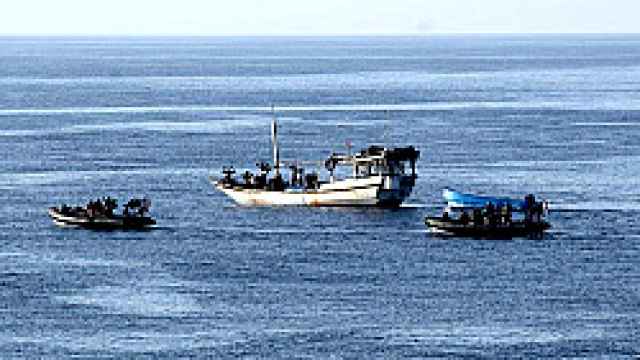 British Defense Ministry / AP Boats from the British warship HMS Cumberland intercepting a dhow carrying the eight suspected pirates last week. Three sailors on the dhow were killed. |  |
| |
The British military said the Cumberland then sent boats to circle a captured Yemeni-flagged dhow -- a traditional wooden vessel -- that had been involved in the attack on the Danish-registered MV Powerful and refused to halt.
The crew of the dhow opened fire at the boats but surrendered after the British crews returned fire in self-defense, the military said. A British crew boarded the dhow and found that two suspected pirates, believed to be Somalis, had been shot and killed, it said.
A Yemeni man also was found wounded and later died despite emergency treatment, the British military said.
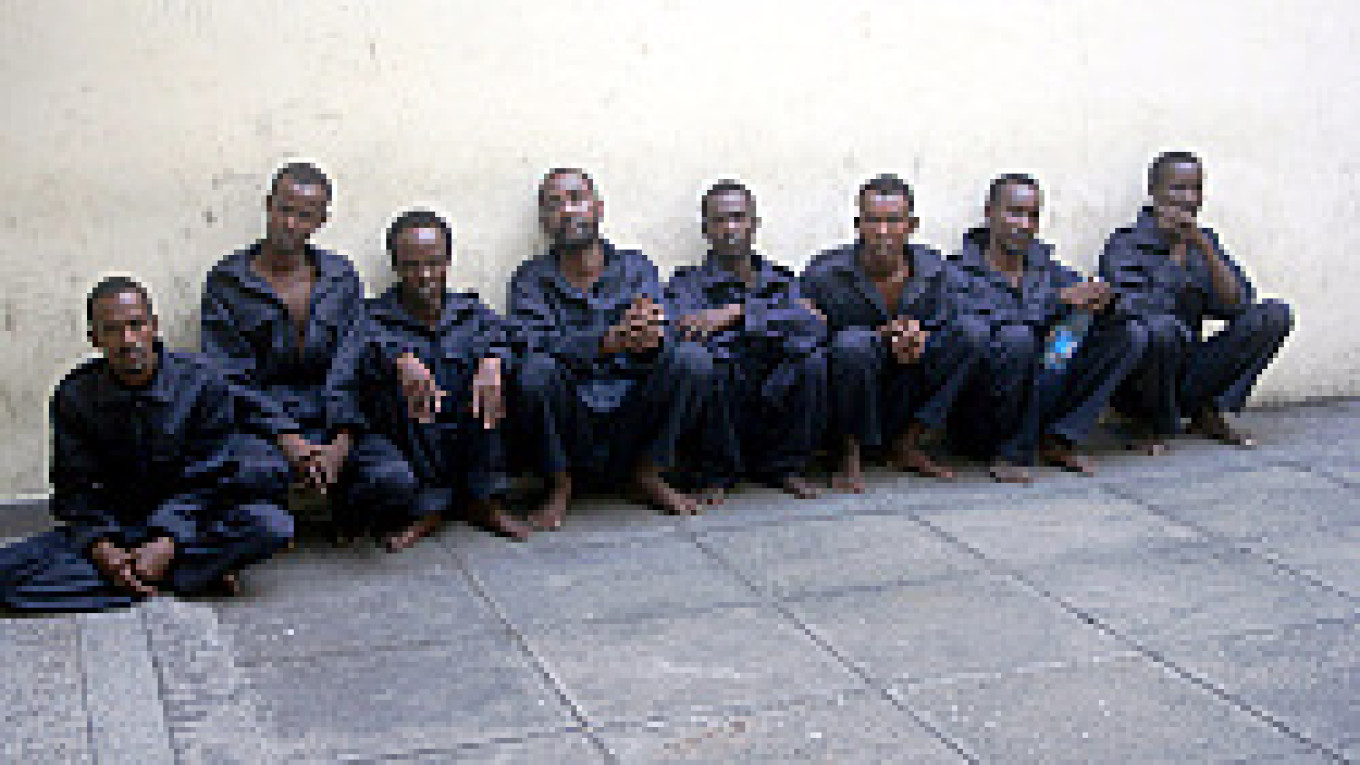
The British military handed over eight suspected Somali pirates from the dhow to Kenyan authorities on Tuesday. In a show of resolve, Kenyan police paraded the suspects in a Mombasa court on Wednesday.
Earlier this week, a Russian patrol boat scared off pirates who tried to capture a Saudi Arabian merchant ship, Interfax reported.
The Neustrashimy was escorting three other ships through the gulf when it received a signal from the Saudi vessel, Rabih, that it was under attack. It launched a patrol boat to intercept the pirates, who fled, Interfax reported.
 Nation Tv / AP The captain of the Kapitan Maslov pointing to bullet holes in his ship after it escaped capture this week. | |
| |
Ammunition fired by the pirates from a fast-moving boat started a fire in a crew member's cabin aboard the Cypriot-flagged cargo ship Kapitan Maslov, but nobody was hurt, and the blaze was extinguished, the ministry said.
The attack took place 480 kilometers off the coast of Somalia as the 16,000-ton cargo ship headed from Colombo, Sri Lanka, to the Kenyan city of Mombasa, the ministry said. The ship, operated by the Vladivostok-based shipping company FESCO Transport Group, had an all-Russian crew of 17 on board.
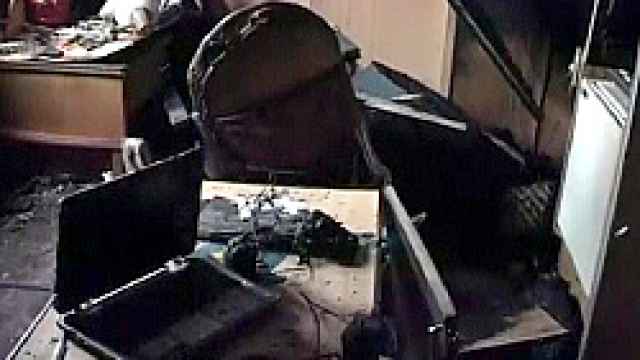 Nation Tv / AP The attack damaged one of the ship's cabins. | |
| |
Pirates, however, succeeded in hijacking a small Danish cargo ship with a crew of eight Russians, four Estonians and one Latvian on Nov. 7.
The pirates are believed to live on "mother ships," storing arms, fuel and other supplies on board and using high-speed boats to catch target vessels.
Three trawlers in the Gulf of Aden are thought to be mother ships, intelligence sources said.
All three might be of Russian origin, said Sam Dawson of the International Transport Workers' Federation.
"We know there are three probably ex-Soviet trawlers acting as mother ships," Dawson said.
"This is not just guys in little fishing boats anymore," he said.
(MT, Reuters, AP)
A Message from The Moscow Times:
Dear readers,
We are facing unprecedented challenges. Russia's Prosecutor General's Office has designated The Moscow Times as an "undesirable" organization, criminalizing our work and putting our staff at risk of prosecution. This follows our earlier unjust labeling as a "foreign agent."
These actions are direct attempts to silence independent journalism in Russia. The authorities claim our work "discredits the decisions of the Russian leadership." We see things differently: we strive to provide accurate, unbiased reporting on Russia.
We, the journalists of The Moscow Times, refuse to be silenced. But to continue our work, we need your help.
Your support, no matter how small, makes a world of difference. If you can, please support us monthly starting from just $2. It's quick to set up, and every contribution makes a significant impact.
By supporting The Moscow Times, you're defending open, independent journalism in the face of repression. Thank you for standing with us.

Remind me later.