

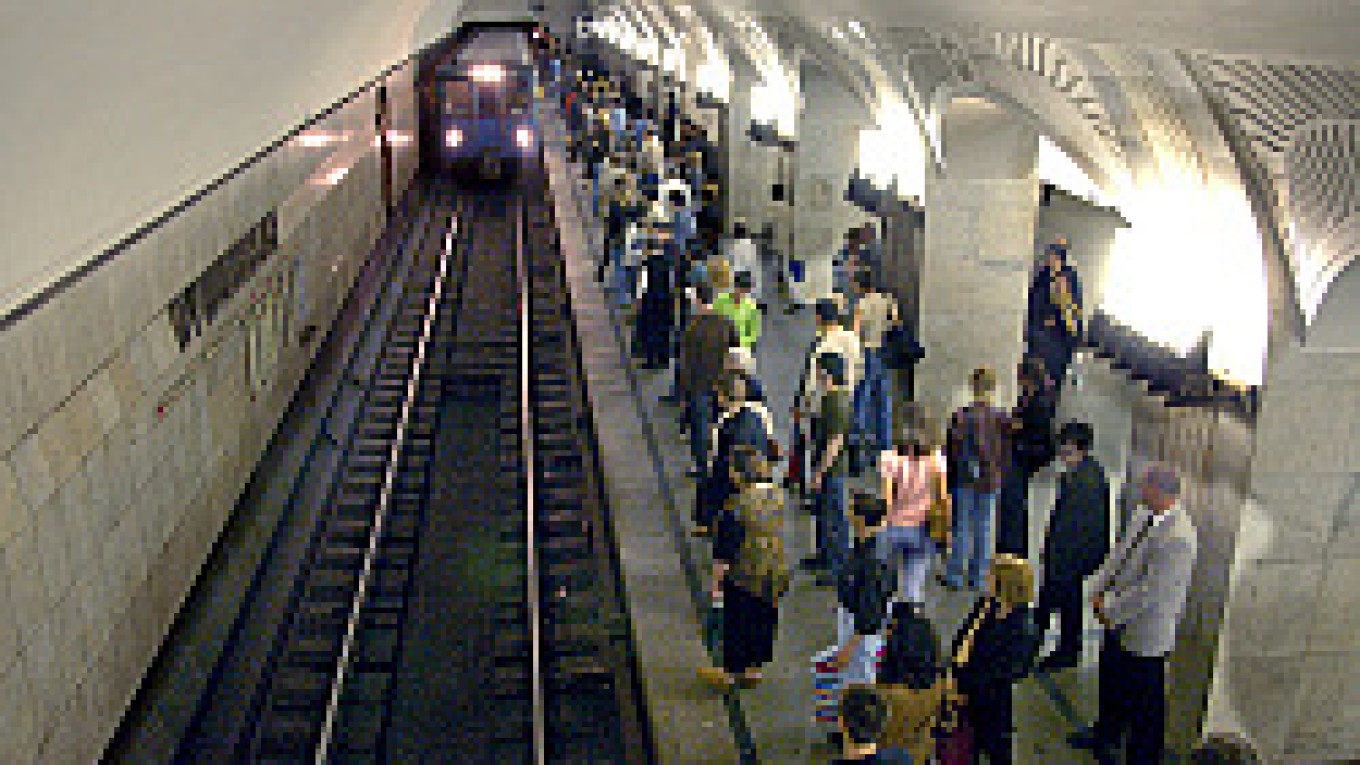
The suit, filed by the City Prosecutor's Office with Moscow's Meshchansky District Court, follows a probe by the Prosecutor General's Office that cited insufficient safety precautions in the Moscow metro, as well as in underground transit systems in several other major cities.
Every year, between 130 and 150 people are killed after being struck by trains pulling into the 177 metro stations that dot the city, according to Moscow metro police statistics.
Many of the deaths are suicides, although accidental falls are frequent. There have been several cases in recent years of passengers being intentionally pushed off metro platforms and into oncoming trains.
The Prosecutor General's Office said in a statement Monday that in addition to Moscow, prosecutors would seek to have barriers erected on metro platforms in St. Petersburg, Yekaterinburg, Nizhny Novgorod and Samara.
The Meshchansky District Court is scheduled to hear the suit against the Moscow metro on Nov. 18, City Prosecutor's Office spokeswoman Valentina Titova said Tuesday.
"It is difficult to say what the ruling will be," Titova said.
Moscow metro spokesman Pavel Sukharnikov said such barriers would be put up in stations on a planned second ring line, whose construction is to begin in 2014. Putting up protective barriers in existing stations, however, would be "very difficult," Sukharnikov said.
Moscow metro chief Dmitry Gayev was less restrained in his criticism of prosecutors' initiative. "The Prosecutor General's Office doesn't have anything better to do," Gayev said, Kommersant reported Tuesday.
"Why is it that when 10,000 people die on the roads, they consider this not to be an issue?" Gayev told Kommersant. "If a man has decided to commit suicide, he will jump in any case: if not under a train, then off the Krymsky Bridge [in central Moscow]."
With 9.5 million passengers daily, the Moscow metro is the second-most heavily used rapid-transit system in the world after Tokyo's, surpassing the New York subway by more than a half million passengers.
The probe by the Prosecutor General's Office concluded that most accidents on metro platforms occur during rush hour, often because of the "careless or intentional actions of citizens."
A Message from The Moscow Times:
Dear readers,
We are facing unprecedented challenges. Russia's Prosecutor General's Office has designated The Moscow Times as an "undesirable" organization, criminalizing our work and putting our staff at risk of prosecution. This follows our earlier unjust labeling as a "foreign agent."
These actions are direct attempts to silence independent journalism in Russia. The authorities claim our work "discredits the decisions of the Russian leadership." We see things differently: we strive to provide accurate, unbiased reporting on Russia.
We, the journalists of The Moscow Times, refuse to be silenced. But to continue our work, we need your help.
Your support, no matter how small, makes a world of difference. If you can, please support us monthly starting from just $2. It's quick to set up, and every contribution makes a significant impact.
By supporting The Moscow Times, you're defending open, independent journalism in the face of repression. Thank you for standing with us.

Remind me later.