

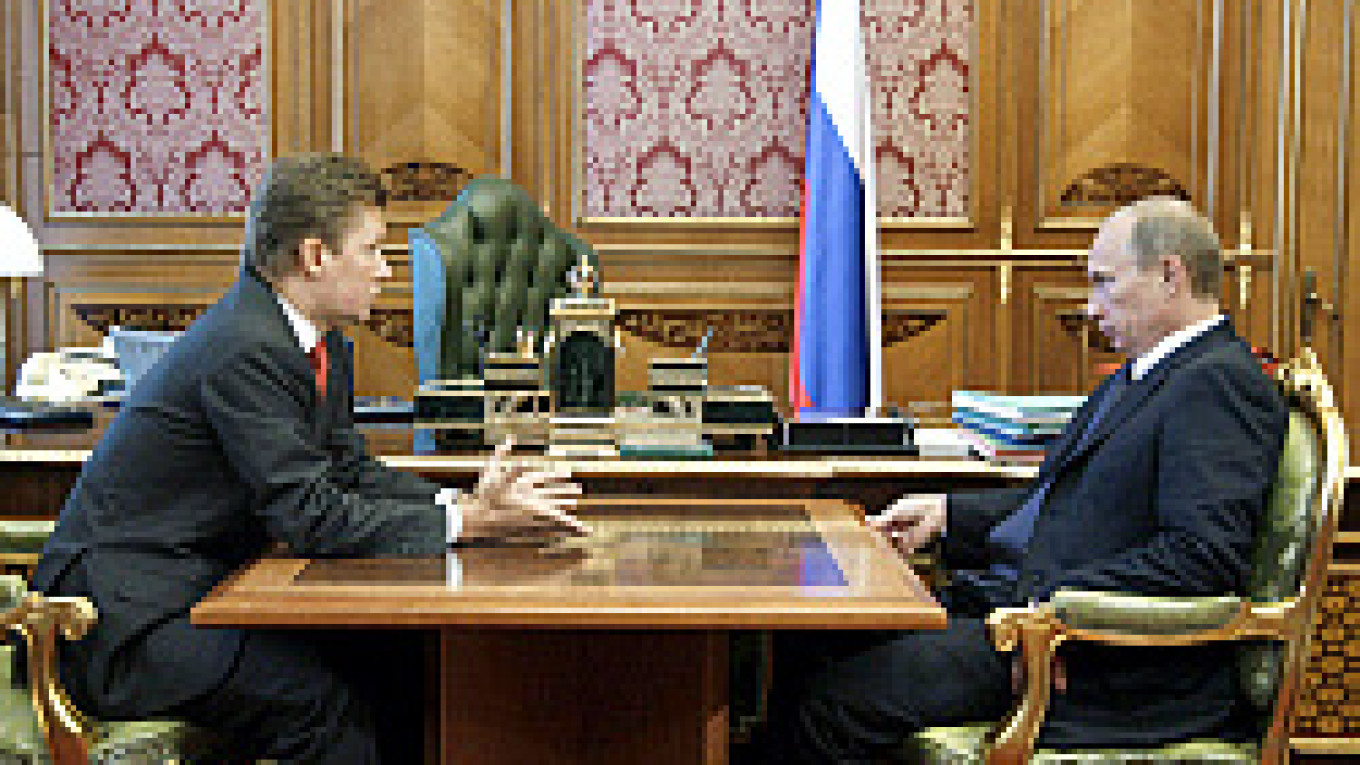
Miller also reiterated that he saw Gazprom's average gas prices to Europe rising to $500 per 1,000 cubic meters by the end of the year, a prediction he made in Azerbaijan last week.
Such price rises will most likely be passed on to Ukraine, the biggest buyer of Gazprom's gas from Central Asia, and could spur renewed price disputes with Kiev.
Growing domestic demand for gas has led to consumption increasing by over 25 billion cubic meters in the last three years, Miller said.
"That is a lot of gas, as much as Gazprom exports to a country like Italy each year," he said.
"The domestic market is becoming a very serious rival to the external market," Miller said, especially after the government decided to move toward reduced gas subsidies for Russian customers.
To meet increasing demand, Gazprom has revised its annual production target from 561 bcm to 563 bcm and will aim for 570 bcm by 2010, Miller said.
In response, Putin said the government would ensure "a much more gentle transition" to market prices for Russian customers than it had planned last year, Interfax reported. He added that the government had not yet made a final decision on exactly when the domestic price liberalization would be pushed through.
Valery Nesterov, an energy analyst at Troika Dialog, said that while such predictions of output growth were reasonable, the real test for Gazprom would come after 2010.
"There is a lot of uncertainty for Gazprom after that. That will be the moment of truth, to see if they can stick to their schedule for Shtokman," Nesterov said, referring to Gazprom's plans for its huge field in the Barents Sea. The field is estimated to hold 3.7 trillion cubic meters of gas.
In his meeting with Putin, Miller also announced that Gazprom was seeking to purchase gas outside of its main Central Asian suppliers of Kazakhstan, Turkmenistan and Uzbekistan.
Gazprom will soon hold price talks on buying gas from Azerbaijan, Russia's ambassador in Baku, Vasily Istratov, said Tuesday, Trend news agency reported.
Miller and President Dmitry Medvedev held talks with Azeri officials during an official visit to Baku last week.
Azerbaijan, which is currently developing a large gas field in the Caspian Sea, has said it is willing to hold talks with Gazprom on sending its gas north via Gazprom's pipelines, but also plans to export most of its gas westward through a pipeline to Turkey and then on to Europe.
Azerbaijan is also considering U.S.-backed plans to construct a gas pipeline across the Caspian that would export Turkmen gas to Europe, a step that would break Gazprom's current stranglehold on Central Asian gas exports.
Nesterov said potential deals between Gazprom and countries such as Azerbaijan were still only "wishful thinking."
"There are serious doubts about whether Azerbaijan will agree to the deal," Nesterov said. "Gazprom is proud of its status as a unique supplier to Europe. But it is not an indispensable intermediary. For now, Azerbaijan can probably sell its gas on its own."
A Message from The Moscow Times:
Dear readers,
We are facing unprecedented challenges. Russia's Prosecutor General's Office has designated The Moscow Times as an "undesirable" organization, criminalizing our work and putting our staff at risk of prosecution. This follows our earlier unjust labeling as a "foreign agent."
These actions are direct attempts to silence independent journalism in Russia. The authorities claim our work "discredits the decisions of the Russian leadership." We see things differently: we strive to provide accurate, unbiased reporting on Russia.
We, the journalists of The Moscow Times, refuse to be silenced. But to continue our work, we need your help.
Your support, no matter how small, makes a world of difference. If you can, please support us monthly starting from just $2. It's quick to set up, and every contribution makes a significant impact.
By supporting The Moscow Times, you're defending open, independent journalism in the face of repression. Thank you for standing with us.

Remind me later.