

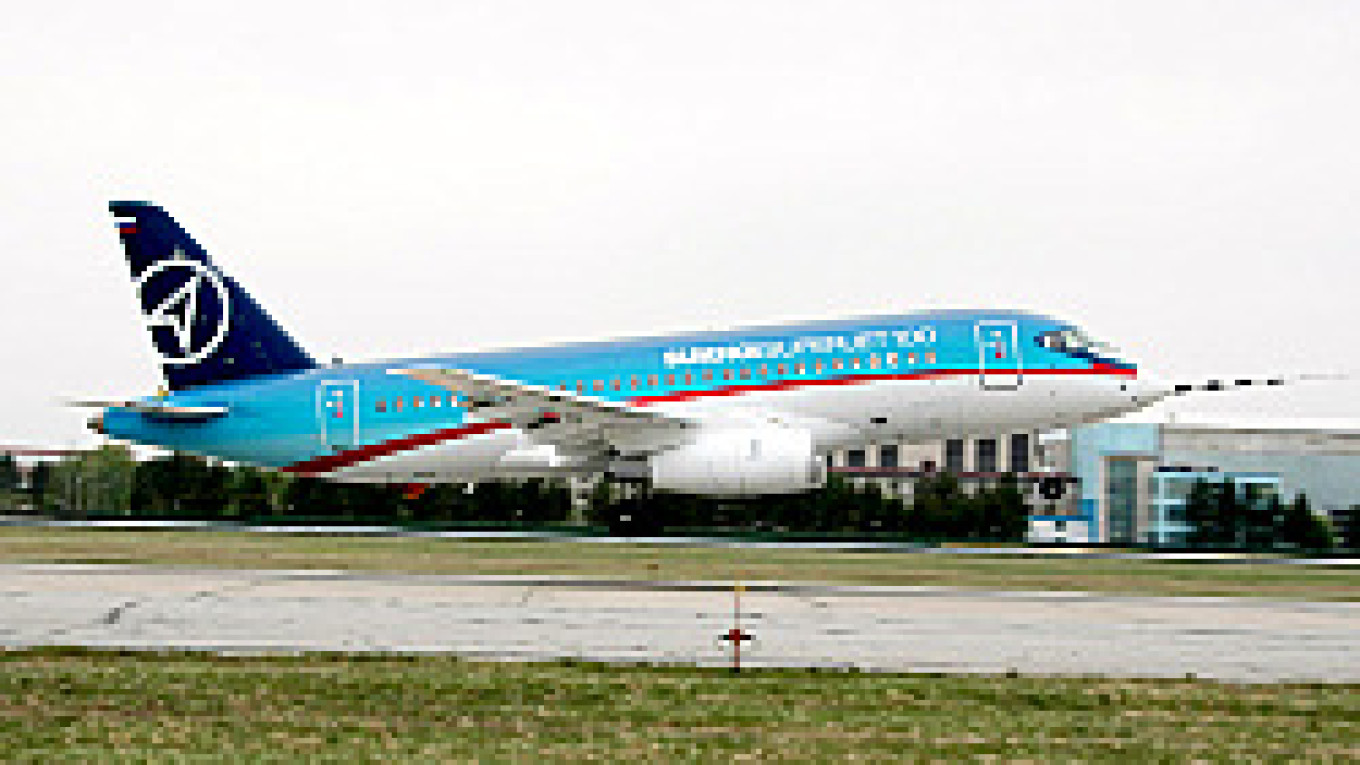
Sukhoi officials only announced the flight — and declared it a success — after the twin-engine midrange jet touched down at its test facility in the far eastern town of Komsomolsk-on-Amur.
The flight, however, came four months later than scheduled, and Sukhoi Aviation Holding is expected to push back delivery of the first jet from November to next year.
The Superjet flew at an altitude of 1,200 meters for 1 hour and 5 minutes on Monday, Sukhoi said in a statement.
"Today is a very important day for us," said Sukhoi CEO Mikhail Pogosyan after watching the flight. "The difficult process of certification tests now lies ahead."
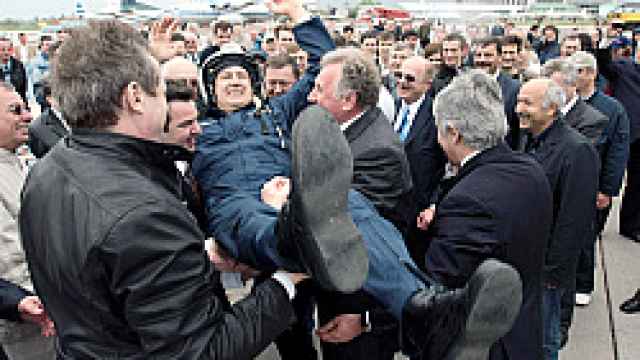
Television footage showed Pogosyan raising a toast with the jet's beaming test pilots at the airport in Komsomolsk-on-Amur, which was closed in Soviet times. Officials picked up the chief test pilot, Alexander Yablontsev, and threw him into the air.
"I'm so happy that I am speechless," Yablontsev said shortly after landing. "I've finally done something manly after all these years."
Sukhoi officials had kept the exact timing of the first flight under tight wraps, saying only that it was expected sometime this month.
Late last week, Pogosyan told reporters that no one would be invited to observe the flight. "The Superjet is our child, and its birth is sacred," he said. "A pregnant woman would never invite the press and guests to watch how she delivers her child."
But the main reason for the secrecy appeared to be worries that something might go wrong. Russia has a lot riding on the Superjet, the first plane to be completely designed and built after the Soviet collapse. It hopes that the plane will revive the once-mighty aviation industry.
Sukhoi and its partner Finmeccanica, Italy's biggest defense company, have invested more than $1.5 billion in the 75- and 95-seat Superjet, which they are positioning to compete with Brazil's Embraer and Canada's Bombardier jets.
The maiden flight was to have taken place in December but was postponed because its equipment needed more testing, Sukhoi said. In addition, it faced difficulties integrating components from about 40 international suppliers.
More than 600 test flights are planned for the next few months, the longest of which will take the plane 6,200 kilometers to the Zhukovsky Air Base, just south of Moscow, where the plane will undergo further tests.
Marina Lystseva / Itar-Tass
A crowd hoisting up chief test pilot Alexander Yablontsev after his flight.
|  |
| |
Sukhoi is under contract to deliver the first jet to Aeroflot in November. The state-run airline has ordered 30 jets and has options for 15 additional aircraft.
Aeroflot deputy director Lev Koshlyakov said he expected delivery sometime next year. "We understand that the plane will be delivered to us not earlier than 2009," he said.
Sukhoi faces no fines if the delay does not exceed six months.
Sukhoi has 73 firm orders and 31 options for the jet from Aeroflot, AirUnion, ItAli, Dalavia and Armavia. The catalog price for the plane is $29.9 million.
The Transportation Ministry voiced concern Monday that the Komsomolsk-on-Amur plant would not have enough capacity to produce the planes. "The project is very ambitious, and the question is whether our aviation industry will be able to meet demand," ministry spokesman Timur Khikmatov said.
The Komsomolsk-on-Amur plant is being expanded to be able to build 70 aircraft per year by 2010.
Sukhoi and Finmeccanica hope to sell at least 800 planes through 2024.
"Our target markets are the U.S. and Western Europe," said Valerio Bonelli, a spokesman for Alenia Auronautica, the subsidiary of Finmeccanica responsible for the Superjet.
"The Superjet has now showed that it can fly, so interest will be growing with every passing day," he said.
Lufthansa, the second-biggest carrier in Europe, said the airline was aware of Monday's test flight but had no plans to place an order.
"We are now considering a number of projects, but by the already-signed contracts we will be filling our midrange fleet with Bombardier and Embraer planes until 2015," Lufthansa spokeswoman Stefanie Stopz said.
Aviation analysts said the Superjet had a shot at success if it was sold right. "It will really depend if marketing, product support and the customer financing system work properly, as these parameters are the most important in the market for midrange aircraft," said Richard Aboulafia, vice president of the Teal Group, a Virginia-based aerospace consulting firm.
He said it was too early to discuss how economical the plane would be to airlines.
"We will know that after several months of the exploitation," Richard said.
"Much will depend on how committed to the Sukhoi's project its Italian partners will be, as their company has got a huge experience and can really help promote the Superjet," he added.
A Message from The Moscow Times:
Dear readers,
We are facing unprecedented challenges. Russia's Prosecutor General's Office has designated The Moscow Times as an "undesirable" organization, criminalizing our work and putting our staff at risk of prosecution. This follows our earlier unjust labeling as a "foreign agent."
These actions are direct attempts to silence independent journalism in Russia. The authorities claim our work "discredits the decisions of the Russian leadership." We see things differently: we strive to provide accurate, unbiased reporting on Russia.
We, the journalists of The Moscow Times, refuse to be silenced. But to continue our work, we need your help.
Your support, no matter how small, makes a world of difference. If you can, please support us monthly starting from just $2. It's quick to set up, and every contribution makes a significant impact.
By supporting The Moscow Times, you're defending open, independent journalism in the face of repression. Thank you for standing with us.

Remind me later.