

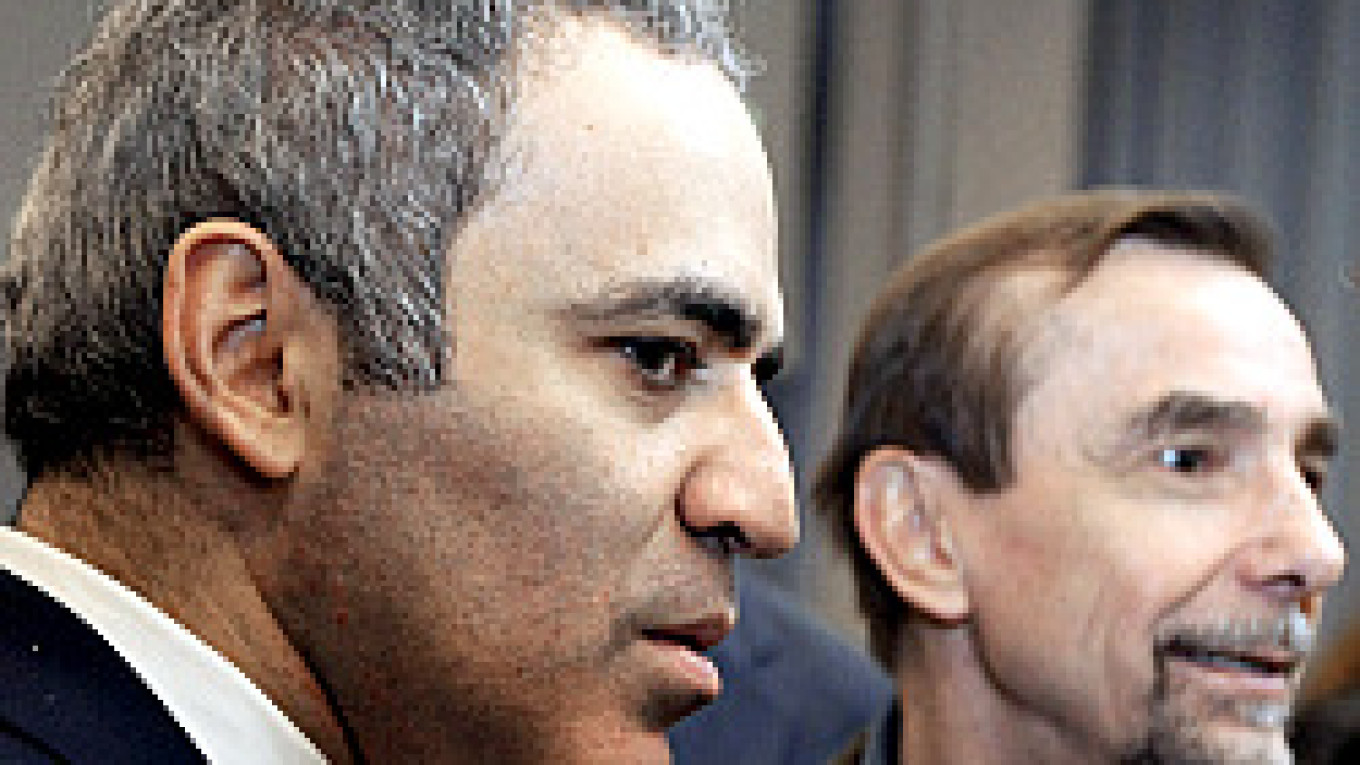
The assembly, which was initially supposed to declare itself an alternative parliament, turned out to be only a halfhearted attempt by the fractured opposition to unite.
The event brought together more than 700 people, including regional activists from dozens of political groups and human rights and nongovernmental organizations.
Scheduled to start at 11 a.m. at Amber Plaza, near the Novoslobodskaya metro station, the schedule was pushed back an hour by a protracted registration process for participants. Garry Kasparov, one of the leaders of The Other Russia, didn't arrive himself until noon.
"May 17 is a special day," Kasparov said, finally opening the session.
"On May 17, 1606, Moscow rebelled against the False Dmitry," he said, in a clear attempt to link the 17th-century pretender to the Muscovite throne to President Dmitry Medvedev.
The assembly's political declaration called the ruling political regime in Russia "illegitimate" and said State Duma elections in December and the presidential vote in March were "neither free, nor competent, nor fair." The assembly was created to turn Russia into a "legal, democratic, secular, federative republic," the declaration said.
In line with the idea of creating an alternative parliament, the assembly adopted some of the characteristics of the State Duma, creating committees and commissions to draft legislation to solve Russia's most pressing problems.
Nine committees were elected, including those for human rights, ethnic policy, cooperation with nongovernmental and political groups, freedom of speech and media and the structure of the state.
The 717 regional deputies to the body include the 300 names from the Other Russia list for the December Duma vote, although the list itself was not registered, as the organization has no official party status. The remainder were chosen at April conferences held by "left," "national-patriotic" and "democratic" organizations, the declaration said.
Organizers backed off the initial idea of proclaiming the assembly an alternative people's parliament, prompting shouts of "shame" from members of the banned National Bolshevik Party, dozens of whom walked out on the proceedings.
There were further signs of discord in the speeches of assembly participants. Some speakers called for violent street protests, others for legal initiatives, and others yet for the rebirth of the Soviet Union.
Sergei Udaltsov, the leader of the Red Youth Vanguard, provided his own reason for attending the event.
"I celebrated [Medvedev's] inauguration in a cell ?€¦ where [Kasparov] had been detained before me. I listened to [Medvedev] together with Oborona leader [Oleg] Kozlovsky, who was placed in the cell the day before me," he said. "They want to drive us all into one big cell."
"We all want to express our opinion freely and not serve jail time for it," he said.
A couple of pro-Kremlin Young Russia activists added to the commotion at the event by launching plastic phallus on propellers, which were knocked out of the air by security guards.
A Message from The Moscow Times:
Dear readers,
We are facing unprecedented challenges. Russia's Prosecutor General's Office has designated The Moscow Times as an "undesirable" organization, criminalizing our work and putting our staff at risk of prosecution. This follows our earlier unjust labeling as a "foreign agent."
These actions are direct attempts to silence independent journalism in Russia. The authorities claim our work "discredits the decisions of the Russian leadership." We see things differently: we strive to provide accurate, unbiased reporting on Russia.
We, the journalists of The Moscow Times, refuse to be silenced. But to continue our work, we need your help.
Your support, no matter how small, makes a world of difference. If you can, please support us monthly starting from just $2. It's quick to set up, and every contribution makes a significant impact.
By supporting The Moscow Times, you're defending open, independent journalism in the face of repression. Thank you for standing with us.

Remind me later.