

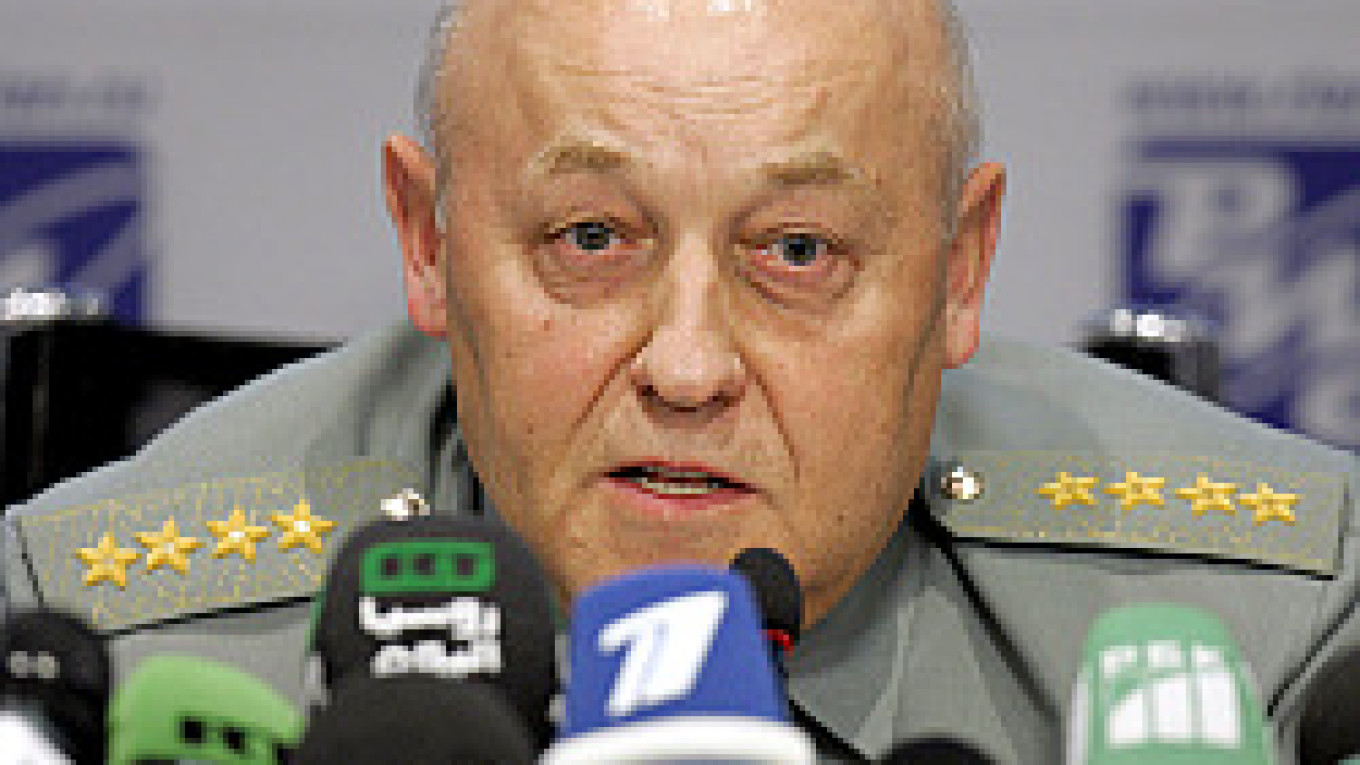
General Yury Baluyevsky's comment did not mark a policy shift, military analysts said. Amid disputes with the West over security issues, it may have been meant as a warning that Russia is prepared to use its nuclear might.
"We do not intend to attack anyone, but we consider it necessary for all our partners in the world community to understand clearly ... that to defend the sovereignty and territorial integrity of Russia and its allies, military forces will be used, including preventively, including with the use of nuclear weapons," Baluyevsky said at a military conference in remarks broadcast on state-run cable channel Vesti-24.
Baluyevsky added that Russia would use nuclear weapons and carry out preventive strikes only "in cases specified by the doctrinal documents of the Russian Federation," RIA-Novosti reported.
The national military doctrine approved by President Vladimir Putin in 2000 says Russia may use nuclear weapons to counter a nuclear attack on Russia or an ally, or a large-scale conventional attack that poses a critical risk to Russia's security.
Retired General Vladimir Dvorkin, formerly a top arms control expert with the Defense Ministry, said he saw "nothing new" in Baluyevsky's statement. "He was restating the doctrine in his own words," Dvorkin said.
Moscow-based military analyst Alexander Golts said that when Russia broke with stated Soviet-era policy in the 2000 doctrine and declared it could use nuclear weapons first against an aggressor, it reflected the decline of Russia's conventional forces in the decade following the 1991 Soviet collapse.
"Baluyevsky's statement means that, as before, we cannot count on our conventional forces to counter aggression," Golts said on Ekho Moskvy radio. "It means that, as before, the main factor in containing aggression against Russia is nuclear weapons."
Putin and other Russian officials have stressed the need to maintain a powerful nuclear deterrent and reserved the right to carry out preventive strikes. Putin, who has sought to boost his popularity at home and win support abroad with his vocal criticism of U.S. foreign policy, has said Russia opposes the use of preventive military attacks but reserves the right to carry them out because other countries do so.
But in most of their public remarks on preventive strikes, Russian officials have not specifically mentioned nuclear weapons, and top officials have said preventive strikes against terrorists would not involve nuclear weapons.
Baluyevsky spoke at a time of increasingly strained relations between Moscow and the West.
A Message from The Moscow Times:
Dear readers,
We are facing unprecedented challenges. Russia's Prosecutor General's Office has designated The Moscow Times as an "undesirable" organization, criminalizing our work and putting our staff at risk of prosecution. This follows our earlier unjust labeling as a "foreign agent."
These actions are direct attempts to silence independent journalism in Russia. The authorities claim our work "discredits the decisions of the Russian leadership." We see things differently: we strive to provide accurate, unbiased reporting on Russia.
We, the journalists of The Moscow Times, refuse to be silenced. But to continue our work, we need your help.
Your support, no matter how small, makes a world of difference. If you can, please support us monthly starting from just $2. It's quick to set up, and every contribution makes a significant impact.
By supporting The Moscow Times, you're defending open, independent journalism in the face of repression. Thank you for standing with us.

Remind me later.