

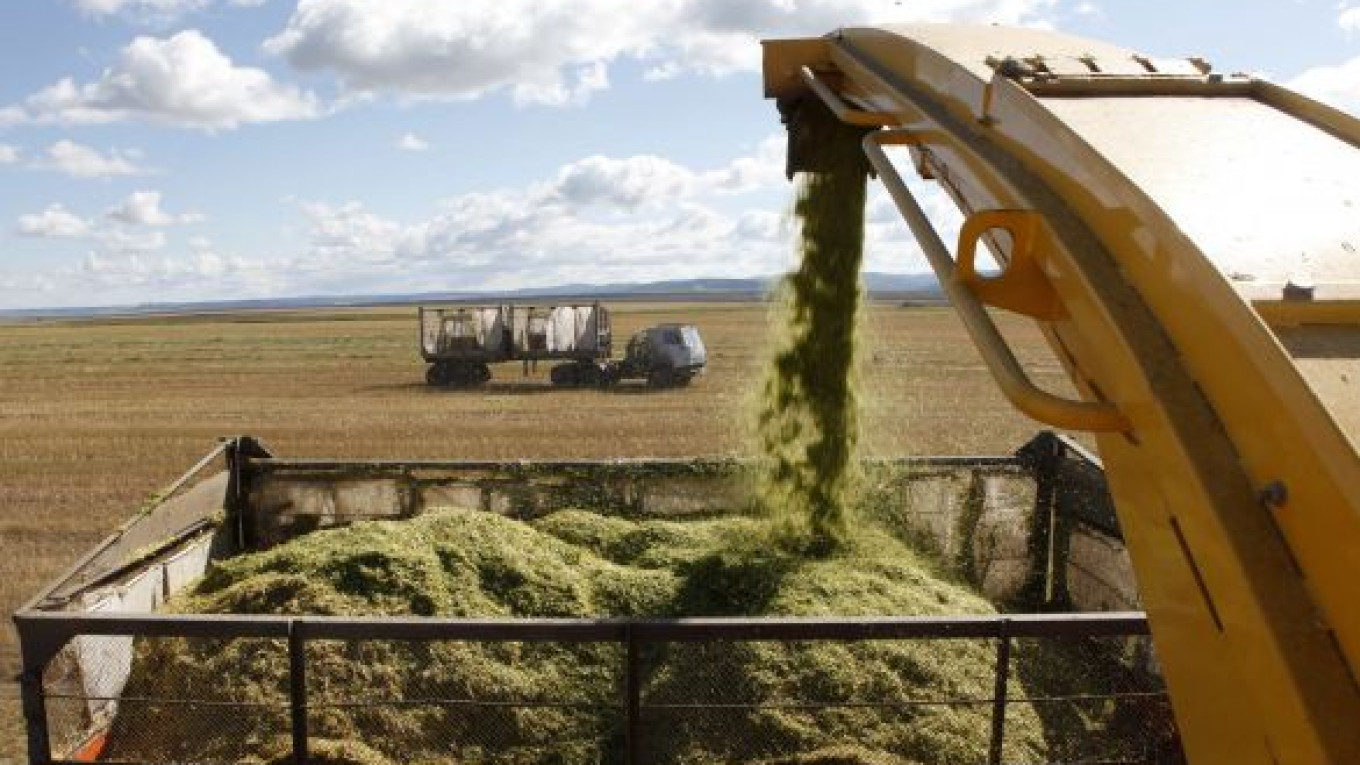
Wheat prices in both the United States and Europe retreated Friday but held just below two-year highs as markets reacted to the sudden imposition of a ban on grain exports from drought-hit Russia.
Prime Minister Vladimir Putin moved Thursday to halt grain and flour exports to head off inflation following Russia's worst drought in 130 years, and Russian Railways said Friday that it would stop loading grain for export from Saturday.
The introduction of the export ban from Aug. 15 to the end of the year may be revised depending on results of the harvest season, First Deputy Prime Minister Igor Shuvalov said Friday.
U.S. wheat futures on the Chicago Board of Trade fell 5 percent Friday after surging more than 20 percent earlier in the week and nearly doubling since early July to $8.41 per bushel.
The rise has revived memories of the surge in prices in early 2008, when U.S. wheat rose above $13 a bushel, which helped fuel food inflation and led to rioting in many countries across the world.
Analysts, however, downplayed the link, adding that world stocks have grown steeply during the last couple of years, which saw the two biggest wheat crops in history.
"Stocks are close to 50 percent higher today [than they were during the last price spike in early 2008]. You had a completely different scenario then," said Sudakshina Unnikrishnan, an analyst at Barclays Capital.
The current tensions are focused on the wheat market, whereas the previous price spike affected a range of food staples and was fueled by soaring energy markets, said Ken Ash, director of trade and agriculture for the Organization for Economic Cooperation and Development.
"At this stage it's much too early to make comparisons with the 2007-08 price spike," Ash said.
He reiterated, however, the OECD's opposition to export restrictions, which it sees as making international prices more volatile and depriving farmers of an incentive to grow more by curbing domestic prices.
"I think probably what we're seeing now is not fundamental supply and demand factors … but market expectations," he said.
Shares in Danish brewer Carlsberg, which faces a sharp rise in input costs, lost 4.5 percent, while food companies such as Nestle and Danone also saw their shares decline in value.
Shares of Flowers Foods, one of the largest U.S. food makers, were down 2 percent, and shares of General Mills were down almost 1 percent, but shares of other U.S. food companies rose, including Kraft Foods, which reported better-than-expected quarterly earnings Thursday afternoon.
Persistent high prices could, however, drive fear of food inflation in key buyers such as Indonesia and the Philippines, analysts said.
"If prices remain elevated for a sustained period, then the probability of upward adjustment in retail price of wheat and its derivatives goes up," Barclays Capital said in a report. "However, food prices tend to be politically sensitive, so we can expect some action from Asian governments."
Top consumers China and India are largely insulated from rising prices by sufficient wheat reserves.
Russia was the world's third-largest wheat exporter last year but is set to slide down the table this season with crops devastated by the worst drought since records began.
"Effectively, a big chunk of the global market is offline — there's going to be something like 5 million tons that aren't going to be available for export," said Matthew Kaleel, a commodities specialist at fund manager H3 Global in Sydney.
Trading companies that have sold Russian wheat to millers in Asia are considering declaring force majeure on supply contracts that could involve up to 1 million tons of wheat.
Force majeure clauses in supply contracts free firms from their obligations without penalty because of events beyond their control. They are often used in response to natural disasters.
"If the contract says Russian wheat, it is straight away force majeure," said one trader with an international trading company in Singapore. "We haven't heard, but it will happen; even my company will do it."
Two suppliers scrapped deals to ship 65,000 tons of Black Sea wheat to Bangladesh, while in the Philippines, a leading importer of feed wheat from the Black Sea, buyers were waiting to hear from suppliers.
"Those with supply contracts are a bit nervous, even the buyer," said a grains trader in Manila.
"The contracts are written with optional origins, but it means the sellers will also have to pay through their noses and those noses will bleed really bad."
The first Russian grain export contracts have been canceled using contract clauses from international grain trade association GAFTA rather than declaring force majeure, European traders said Friday.
Contracts from the Grain and Feed Trade Association contain a prohibition clause that permits contract cancellation if a government prohibits exports.
"The prohibition clause is being used rather than force majeure as it is legally much clearer," one trader said. "The first contracts have been canceled."
"Everything that can be moved out of Russia before the ban starts is being shipped," one trader said.
A Message from The Moscow Times:
Dear readers,
We are facing unprecedented challenges. Russia's Prosecutor General's Office has designated The Moscow Times as an "undesirable" organization, criminalizing our work and putting our staff at risk of prosecution. This follows our earlier unjust labeling as a "foreign agent."
These actions are direct attempts to silence independent journalism in Russia. The authorities claim our work "discredits the decisions of the Russian leadership." We see things differently: we strive to provide accurate, unbiased reporting on Russia.
We, the journalists of The Moscow Times, refuse to be silenced. But to continue our work, we need your help.
Your support, no matter how small, makes a world of difference. If you can, please support us monthly starting from just $2. It's quick to set up, and every contribution makes a significant impact.
By supporting The Moscow Times, you're defending open, independent journalism in the face of repression. Thank you for standing with us.

Remind me later.