

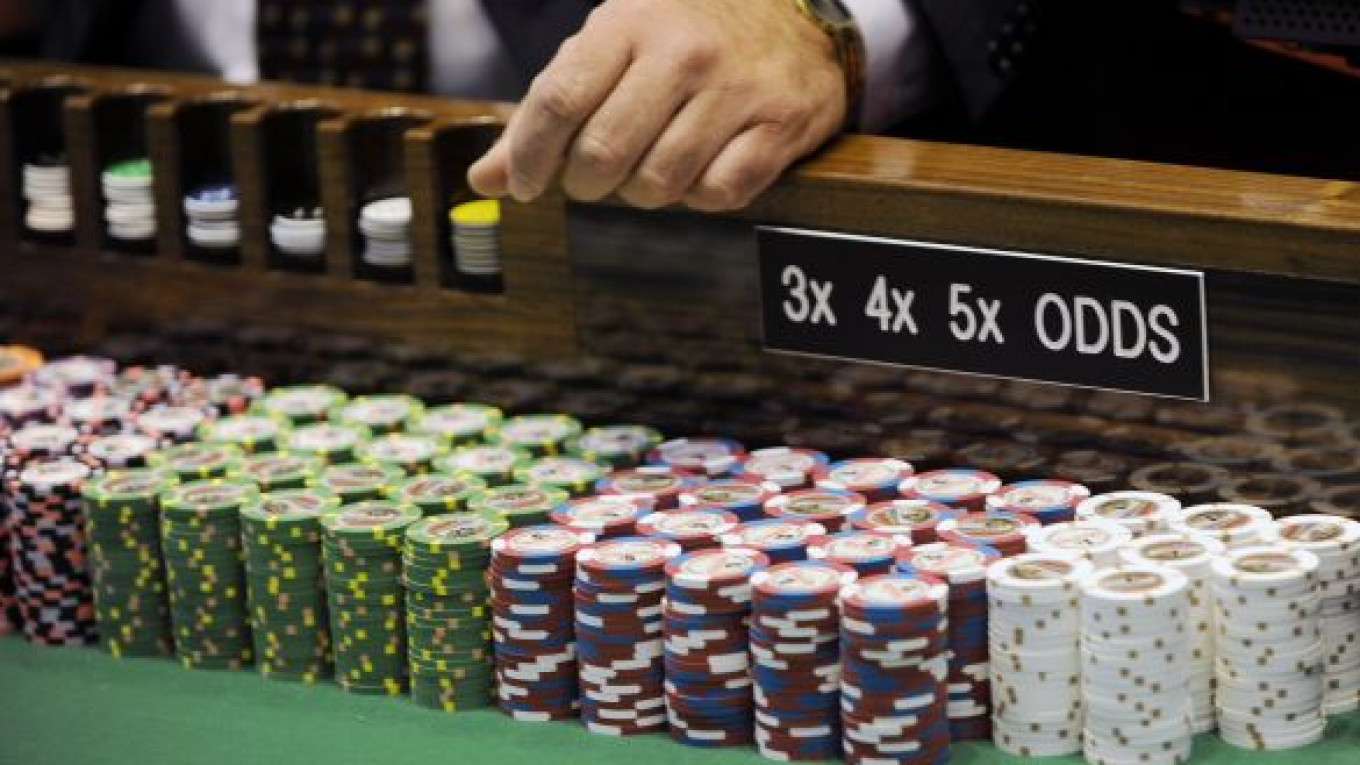
The Russian authorities have essentially given up on their plan to move all gambling to four remote zones, and Azov-City, the only one now functioning, might be eliminated in favor of Black Sea resort Anapa, Vedomosti has learned.
Krasnodar Governor Alexander Tkachyov raised the question of whether it made sense for Azov-City to remain in its current location on the border of the Rostov and Krasnodar regions, sources in several companies linked to the gambling industry told Vedomosti.
The sources said Tkachyov sent a letter to President Dmitry Medvedev several weeks ago proposing that Azov-City be relocated to Anapa, since the current location is too far from settled areas to attract gamblers or investors. The president ordered the government to study the proposal.
It was none other than Prime Minister Vladimir Putin — then serving as president — who proposed banning gambling in Russia in easily accessible places. After comparing the gambling business to the "alcoholization of the people," Putin in October 2006 personally submitted to top lawmakers in the Duma his bill relocating gambling facilities to special zones.
As of July 1, 2009, gambling was banned in all but four so-called gaming reservations: Azov-City, the Sibirskaya Moneta zone in Altai, the Yantarnaya zone in the Kaliningrad region and Primorye in the Far East.
"Since the law took effect, it has become clear that no one wants to go to these zones. There isn't enough infrastructure in Azov-City. But in Anapa there's a modern airport, beaches and tourists," said State Duma Deputy Gleb Khor, a member of United Russia's faction and first deputy chairman of the Budget and Taxes Committee.
He has submitted amendments to the law on gambling that would remove the Rostov region from the list of territories where gambling is sanctioned. The changes would also withdraw a point in the current law that forbids the elimination of zones within 10 years of their creation.
The Duma's Economic Policy and Entrepreneurship Committee has already approved the changes.
Vedomosti was unable to reach spokespeople for Tkachyov on Wednesday. A source close to the Rostov regional administration said "no one from the Krasnodar region sent any official documents to the Rostov regional administration, and [Krasnodar] didn't approve anything with [Rostov]."
The source said he knew about Tkachyov's letter to Medvedev.
The government officials responsible for the gambling zones were also aware of the Krasnodar governor's proposal. A final decision has not been made, they said, and it remains unclear how Azov-City investors would be compensated for their expenses.
"The idea has already been approved. Sochi was proposed as an option, but there wasn't a suitable spot there, and Anapa was chosen," said a source close to the presidential administration.
The source said the new zone could be placed on a certain military site within the city. Spokespeople for the Defense Ministry said they knew nothing of the plan.
Most likely, the site under consideration is at the Institute of Coastal Defense, which is run by the Federal Security Service's border guards and sits on more than 25 hectares of land — some of it waterfront. Vedomosti was unable to get a comment on the matter from the border guards.
"Anapa is the latest half-measure. If you're going to talk about a zone in the Krasnodar region, then it needs to be done in Sochi. They could build five-star hotels with casinos by the time the Olympics start, using investments from the gambling campaign," said Anatoly Kuznetsov, president of hotel and casino developer Korston.
He said the law on gambling was not working and that in Moscow alone there were twice as many casinos as there were before the changes took effect.
Azov-City is the most lively of the four zones. The Krasnodar region invested about 1 billion rubles ($33 million) for infrastructure, while the Rostov region contributed 170 million rubles ($5.6 million).
The first tenders for gambling investors were also held in Azov-City, and last winter Royal Time's Oracle casino became the first to open there. About $10 million was invested into the project, and the company was preparing to invest another 4 billion to 4.5 billion rubles ($132 million to $148 million) over the next three to four years.
"We're shocked; we just don't understand it. Of course, all sorts of rumors have been floating around, but no one officially told us anything — even though we're in regular contact with the authorities," said Alexander Odintsov, chief executive of the group Odis, which rents 1.5 hectares in the Rostov part of Azov-City.
He said the company had finished developing plans for its project. Investments have already reached 12 million rubles, and the company has purchased about 1,500 slot machines at a price of 3,000 euros to 5,000 euros each ($3,900 to $6,500).
A Message from The Moscow Times:
Dear readers,
We are facing unprecedented challenges. Russia's Prosecutor General's Office has designated The Moscow Times as an "undesirable" organization, criminalizing our work and putting our staff at risk of prosecution. This follows our earlier unjust labeling as a "foreign agent."
These actions are direct attempts to silence independent journalism in Russia. The authorities claim our work "discredits the decisions of the Russian leadership." We see things differently: we strive to provide accurate, unbiased reporting on Russia.
We, the journalists of The Moscow Times, refuse to be silenced. But to continue our work, we need your help.
Your support, no matter how small, makes a world of difference. If you can, please support us monthly starting from just $2. It's quick to set up, and every contribution makes a significant impact.
By supporting The Moscow Times, you're defending open, independent journalism in the face of repression. Thank you for standing with us.

Remind me later.