

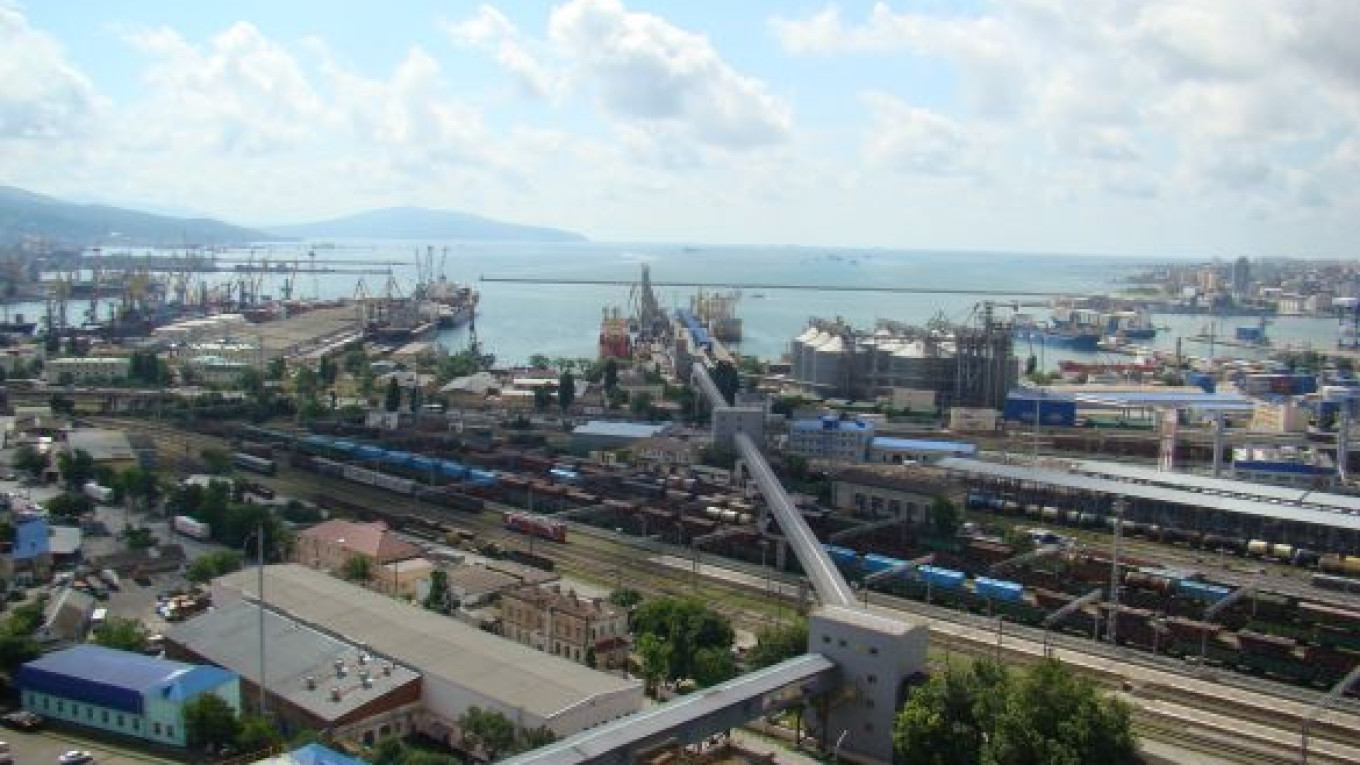
Deputy Prime Minister Igor Sechin asked the government to sell its stake in Novorossiisk Commercial Sea Port directly to state-owned oil firm Rosneft, bypassing the normal privatization service.
In a letter to Prime Minister Vladimir Putin, which was leaked to Kommersant and Vedomosti over the weekend, Sechin argued that a 25 percent blocking stake in the port should be transferred directly to Rosneft rather than auctioned off in the normal privatization process because of the port's "strategic significance."
The stake would consist of the 20 percent currently directly held by the state, plus 5 percent currently controlled by Russian Railways, the papers reported.
Sechin apparently suggested that the price for the stake be set by an independent auditor.
Shares in the port traded down 1.54 percent to $7.01 in London and up 0.69 percent to 2.9 rubles on the MICEX at close Monday.
That would value the entire company at about $1.83 billion, Reuters reported — putting the value of the blocking stake at about $460 million.
That values the port significantly below the $4.93 billion valuation the port received when it floated in 2007.
Plans to privatize 20 percent of the port were included in government's 2005 privatization program, but the port was subsequently struck from the list because it is a "strategic asset." It is currently listed for privatization in 2011-13.
Contenders for the stake are believed to include Summa Group, which together with Transneft acquired a controlling stake in the seaport at the beginning of last year.
Igor Sechin was chairman of the board of directors at Rosneft from 2004-11, when he resigned as part of President Dmitry Medvedev's drive to purge ministers from board chairmanships in state firms.
Novorossiisk, on the Black Sea, is the main container port in the south of Russia, with a total capacity of 750,000 to 800,000 twenty-foot equivalent units, or TEU — the size of a standard shipping container — per year. Actual container traffic amounted to 436,000 TEU in 2011, according to the company's website, up 44 percent from 2010.
It is the gateway for the second-largest consumer market in Russia. Its main commodities are imported fruits and vegetables and grain exports, and it is favored by international logistics firms for its ice-free harbor and the shorter transit time to the Far East than from Russia's Baltic ports, said Perry Neumann, managing director of the Kuehne + Nagel logistics firm in Russia and Belarus.
But room for expansion is limited because the port is surrounded by hills, and the port suffers from insufficient infrastructure and handling procedures and poor road conditions, especially in winter.
Seasonal imports of fruit from Turkey, Israel and Egypt and massive grain exports often cause bottlenecks and impact the handling capacity and productivity of the port, Neumann added.
A Message from The Moscow Times:
Dear readers,
We are facing unprecedented challenges. Russia's Prosecutor General's Office has designated The Moscow Times as an "undesirable" organization, criminalizing our work and putting our staff at risk of prosecution. This follows our earlier unjust labeling as a "foreign agent."
These actions are direct attempts to silence independent journalism in Russia. The authorities claim our work "discredits the decisions of the Russian leadership." We see things differently: we strive to provide accurate, unbiased reporting on Russia.
We, the journalists of The Moscow Times, refuse to be silenced. But to continue our work, we need your help.
Your support, no matter how small, makes a world of difference. If you can, please support us monthly starting from just $2. It's quick to set up, and every contribution makes a significant impact.
By supporting The Moscow Times, you're defending open, independent journalism in the face of repression. Thank you for standing with us.

Remind me later.