

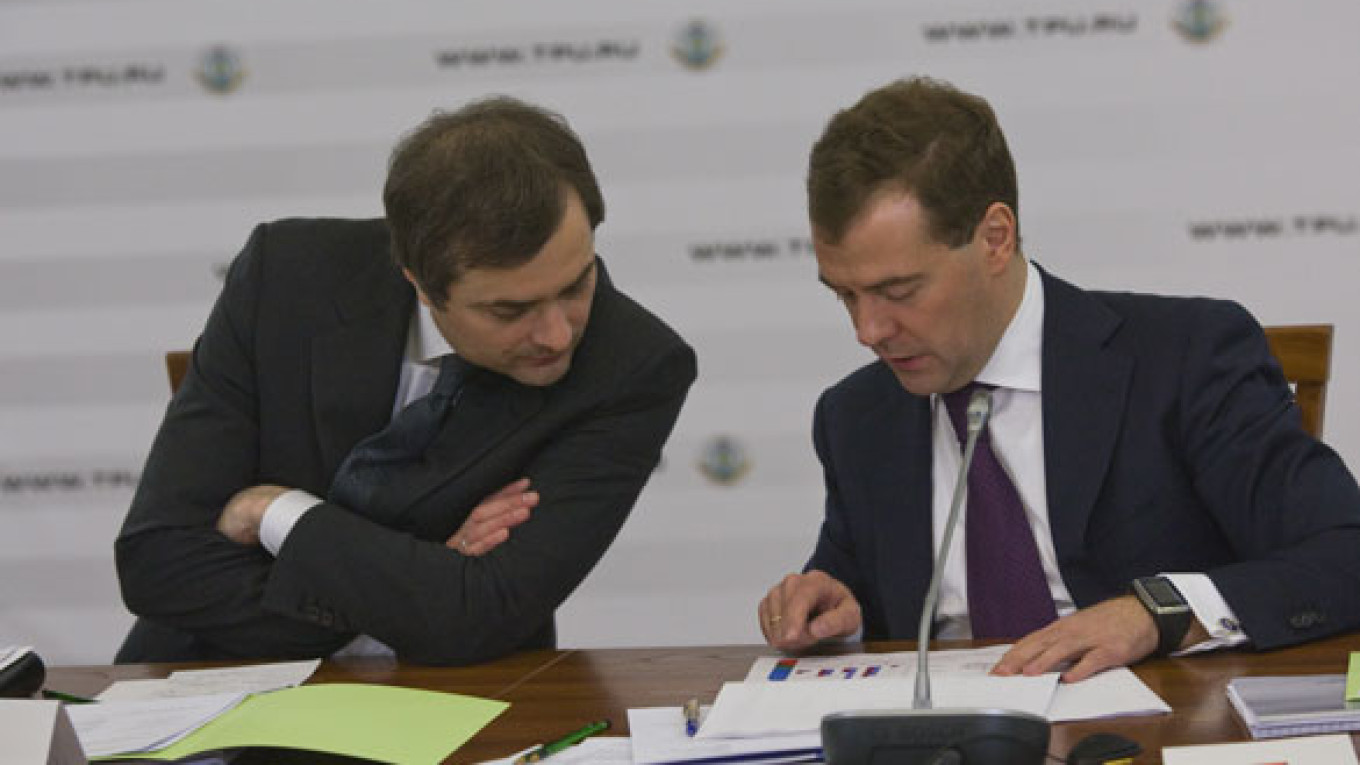
Boosting Kremlin plans to transform Moscow into a global financial center, President Dmitry Medvedev told visiting U.S. fund managers that his country was a haven for equity firms suffering from stricter financial regulation at home.
Medvedev said tough policies enacted by a host of governments after the financial crisis should raise the appeal of the Kremlin's plans.
"We invite all those who suffer at home to come to Russia," Medvedev said, according to a transcript posted on his web site.
Medvedev did not name any government, but European countries and the United States have increased regulation in the financial sector to prevent more turmoil.
Last week, European governments tightened rules for hedge funds, and Germany announced curbs on traders of government debt and bank stocks. German Chancellor Angela Merkel also demanded that next month's Group of 20 summit adopt tighter financial markets regulations.
The Kremlin has long pushed for reforming global financial institutions, and Medvedev has called on the G20 to reach globally binding agreements on financial market regulation.
On Tuesday, Medvedev merely said an upcoming G20 summit in Canada should discuss new auditing rules.
The president was speaking after a meeting with 22 executives from U.S.-based private equity funds at his Gorki residence outside the capital.
Medvedev acknowledged that the country's venture capital markets were underdeveloped, with just 20 funds managing about $2 billion in capital.
"That's almost nothing," he said.
Some of Tuesday's participants said American investors still harbor great doubts about investing in Russia.
"There is a widespread feeling that there are thousands of ways to steal your money in Russia," David Kronfeld of Chicago-based JK&B Capital told Interfax. He added that this was a legacy of the 1990s.
Medvedev addressed those fears by promising to compensate risks with favorable treatment.
"These risks are estimated as being quite high, but they can be counterbalanced by the preferences that we are willing to offer," he said.
The Kremlin has recently stepped up efforts to convince badly needed foreign investors to help modernize and diversify the economy.
Medvedev said last month that the country's new image should be modern and friendly and no longer include "teeth gnashing" at anyone.
Only weeks later, a leaked foreign policy paper indicated that the government was ready to substitute saber-rattling tactics with closer economic cooperation.
The government has also championed plans to build a Russian version of Silicon Valley in Skolkovo outside Moscow.
A new law passed earlier this month promises eased visa rules for foreigners.
Drew Guff of Siguler Guff, a New York-based investment firm, told Medvedev that Russia's tax rate was a major advantage and that his U.S. colleagues could "only dream of" having a flat 13 percent income tax.
Medvedev replied that the tax system was "not ideal but balanced."
The country's tax regulations have led to many cases where authorities have closed businesses under unclear circumstances. One of the prime examples is Hermitage Capital, which was the country's largest investment fund before it was forced to cease its Russian operations in 2005.
Bill Browder, the company's founder, said Tuesday that investing in Russia amounted to "complete insanity" for U.S. venture capital firms because they would put both their property and staff at risk.
"My advice to these people is to lie down for half an hour and let the urge pass," he told The Moscow Times by telephone from London.
Last year, a lawyer for Hermitage Capital, Sergei Magnitsky, died in a Moscow prison under unclear circumstances. Browder maintains that Magnitsky is a victim in a campaign by corrupt law enforcement officials to steal his business.
The fund managers' trip was jointly organized by Rusnano and the U.S.-based American Business Association of Russian-speaking Professionals, known as AmBAR.
Also present at the meeting were Michael McFaul, U.S. President Barack Obama's chief adviser on Russia; Medvedev's first deputy chief of staff, Vladislav Surkov; and Economic Development Minister Elvira Nabiullina.
Experts said investor perception of Russia remains poor and private equity would continue to stay away as long as the country's image as a risky and dangerous place persists.
Chris Weafer, chief strategist at Uralsib, said the current low level of investment was also a legacy of the past 10 years, when the government was occupied more with establishing rules in strategic industries like energy and less in creating an attractive overall climate.
"If the Medvedev plan to modernize Russia is to succeed, the government needs to completely reverse that perception," he said in e-mailed comments.
Sergei Udaltsov, leader of the Left Front youth group, said the government's plans were doomed as long as political and social institutions remained underdeveloped. "It will all work only with systemic reforms, when the law is no longer ignored by officials and when the judiciary no longer depends on executive," he said.
Medvedev, however, asked his U.S. visitors to understand the government's top-down approach.
"Many things in Russia only have a chance of getting done after the head of state takes them up. That's how our society has worked since the days of the patriarchate. That's not very good, but it's a fact," he said.
A Message from The Moscow Times:
Dear readers,
We are facing unprecedented challenges. Russia's Prosecutor General's Office has designated The Moscow Times as an "undesirable" organization, criminalizing our work and putting our staff at risk of prosecution. This follows our earlier unjust labeling as a "foreign agent."
These actions are direct attempts to silence independent journalism in Russia. The authorities claim our work "discredits the decisions of the Russian leadership." We see things differently: we strive to provide accurate, unbiased reporting on Russia.
We, the journalists of The Moscow Times, refuse to be silenced. But to continue our work, we need your help.
Your support, no matter how small, makes a world of difference. If you can, please support us monthly starting from just $2. It's quick to set up, and every contribution makes a significant impact.
By supporting The Moscow Times, you're defending open, independent journalism in the face of repression. Thank you for standing with us.

Remind me later.