

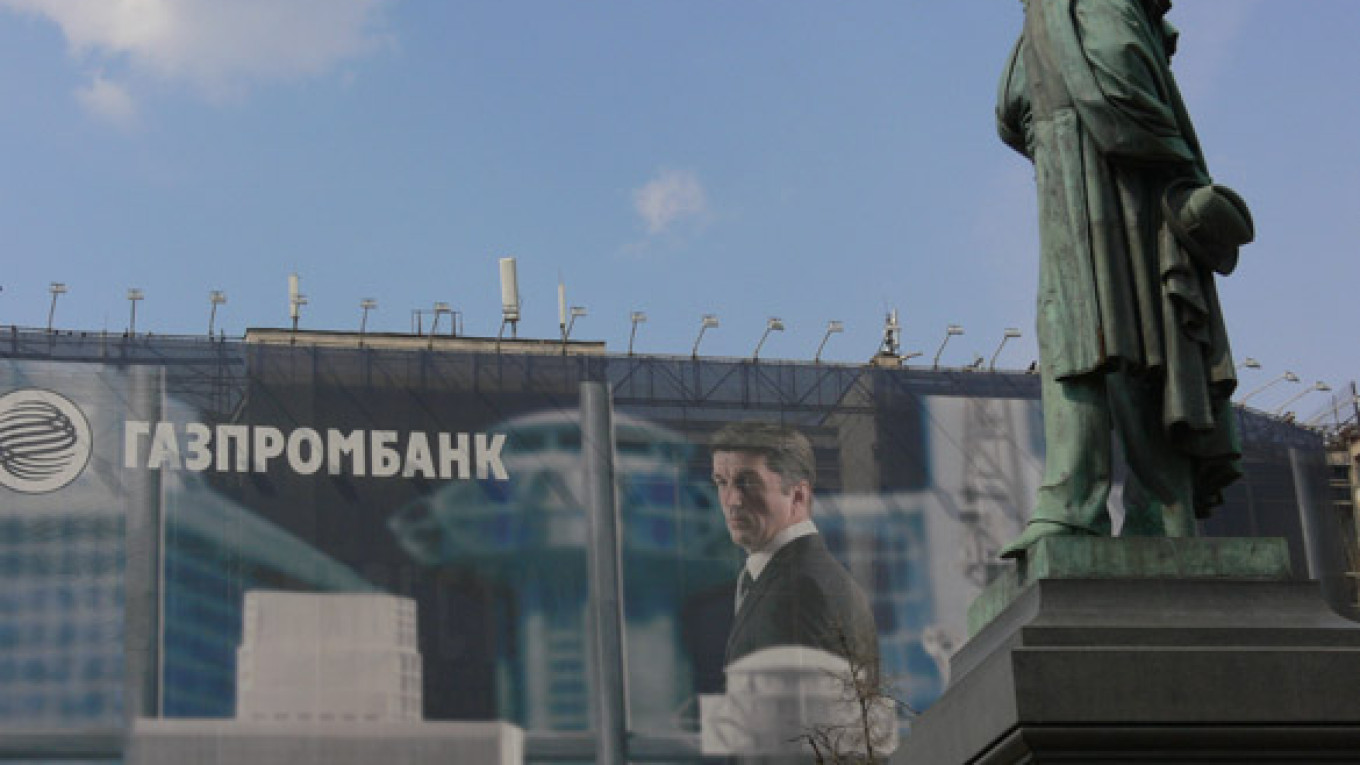
Gazprombank reported losses of 15.5 billion rubles ($529 million) after the ruble strengthened in September, its worst month this year, but a spokesman said the damage was only on paper and that it has earned more than 24 billion rubles in 2009.
The results were the sixth time this year that Gazprombank has posted a monthly loss. The previous worst month was May, when the bank lost 8.4 billion rubles.
The lender's losses are coming from currency deals, said Maxim Osadchy, an analyst at Bank of Corporate Financing. Gazprombank's foreign-currency assets exceeded its foreign-currency liabilities by 392.6 billion rubles as of Oct. 1. According to official Central Bank exchange rates, the ruble strengthened against the dollar 1.1 percent in September and against the euro by 3.4 percent.
The September results are a consequence of the strengthening ruble, a bank spokesperson said. But the bank did not suffer any real losses since the changes were a result of exchange-rate shifts and related revaluations of foreign-currency assets — not expenses from currency operations.
Gazprombank suffered from exchange-rate changes last year as well. According to the bank's full-year results to international financial reporting standards, it had a record loss of 68.2 billion rubles. The losses were from the bank's futures contracts for currency, which were worth 96.9 billion rubles, according to the results, including 75.8 billion rubles in downward revaluations because of the ruble devaluation and falling securities prices.
At the time, a bank spokesman said the risks were hedged but that because of the way the figures for the cash transactions and futures contracts show up in its results, there was an accounting loss of 33 billion rubles under international financial reporting standards. Gazprom bank would have additional profit of the same amount in the following reporting period, he said.
In the first quarter of 2009, the bank made 8.1 billion rubles on currency operations, and a total of 16.5 billion rubles.
Gazprom owns 41.7 percent of the lender, while its pension fund, Gazfond, owns 50 percent. As of the first quarter of 2009, the lender was Russia's third-largest, with assets of 2.05 trillion rubles.
All of Gazprombank's operations are hedged now, as well, and the company doesn't have currency risks, deputy chief Alexander Sobol said. These transactions, as well as the profit from them, are not included in the balance, he said.
The bank's international financial reporting will be more telling, with a profit of 24 billion rubles in the first half and even more for the first nine months, the spokesman said. Even the company's nine-month profit of 16 billion rubles under Russian reporting standards wasn't bad, he said.
VTB Group, which is larger than Gazprombank by assets, had net profit of 7.9 billion rubles in the first nine months, while Sberbank gained 7.4 billion rubles in the first eight months of the year.
A Message from The Moscow Times:
Dear readers,
We are facing unprecedented challenges. Russia's Prosecutor General's Office has designated The Moscow Times as an "undesirable" organization, criminalizing our work and putting our staff at risk of prosecution. This follows our earlier unjust labeling as a "foreign agent."
These actions are direct attempts to silence independent journalism in Russia. The authorities claim our work "discredits the decisions of the Russian leadership." We see things differently: we strive to provide accurate, unbiased reporting on Russia.
We, the journalists of The Moscow Times, refuse to be silenced. But to continue our work, we need your help.
Your support, no matter how small, makes a world of difference. If you can, please support us monthly starting from just $2. It's quick to set up, and every contribution makes a significant impact.
By supporting The Moscow Times, you're defending open, independent journalism in the face of repression. Thank you for standing with us.

Remind me later.