

Over the past month, investors have fled Russia, spooked by disputes over BP's Russian venture TNK-BP and a government attack on coal miner Mechel as well as the military conflict with Georgia and the subsequent souring of relations with the West.
Dealers estimate that the Central Bank sold about $5 billion Thursday and Friday to prop up the ruble, and authorities hammered the message home verbally.
"We are not planning to further widen the boundaries of the corridor in the next few months. For now it suits us," Alexei Ulyukayev, Central Bank first deputy chairman, told reporters at a banking conference in Sochi, adding that the ruble's recent selloff was "not critical."
The comments sent the ruble to 30.32 against its basket of 55 cents and 45 euro cents, off Thursday's historic low of 30.41. That was the weakest level since the basket's current composition was set 1 1/2 years ago, and also the boundary at which the Central Bank intervened.
The Central Bank has so far not allowed the ruble to strengthen beyond 29.26 to the basket, or to weaken beyond 30.41, although it does not disclose its focus corridor.
"[Ulyukayev's] statement together with actual interventions suggest that the Central Bank is drawing a line ... and this may provide support for the basket in the near-term," UniCredit Aton analysts said in a research note.
Total currency trading volumes reached a record $8.5 billion on Thursday, compared with average daily trading of about $3 billion to $4 billion, said Denis Uvchukhov, a currency trader at UralSib. At least half of the volume may have been nonresidents pulling money out of the market, he said.
"Interventions will probably continue for some time, given the situations in the global and domestic markets," Uvchukhov said. "We're seeing an active strengthening of the dollar in the global markets and continued withdrawal of money from the Russian market."
Ulyukayev estimated that Russia had net capital outflows of around $4.6 billion in August and that it would see zero inflows this month. Analysts' outflows forecasts are higher.
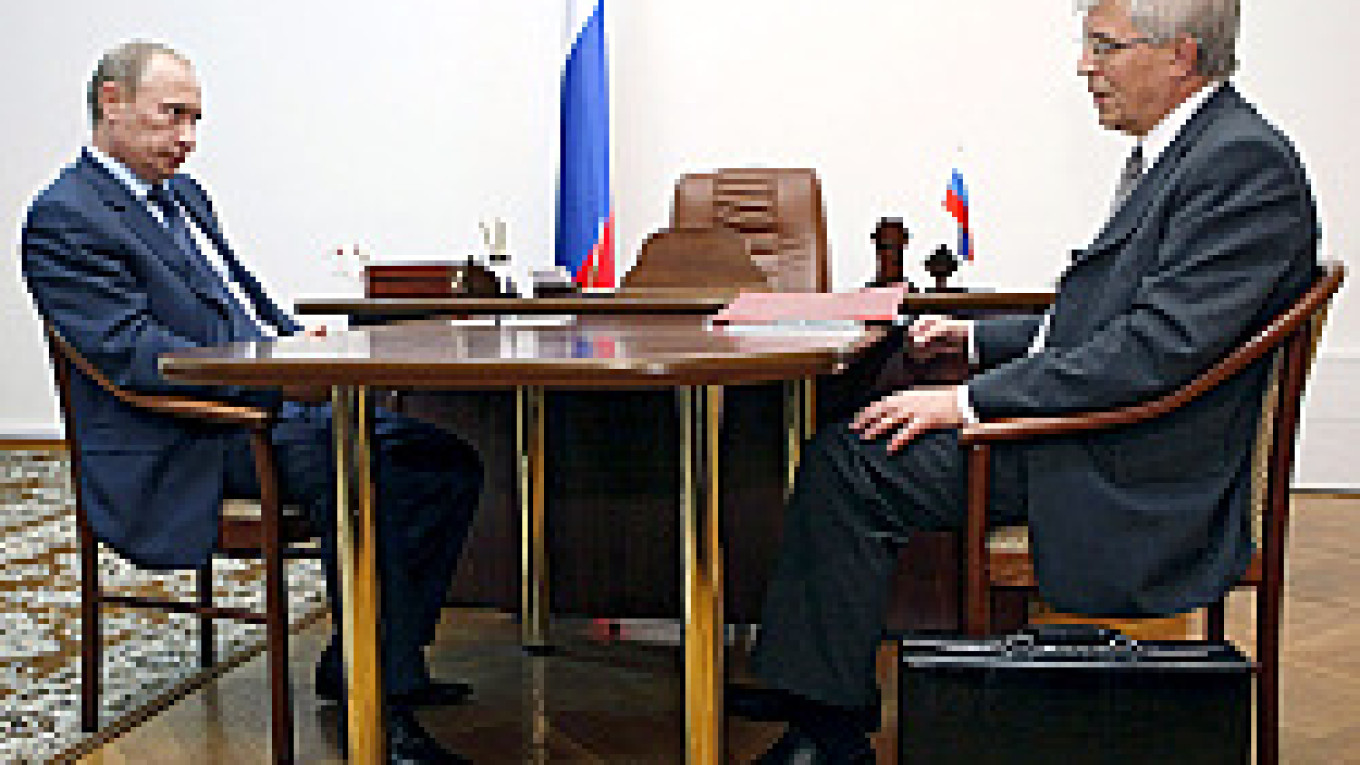
Sergei Ignatyev, chairman of the Central Bank, said Friday during a meeting with Prime Minister Vladimir Putin that the outflow in August "wasn't large, and I believe it didn't affect the macroeconomic situation very much," according to a transcript posted on the government's web site.
The Central Bank bought the equivalent of $100 billion in the first eight months of 2008 to manage the ruble, Ulyukayev said. And with $582.5 billion of foreign exchange and gold reserves as of Sept. 1, it has ample ammunition to support the ruble.
The big reserves mean "there is no risk of any currency crisis in Russia, and the Central Bank will do everything to preserve stability," Kremlin economic aide Arkady Dvorkovich said Friday at an economics conference in Cernobbio, Italy.
"We do not expect any difficulties, even with the substantial capital outflow we've had over the last few weeks."
(Reuters, Bloomberg)
A Message from The Moscow Times:
Dear readers,
We are facing unprecedented challenges. Russia's Prosecutor General's Office has designated The Moscow Times as an "undesirable" organization, criminalizing our work and putting our staff at risk of prosecution. This follows our earlier unjust labeling as a "foreign agent."
These actions are direct attempts to silence independent journalism in Russia. The authorities claim our work "discredits the decisions of the Russian leadership." We see things differently: we strive to provide accurate, unbiased reporting on Russia.
We, the journalists of The Moscow Times, refuse to be silenced. But to continue our work, we need your help.
Your support, no matter how small, makes a world of difference. If you can, please support us monthly starting from just $2. It's quick to set up, and every contribution makes a significant impact.
By supporting The Moscow Times, you're defending open, independent journalism in the face of repression. Thank you for standing with us.

Remind me later.