

The poor print quality of the tiny, yellow book called "An Overview of Modern Russian Literature" makes it look like a self-published book, but the cover credits a Saratov publishing house called Scientific Book.
Kats is a literary critic and the professor of literature from Saratov. It is no secret that the author has many other aliases, one of which he uses to write detective thrillers. But it's known that he really is from Saratov.
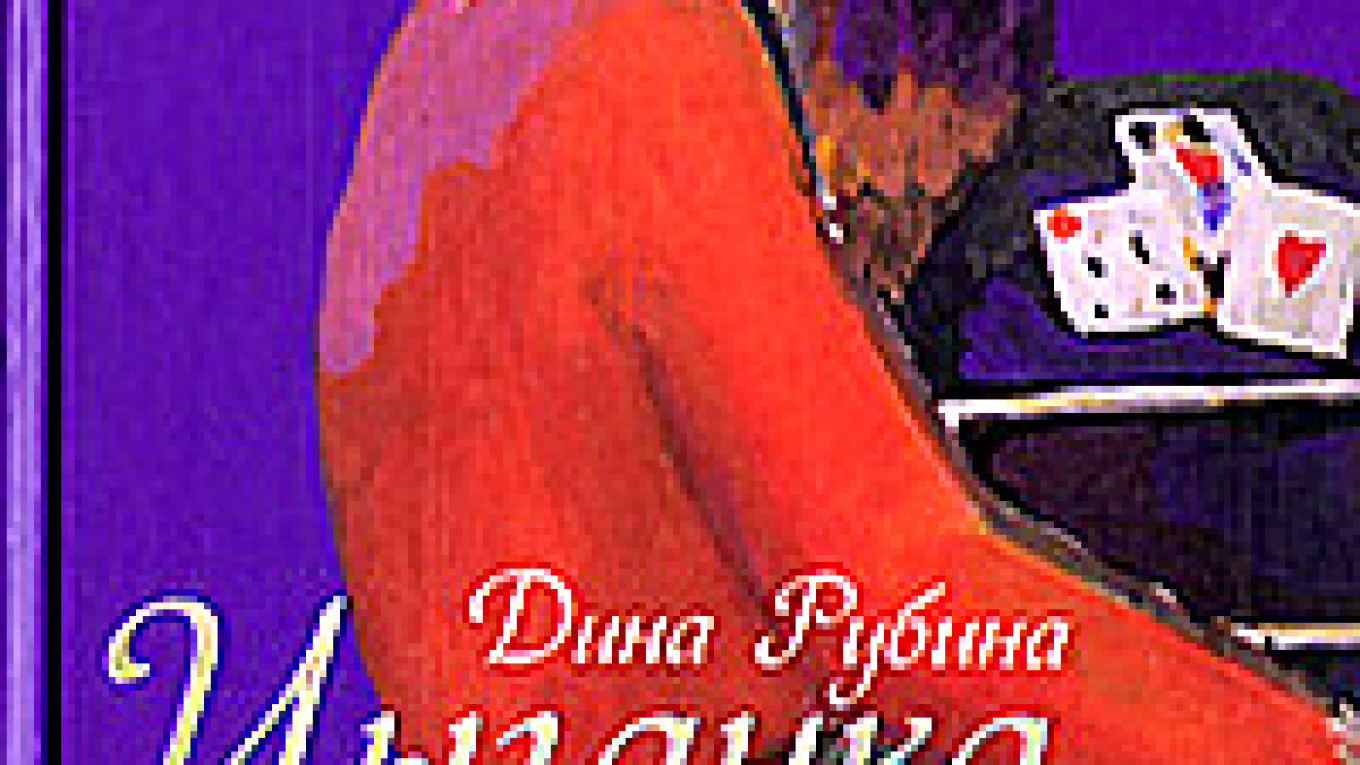
It's hard not to laugh when reading his reviews. For example, when reviewing "The Gypsy" by Dina Rubina, featuring a somewhat avant-garde cover portrait in blue and green hues (pictured above), Kats explains that the main character of Rubina's story acquired her dark-green skin color as a result of a military chemical experiment gone haywire. Her skin problem led to many trials in later life. Needless to say, there's nothing of the sort in Rubina's book.
In a similar vein, Kats explains that the counter-culture novel "Sankya," by Zakhar Prilepin, a supporter of radical politician and writer Eduard Limonov, is a biography of Alexander the Great. Sankya is indeed an unusual diminutive of Alexander. Kats also claims that Maksim Kantor's sweeping two-part novel "The Drawing Textbook" actually is a drawing textbook.
At a closer look, Kats' reviews betray better knowledge of the books and authors than he claims. For example, when reviewing Linor Goralik's collection of short prose "Non-Baby Food," Kats describes it as a novel about an Israeli ex-commando, Barbie Rottensteiner, who returns to her native Russia to avenge her childhood troubles by feeding the offenders food that she cooks herself. It is evident that Kats is quite aware of Goralik's life story, her recent highly acclaimed study of the Barbie doll and her participation in the project Gastrolalia, where she was, indeed, cooking and lecturing at the same time.
Kats laughs at his fellow critics and at authors -- but the literary landscape he describes is quite recognizable. Try as he might, he does not get very far from the real idiosyncrasies of today's literary scene.
Kats' book was noticed by fellow critics, and has been partially republished on Booknik.ru, a site on Jewish culture and literature.
A Message from The Moscow Times:
Dear readers,
We are facing unprecedented challenges. Russia's Prosecutor General's Office has designated The Moscow Times as an "undesirable" organization, criminalizing our work and putting our staff at risk of prosecution. This follows our earlier unjust labeling as a "foreign agent."
These actions are direct attempts to silence independent journalism in Russia. The authorities claim our work "discredits the decisions of the Russian leadership." We see things differently: we strive to provide accurate, unbiased reporting on Russia.
We, the journalists of The Moscow Times, refuse to be silenced. But to continue our work, we need your help.
Your support, no matter how small, makes a world of difference. If you can, please support us monthly starting from just $2. It's quick to set up, and every contribution makes a significant impact.
By supporting The Moscow Times, you're defending open, independent journalism in the face of repression. Thank you for standing with us.

Remind me later.