

The first major production of the theater season has already taken place — Rimas Tuminas’ interpolation of Anton Chekhov’s “Uncle Vanya” at the Vakhtangov Theater — but that is hardly an isolated event. A veritable horde of top directors and important writers are aiming to storm the city’s stages.
Not surprisingly, homegrown talent will be well represented as Pyotr Fomenko, Kama Ginkas, Valery Fokin, Dmitry Krymov and Yury Butusov, to name just a few, prepare to unveil shows. But the international flavor this year promises to be especially strong. Foreign dignitaries taking bows will include English writer Tom Stoppard, French playwright Gerard Sibleyras, Georgian director Robert Sturua, Bulgarian director Alexander Morfov and Polish director Krzysztof Zanussi.
Arguably, the busiest venue this season will be the Russian Youth Theater, where artistic director Alexei Borodin has scheduled 15 premieres on three stages. Between September and December the theater will open four plays for children, directed by four promising young directors who have recently graduated from Sergei Zhenovach’s directing classes at the Russian Academy of Theater Arts. The first, which opened Tuesday and next plays Wednesday, is a dramatization of Rudyard Kipling’s “The Cat That Walked By Himself.” In the theater’s “Night Projects” program, Pavel Safonov, one of the most interesting directors to emerge over the last five years, opens his dramatization of “Invitation to a Beheading,” the novel by Vladimir Nabokov, on Oct. 1.
But it is next spring when the Youth Theater will open its doors to the world. Zanussi, a renowned Polish film director who has worked occasionally on Moscow stages, will direct “Proof,” by American writer David Auburn for a March opening. And in June, the popular British director David Leveaux will mount “Rock ’n’ Roll,” Stoppard’s sweeping look at the effect that the counter culture had on bringing down the communist regime in Czechoslovakia.
The Et Cetera Theater has a tradition of working with Sturua and Morfov, who have mounted several of the playhouse’s longest-running shows. Sturua begins rehearsals of Shakespeare’s “The Tempest” after New Year’s, while Morfov plans to stage an as yet unnamed play in the season’s second half. Et Cetera kicks off the early part of the season with its first new show, “Olesya,” an adaptation of Alexander Kuprin’s novella about a strong woman’s love for a weak man. Adapted and directed by Galina Polishchuk, it is slated to open Oct. 24.
The Pushkin Theater is developing an international work with French director Lukas Hemleb, who will take on a joint French-Russian production of Marina Tsvetaeva’s drama-in-verse “Phaedra.” The piece, premiering Oct. 10, stars Tatiana Stepantchenko, a French actress of Russian descent.
The Theater Yunogo Zritelya will be in command of the city’s cultural headlines for much of October. Ginkas will unveil two large-scale shows in three weeks, an almost unheard-of feat for a major director. His dramatization of Nikolai Gogol’s short story “The Diary of a Madman,” starring Sergei Makovetsky, will open on the theater’s main stage Oct. 4 and 5. For good measure, Ginkas will then unveil “Medea,” a piece created on the basis of texts by Jean Anouilh and Joseph Brodsky, on Oct. 29 and 30.
Ginkas, in fact, will have more than a little to do with the theater’s third production in October — his former student Irina Keruchenko will premiere her dramatization of Fyodor Dostoevsky’s story, “The Meek One,” on Oct. 6 and 7 on the small stage.
The School of Dramatic Art, perhaps Moscow’s most diverse theatrical entity with its half-dozen semi-independent workshops existing under a single roof, has two new shows scheduled early on. Igor Yatsko, the actor who took over the reigns as artistic director after Anatoly Vasilyev left the theater a few years ago, opens his production of Oscar Wilde’s “Salome” on Sept. 26 and 27. The piece has been tailored to the unusual Globe stage, a vertical space in which the action will take place on a terrace suspended in the air.
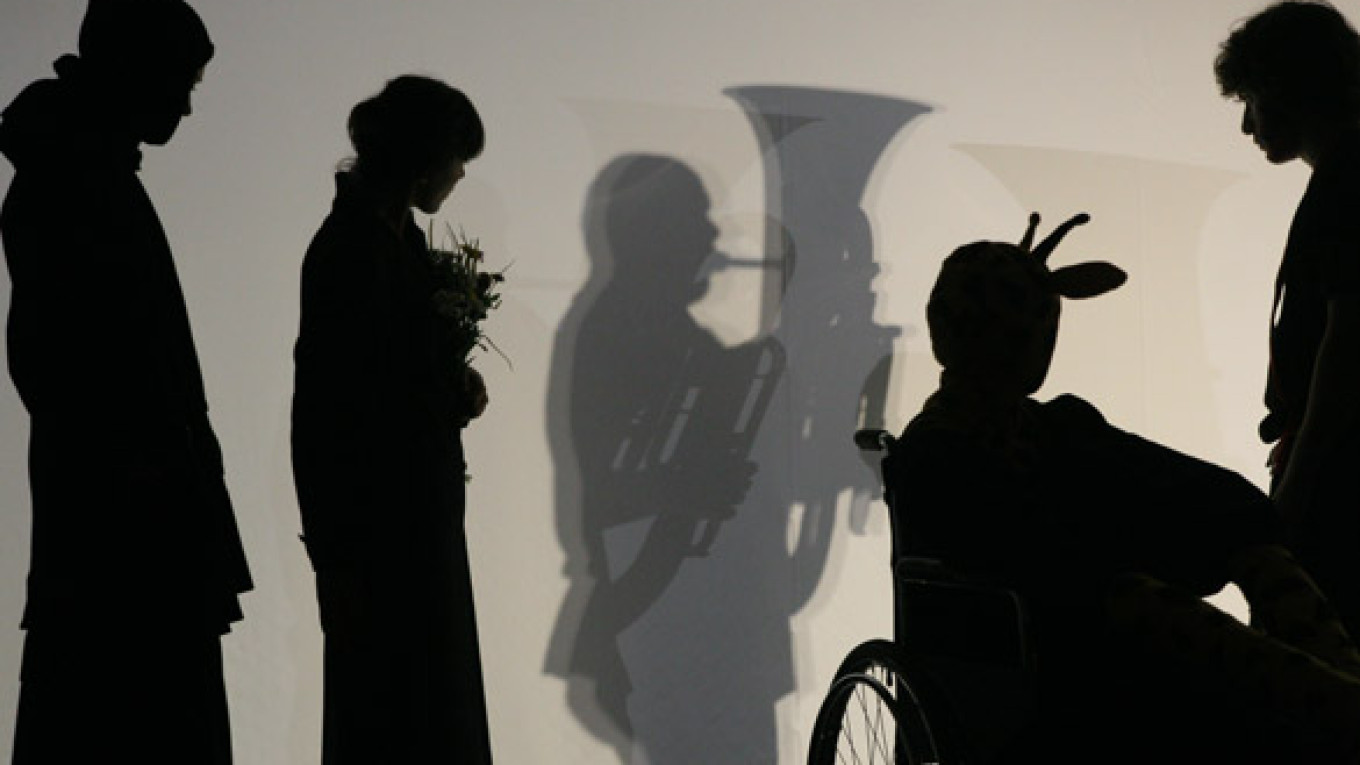
Dmitry Krymov, whose group continues to work occasionally on Vasilyev’s old stage on Povarskaya Ulitsa — now known as the Open Stage Project — will return to these old stomping grounds for “The Death of a Giraffe.” This is being billed as a collective creation of the eight actors in the troupe, who created a series of scenes depicting the old friends of a giraffe gathering at his funeral. The show opens Oct. 10 and 12.
In the second half of the season, Krymov will again pair with composer Alexander Bakshi, his creative partner in last year’s award-winning “Opus No. 7.” This time they will collaborate on a piece called “Tararabumbia,” an exploration of the works and characters of Anton Chekhov. “Tararabumbia” will be mounted jointly by the School of Dramatic Art and the Chekhov International Theater Festival, which will break with tradition this year and hold a festival for the second year in a row — this one to be devoted to the 150th anniversary of Chekhov’s birth. The show opens Jan. 28, 29, 30 and 31.
Another theater turning its eyes to Chekhov will be the Studio of Theatrical Art, whose most recent production, “Three Years,” was also a Chekhov work. Sergei Zhenovach is currently at work on a piece called “Chekhov’s Notebooks,” which will go behind the facade of published works and draw inspiration from private texts that the writer never intended to make public. As yet the theater has not announced a premiere date.
Chekhov will also be in evidence at the Moscow Art Theater, where St. Petersburg director Yury Butusov is rehearsing a production of “Ivanov” for a November premiere.
In fact, there may be reason to call this the St. Petersburg season at the Art Theater. Ilya Erenburg, who gained cult status as the founder of the Nebolshoi Theater in St. Petersburg several years ago and has had international success with his work in Magnitogorsk, will make his Moscow debut in February with a production of Maxim Gorky’s “Vassa Zheleznova. Variant 2.” But that is not all. Andrei Moguchy, whose experimental works have made him one of the most unique directors in the so-called “Russian Venice,” is set to direct Harold Pinter’s “The Hothouse.” Its premiere date is not yet known.
At the Fomenko Studio, Pyotr Fomenko is planning a piece called “Triptych” with the top actors who helped him secure his reputation as a master when he founded his theater some 16 years ago. Yes, you read that right: 16 years ago. “Triptych” is billed as an experiment in mixing comedy, drama and tragedy, in which each actor will take on a multitude of roles.
Plans at the powerful Satirikon Theater include Gerard Sibleyras’ “The Wind of the Poplars,” better known in English as “Heroes” by way of Stoppard’s translation. As directed by Konstantin Raikin, the tale about three World War I veterans looking for an escape from their lives opens Sept. 25, 26 and 27.
Also noteworthy are plans for Valery Fokin to join up with the Satirikon for the first time in 15 years. Fokin has signed on to do a production of Dostoevsky’s “Notes from Underground” in spring of 2010.
As for Tuminas’ production of “Uncle Vanya” at the Vakhtangov, keep an eye on this space next week. We’ll have plenty to say about it.
A Message from The Moscow Times:
Dear readers,
We are facing unprecedented challenges. Russia's Prosecutor General's Office has designated The Moscow Times as an "undesirable" organization, criminalizing our work and putting our staff at risk of prosecution. This follows our earlier unjust labeling as a "foreign agent."
These actions are direct attempts to silence independent journalism in Russia. The authorities claim our work "discredits the decisions of the Russian leadership." We see things differently: we strive to provide accurate, unbiased reporting on Russia.
We, the journalists of The Moscow Times, refuse to be silenced. But to continue our work, we need your help.
Your support, no matter how small, makes a world of difference. If you can, please support us monthly starting from just $2. It's quick to set up, and every contribution makes a significant impact.
By supporting The Moscow Times, you're defending open, independent journalism in the face of repression. Thank you for standing with us.

Remind me later.