

The invitation asked if I would participate in a symposium on the relationship between theater journalists and laboratory theaters. I quickly accepted. But the thought soon struck me: What could I contribute to a conversation about laboratory theaters? In the strictest sense, Russia barely knows the word.
For all the influence it has had over the last century, Russian theater hardly has a lock on innovation. Yes, it gave us Stanislavsky and the Moscow Art Theater. Yes, it gave us Meyerhold and the theatrical avant-garde. Yes, it gave us Anton Chekhov and Mikhail Chekhov, Anton's nephew, who had an enormous impact on dozens of great Hollywood actors in the middle of the 20th century. Yes, it gave us the notion of a repertory theater, a place where a troupe lives, works, fights, creates and sometimes makes up together as a family.
Where it hasn't been strong is in the realm of theater as a laboratory &mdash a closed place of experiments where actors and directors can appear, at least to outsiders, to work almost as a hermetic society. The idea for this reached its best expression in the work of Jerzy Grotowski in Poland in the 1960s and 70s. Not surprisingly, he called his theater "The Laboratory" when he founded it in 1959.
Probably the only major Russian director who drew sustained inspiration from Grotowski was Anatoly Vasilyev, who founded his School of Dramatic Art in 1989. But Vasilyev was pushed out of his theater by some shady political moves in 2007, more or less bringing to a close the notion of a pure laboratory theater in Russia.
What I soon realized was that while I had been invited to share my experiences at an international forum, what I really was going to Ashfield for was to learn something myself.
And did I ever!
 |
|
By John Freedman / For MT
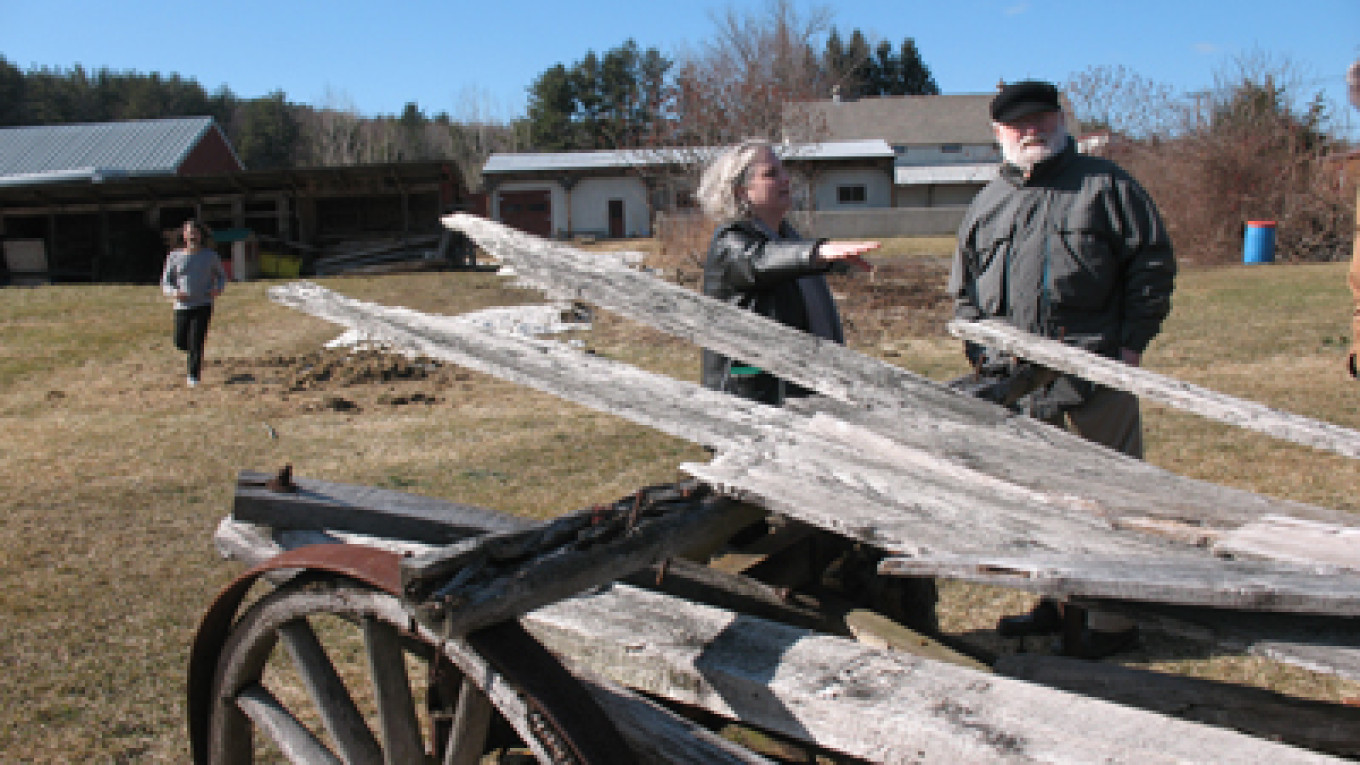
A barn that has been renovated to be used as a performance space by the Double Edge Theater. |
At present, Stacy and her actors are at work on a cycle bearing the title "The Garden of Intimacy and Desire." It includes three productions sharing nothing in character or plot but finding common ground in the themes of the human need for idealism, integrity and spiritual exploration. "The Unpossessed," based on Cervantes' "Don Quixote," premiered in 2004; "Republic of Dreams," inspired by the work of Bruno Schulz, opened in 2007; and "The Disappearance," based on a story by Ilan Stavans about a Jewish actor in Belgium who fakes his kidnapping as a protest against anti-Semitism, opened last October.
All these pieces, developed over a period of years and transforming as the actors have grown and the times have changed, have attracted international attention. In addition to its travels throughout the United States, Double Edge has gone on tours to Europe and South America. Its troupe includes actors from England and Argentina. The symposium I attended included guests from Germany, Russia and England.
All this has taken shape in a one-horse town with a rich history of political radicalism and fierce independence. This is a place, as Klein pointed out on a tour of the Farm, where the surviving Salem witches were given refuge. The Shakers, driven out of other cities, were allowed to worship here. It was a stop on the Underground Railroad that helped runaway slaves escape the South. In the middle of the 1950s, gays and lesbians moved here to avoid persecution.
"This history must have been the reason you chose to settle here," I commented.
"No," Klein said. "I liked the slate roof on the barn. I knew nothing about the town's radical background. But I've come to realize it was no coincidence that we ended up here."
I cannot imagine a theater more unlike everything I know from my experience in Russia. The intensity at Double Edge is ever-present but low-key. The commitment each member of the troupe makes to his or her work includes plenty of room for generosity of spirit and appears utterly lacking in ego-driven behavior. Stacy is the obvious leader of everything that happens on the Farm, but everybody there, even the short-term interns or apprentices who come from Poland, Bulgaria and the American West to study and train with the troupe, are included in all activities as equals. What a concept!
I have spent the last 20 years singing the praises of Russia's rough-and-tumble theater world. and I have no intention of stopping now. Few things have fascinated and enriched me like Russian theater. But I must take this opportunity to step back and say this: There is something extraordinarily attractive, extraordinarily American about the Double Edge Theater. If I'm lucky, when I get on a plane back to Moscow tomorrow, I'll take a little of this amazing theater back with me.
A Message from The Moscow Times:
Dear readers,
We are facing unprecedented challenges. Russia's Prosecutor General's Office has designated The Moscow Times as an "undesirable" organization, criminalizing our work and putting our staff at risk of prosecution. This follows our earlier unjust labeling as a "foreign agent."
These actions are direct attempts to silence independent journalism in Russia. The authorities claim our work "discredits the decisions of the Russian leadership." We see things differently: we strive to provide accurate, unbiased reporting on Russia.
We, the journalists of The Moscow Times, refuse to be silenced. But to continue our work, we need your help.
Your support, no matter how small, makes a world of difference. If you can, please support us monthly starting from just $2. It's quick to set up, and every contribution makes a significant impact.
By supporting The Moscow Times, you're defending open, independent journalism in the face of repression. Thank you for standing with us.

Remind me later.