

In my book, that idea — comparing performing artists as if they were pieces of candy being subjected to a quality check — is total nonsense. The show you tell me is a piece of hackwork is the show I know to be a stunning piece of work done by a troupe that has put itself on the line to have its say on stage. Who will ever prove me right? Or you wrong?
Isn’t this all just a great big waste of time and money?
Take the Golden Mask Festival, which concluded Saturday with its traditional award ceremony. The Golden Mask is one of the greatest things to hit Russian theater in the 15 years since the festival was founded. It has done more than any other single enterprise to promote Russian theater nationally and internationally (through the Russian Case festival which is part of the Golden Mask). It restored a sense of pride and excitement to the theatrical process that had been lost after the collapse of the Soviet Union. It revived the notion that the territory of Russian theater, whether it is made in Novosibirsk or in St. Petersburg, is a single space unified by shared spiritual values. Before the notion of gloss and glamour ran rampant in the 2000s, the Golden Mask had already reinstated the theater artist as a singular member of society, worthy of special attention. The Golden Mask has grown from a local Moscow awards ceremony, first held in 1995, into a huge array of events that keeps the Russian press running ragged for over a month.
Good theater is always paradoxical, and it surely should come as no surprise that the Golden Mask is wrapped up in some knotty paradoxes. Many of the same people are included every year in the council of experts who select the plays to be included and the artists to be nominated. By failing to find a way to bring new blood into the councils, the festival organizers ensure that the same basic tastes and prejudices are repeated every year. Moreover, the system of juries drawn from a mix of performers, directors and critics is extremely unwieldy. The wildly different tastes, experiences and expectations represented among the jury members often make for very strange and highly controversial decisions.
I personally think the Golden Mask ought to make more noise about the nominees. This is where the real value of the festival lies. This is where the variety of the Russian theatrical landscape becomes evident — in the nominees from Barnaul, Perm, Neryungri, Petrozavodsk, and in the vastly different styles of shows from the denser cultural capitals of Moscow, St. Petersburg and Yekaterinburg. A certain kind of truth arises in the sharing of such disparate artistic visions.
But by the time the festival is over and it’s time to hand out awards, it is also time, in my opinion, for all of us so-called experts to climb down off our high horses. I can’t think of anything easier — or more boring — than moaning and groaning about who won what and who didn’t, who got snubbed and who got lucky.
Let it be known that the winner of a Golden Mask award has not been proclaimed a genius, but that he or she has been recognized by a jury of peers to have achieved something worthy of note — nothing more, but certainly nothing less. In other words, let the winners be winners and let the rest of us join in the applause.
 |
|
John Freedman / MT
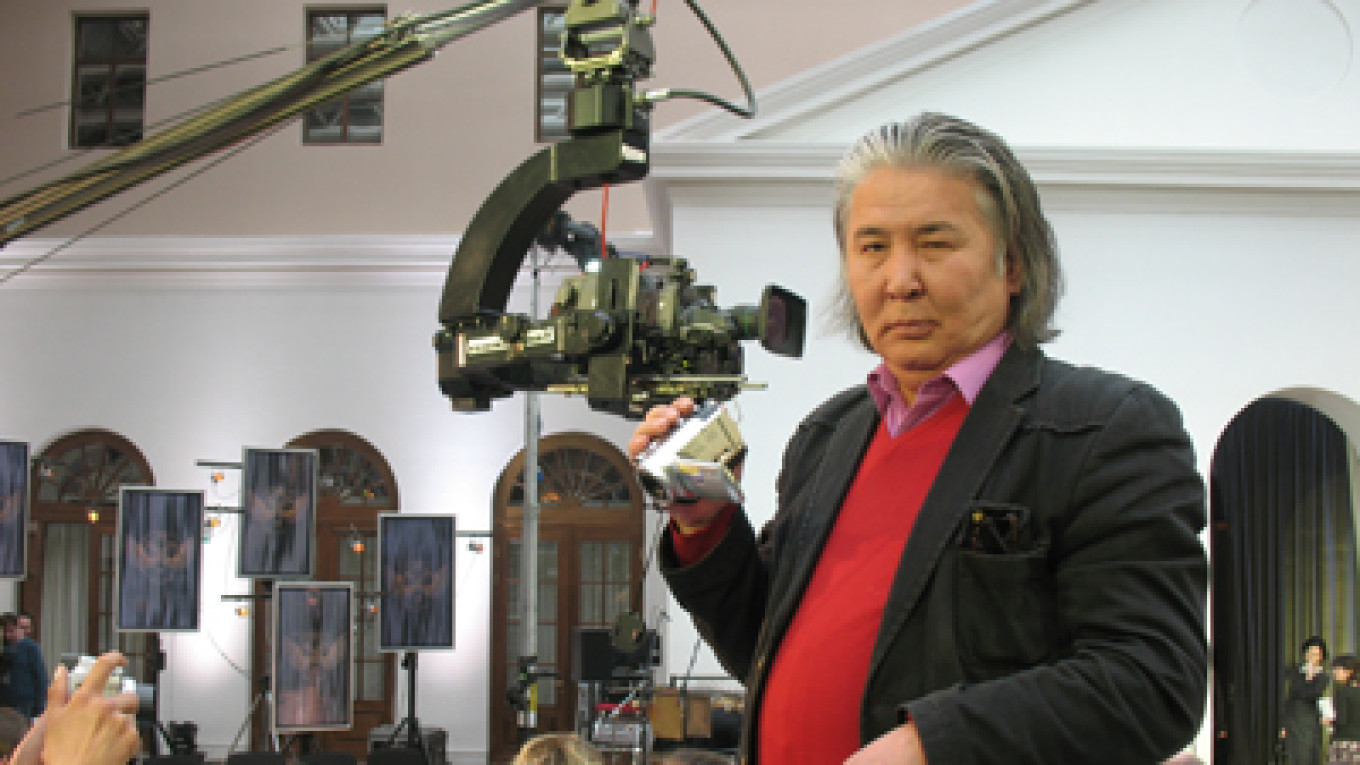
Andrei Danilov returning to his seat after receiving the Golden Mask award for best conductor of a ballet. |
Georgy Isaakyan, accepting his award for best director of an opera, put it this way: “No state award can compare to an award given by your peers.”
And can anything compare with the sheer joy expressed in the ecstatic burst of whoops and hollers that came from the cast of “Neighbors” when their show was named best puppet show of the 2007-2008 season? Or the screams of delight that the troupe of “Catherine the Great” unleashed when one of their own, Maria Vinenkova, was declared best female singer in a musical or operetta?
You’ve got to love stuff like that.
After a festival as rich and varied as the one we witnessed this year, all that’s left to say is congratulations to everyone — every nominee, every winner, every employee of the Golden Mask who contributes to making this event one of the genuine highlights in the Russian cultural calendar.
The complete list of Golden Mask awards for 2009:
DRAMA
Large-scale production: “The Seagull,” Alexandrinsky Theater, St. Petersburg.
Small-scale production: “The Battle of Life,” Studio of Theater Art, Moscow.
Director: Valery Fokin, “The Marriage,” Alexandrinsky Theater, St. Petersburg.
Actress: Polina Agureyeva, Larisa in “Without a Dowry,” Fomenko Studio, Moscow.
Actor: Oleg Basilashvili, Count K in “Uncle’s Dream,” Bolshoi Drama Theater, St. Petersburg.
Designer: Alexander Borovsky, “The Marriage,” Alexandrinsky Theater, St. Petersburg.
PUPPETRY
Production: “Neighbors,” Khakassian National Fairy Tale Theater, Abakan.
Director: Alexei Shishov, Boris Konstantinov, Denis Shadrin, “The Leningrad Woman,” KUB Theater-Studio, St. Petersburg.
Designer: Viktor Antonov, “The Leningrad Woman,” KUB Theater-Studio, St. Petersburg.
Actor: Pyotr Vasilyev, Kholstomer in “Kholstomer: The Story of a Horse,” Bolshoi Puppet Theater, St. Petersburg.
SPECIAL JURY PRIZES FOR DRAMA AND PUPPET THEATER
Acting Duet of Natalya Makarova and Alexander Khryakov in “Woyzeck,” Altai Drama Theater, Barnaul.
“The Coast of Utopia,” National Youth Theater, Moscow.
OPERA
Production: “Cinderella,” Zazerkalye Theater, St. Petersburg.
Conductor: Pavel Bubelnikov, “Cinderella,” Zazerkalye Theater, St. Petersburg.
Director: Georgy Isaakyan, “Orpheus,” Tchaikovsky Opera and Ballet Theater, Perm.
Female Singer: Kristina Kapustinskaya, Grusha in “The Charmed Pilgrim,” Mariinsky Theater, St. Petersburg.
Male Singer: Alexei Markov, Ivan Karamazov in “The Brothers Karamazov,” Mariinsky Theater, St. Petersburg.
DANCE – BALLET AND CONTEMPORARY
Ballet Production: “Diana Vishneva: Beauty in Motion,” a Sergei Danilyan project (U.S.-Russia).
Contemporary Dance Production: “Clay Wind,” Sergei Smirnov’s Eccentric Ballet, Yekaterinburg.
Conductor: Andrei Danilov, “La Bayadere,” Novosibirsk Opera and Ballet Theater.
Choreographer: Sergei Smirnov, “Clay Wind,” Sergei Smirnov’s Eccentric Ballet, Yekaterinburg.
Female Dancer: Diana Vishneva in “Diana Vishneva: Beauty in Motion,” a Sergei Danilyan project (U.S.-Russia).
Male Dancer: Igor Zelensky, Solor in “La Bayadere,” Novosibirsk Opera and Ballet Theater.
OPERETTA/MUSICAL
Production: “The Little Humpbacked Horse,” Chekhov Moscow Art Theater, Moscow.
Conductor: Ekhtibar Akhmedov, “The Viper,” Novosibirsk Theater of Musical Comedy.
Director: Gali Abaidulov, “The Viper,” Novosibirsk Theater of Musical Comedy.
Female Singer: Maria Vinenkova, Ficke (the young Catherine) in “Catherine the Great,” Yekaterinburg Theater of Musical Comedy.
Male Singer: No award given.
MUSICAL THEATER COMBINED
Composer: Rodion Shchedrin, “The Charmed Pilgrim,” Mariinsky Theater, St. Petersburg.
Set Designer: Ernst Geidebrekht, “Orpheus,” Tchaikovsky Opera and Ballet Theater, Perm.
Costume Designer: Pavel Kaplevich, “Catherine the Great,” Yekaterinburg Theater of Musical Comedy.
Lighting Designer: Ildar Bederdinov, “A May Night, or, the Drowned Woman,” Stanislavsky and Nemirovich-Danchenko Musical Theater, Moscow.
SPECIAL JURY PRIZES FOR MUSICAL THEATER
“Alexander of Macedonia,” the Sakha Republic of Theater and Opera (Yakutia) – “For the creation of a contemporary work on the basis of a national epos.”
Duet of dancers Natalya Osipova and Vyacheslav Lopatin in “Les Sylphides,” Bolshoi Theater, Moscow.
EXPERIMENT
“Liquidation,” Liquid Theater, Moscow-Chelyabinsk.
CRITICS’ PRIZE
“Diana Vishneva: Beauty in Motion,” a Sergei Danilyan project (U.S.-Russia).
LIFETIME ACHIEVEMENT AWARDS
Inna Solovyova, Theater critic and historian.
Semyon Lerman, Chief Director, Niznhy Novgorod Comedy Theater.
FOR SUPPORT OF THEATER ARTS IN RUSSIA
Kommersant Publishing House.
Alexander Filipenko, Governor of the Khanty-Mansiisk autonomous okrug.
BEST FOREIGN PRODUCTION PERFORMED IN RUSSIA IN 2008
“Ivanov,” Jozsef Katona Theatre of Budapest, Hungary. Directed by Tamas Ascher.
A Message from The Moscow Times:
Dear readers,
We are facing unprecedented challenges. Russia's Prosecutor General's Office has designated The Moscow Times as an "undesirable" organization, criminalizing our work and putting our staff at risk of prosecution. This follows our earlier unjust labeling as a "foreign agent."
These actions are direct attempts to silence independent journalism in Russia. The authorities claim our work "discredits the decisions of the Russian leadership." We see things differently: we strive to provide accurate, unbiased reporting on Russia.
We, the journalists of The Moscow Times, refuse to be silenced. But to continue our work, we need your help.
Your support, no matter how small, makes a world of difference. If you can, please support us monthly starting from just $2. It's quick to set up, and every contribution makes a significant impact.
By supporting The Moscow Times, you're defending open, independent journalism in the face of repression. Thank you for standing with us.

Remind me later.