

It is not uncommon in theater for a director to stage an entire show for the sake of the finale. Everything that comes before that last moment is preparation for the culmination.
Konstantin Raikin’s production of “Poplars and Wind” at the Satirikon Theater struck me as just such a show.
“Poplars and Wind” is a sitcom-style play that has been making the rounds of the world’s theaters under various titles. In English-speaking countries, it is known as “Heroes,” thanks to a translation by Tom Stoppard. In Gerard Sibleyras’ original French, it is known as “Le Vent des Peupliers.”
The play, let’s say right off the bat, is underwhelming. Three aging World War I veterans are living out their lives in an old soldiers’ home where they gather each day in a gazebo to fulminate. Most often they gang up on each other, although on occasion they shake a fist at God or, more frequently, the nurses who they think could treat them better.
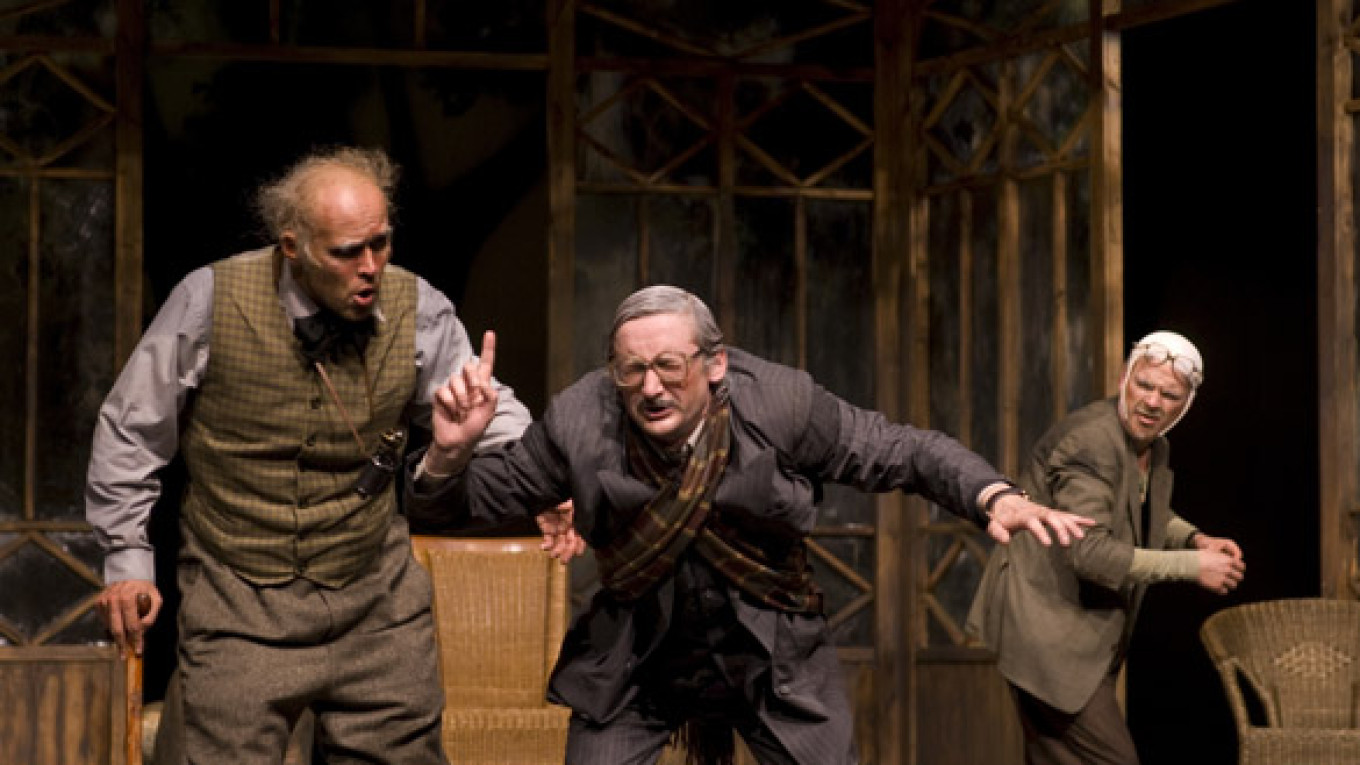
At the Satirikon, we have the complication that each of these doddering oldsters is played by a healthy young actor. To a greater or lesser degree they do so by employing heavy make-up, by stumbling and hunching over when they walk, and by talking as if they have mouths full of marbles. This tends to push the disbelief meter up pretty high, although, ultimately, there is another side to it, too.
Each man has his own identifying feature. Gustave (Denis Sukhanov), despite a bad back, considers himself the young buck of the trio. Fernand suffers from seizures caused by a piece of shrapnel stuck in his head. Rene (Maxim Averin) hobbles around on an artificial leg and has the habit of falling asleep while talking.
Averin, especially, is comfortable and convincing in the guise of a lame old man, in part, I suspect, because he never really tries to play one. Instead, he is always focused on the essence of a man whose nature is to seek peace and compromise, but finds that harder and harder to do as his life advances towards its end. Before that finale comes, Averin’s is the performance that occasionally takes this production beyond the limits of the sitcom formula.
The conversations that the three men engage in are relatively predictable. When they discuss the fact that other veterans may soon try to move in on their gazebo, they fall into memories of crawling through the trenches during the war. The most hated of the nurses is also the object of sexual fantasies. And there is always the impulse to pick up and break out of the confines of the sanatorium.
In the case of Rene, this involves sneaking out for walks in the nearby village where — to the jealous amazement of Gustave and Fernand — he actually talks with a little girl. As for Gustave, freedom is represented by the treetops he sees waving in the wind in the distance. He is certain that everything would be all right if only they all could overcome their bickering and fears and go to where the wind meets the poplars.
Raikin tosses in a good deal of action to keep the chatter moving along. Discussions of the war turn into extended scenes of the men scrambling to avoid what sounds like falling bombs. Gustave, having resolved to fly the coup, almost literally transforms into a roaring airplane that buzzes the astonished Fernand and Rene.
It all is entertaining in measure, especially if you are easily amused by cute portrayals of curmudgeonly old people. But this, as I have stated, is not the full extent of this production.
Things begin to change thanks to a couple of details in Leonid Shulyakov’s set, which represents a drab gazebo. Standing at the center is an oversized statue of a dog, while on either side stand plaster statues of female figures, behind which the men occasionally go to relieve their bladders.
Each of these statues is ultimately more than they would seem to be. Although that still is not the moment of revelation that Raikin has in store. For that, you’ll have to go see the show and, for all intents and purposes, wait until it is already over.
This is the moment when Raikin put a hook in me and convinced me that “Poplars and Wind” was more than just a usual show. Almost too late to save it? Yes. Unequivocally too late? Maybe not.
“Poplars and Wind” (Topolya i Veter) plays Fri., Oct. 27, 28, Nov. 1, 6, 13, 20 and 26 at 7 p.m. at the Satirikon Theater, located at 8 Sheremetyevskaya Ulitsa. Metro Rizhskaya. Tel. 689-7844, Satirikon.ru. Running time: 2 hours, 10 minutes.
A Message from The Moscow Times:
Dear readers,
We are facing unprecedented challenges. Russia's Prosecutor General's Office has designated The Moscow Times as an "undesirable" organization, criminalizing our work and putting our staff at risk of prosecution. This follows our earlier unjust labeling as a "foreign agent."
These actions are direct attempts to silence independent journalism in Russia. The authorities claim our work "discredits the decisions of the Russian leadership." We see things differently: we strive to provide accurate, unbiased reporting on Russia.
We, the journalists of The Moscow Times, refuse to be silenced. But to continue our work, we need your help.
Your support, no matter how small, makes a world of difference. If you can, please support us monthly starting from just $2. It's quick to set up, and every contribution makes a significant impact.
By supporting The Moscow Times, you're defending open, independent journalism in the face of repression. Thank you for standing with us.

Remind me later.