

To this day, many Americans remember Fischer, a gangly 29-year-old from Brooklyn, as the guy who beat the Russians at their own game. Such was their enthusiasm that over 1 million people tuned in to watch the games being played live from Reykjavik, Iceland, and when Channel 13 broke into its chess coverage to air the Democratic National Convention, hundreds of angry callers forced the station to put the match back on the air. In Britain, too, newspapers and television gave the championship widespread attention, with one tabloid headline even proclaiming, "Spasski Smashki!" after Spassky suffered a particularly crushing defeat.
But in fact, the match nearly never got off the ground, as Fischer, who was neurotically obsessed with the minutiae of playing conditions, had his posse of lawyers raise objections to the lighting, television cameras, spectators and even the size and shape of the chess pieces and chessboard. He also demanded higher prize money and a cut of the gate receipts and television rights. This prima-donna behavior, coupled with anti-Semitic outbursts and an erratic attachment to an obscure Californian sect called the Worldwide Church of God, did little to endear Fischer -- himself of Jewish descent -- to potential supporters, and led the White House to balk at setting up a photo opportunity with President Richard Nixon.
Yet Fischer did have his supporters, as Edmonds and Eidinow relate, including another enthusiastic (though strictly hobby) chess player, U.S. Secretary of State Henry Kissinger. According to one of Fischer's lawyers, Kissinger stepped in at the very last minute, telling Fischer in no uncertain terms: "America wants you to go over there and beat the Russians."
When the match finally did get underway, Fischer continued his bizarre behavior, falling for a standard trap -- grabbing a "poisoned pawn" in chess parlance -- and losing the first game. The second game he forfeited, staging a walkout protest at the presence of cameras. In their analysis, which focuses on politics and psychology rather than the moves on the chessboard, Edmonds and Eidinow liken Fischer's brinkmanship to playing a game of "chicken" with two cars bent on a head-on collision. Each one of Fischer's demands was in itself small, even insignificant, but the threat of crashing the match would have been a catastrophe for the players, organizers and sponsors.
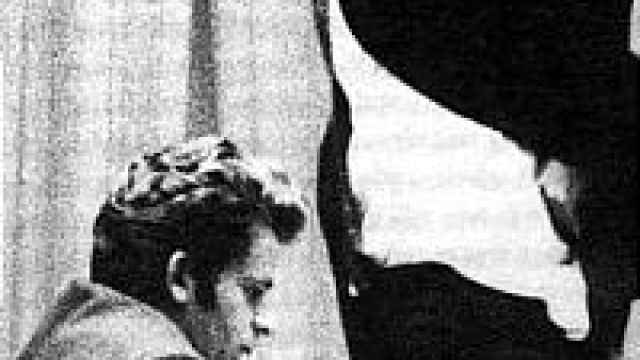 HarperCollins Over 1 million U.S. viewers tuned in to watch Bobby Fischer (right) face off against Spassky in 1972. |  |
| |
But where Edmonds and Eidinow ?€“ whose previous book, "Wittgenstein's Poker," won plaudits for its exploration of a 10-minute argument between philosophers Ludwig Wittgenstein and Karl Popper ?€“ score over other accounts of the match is their attention to the other side of the story. The Western press initially presented the 35-year-old Spassky as an expressionless representative of the Soviet system. Yet as the match progressed, Spassky got praise for his sportsmanlike conduct and willingness to accommodate Fischer's demands.
Soviet establishment members, on the other hand, were worried by Spassky's independence of spirit and comparatively lenient training regime. Edmonds and Eidinow quote one senior Soviet grandmaster, Yury Averbakh, describing how he dropped in one day on Spassky's training camp, a sanatorium just outside of Moscow. "On the table were cards and dominoes, and when lunchtime came Spassky pulled out a bottle of whiskey," Averbakh recalled. "Everything became apparent to me immediately."
Spassky had political conflicts as well, never having fit into the mold of who the authorities wanted their champion to be; he expressed Russian nationalist, as opposed to Soviet patriotic, views, and was proud of descending from a line of Orthodox priests. The defeat at Reykjavik was enough to bring these issues to bear. Upon his return, his salary was cut and KGB surveillance stepped up.
But for Spassky, at least, the story of the Reykjavik match has a happy ending. After meeting and marrying his third wife, the granddaughter of a tsarist general, he immigrated with her to France in 1976. Managing to keep his Soviet citizenship under a deal worked out between the two countries, he spent the following decades in a small town near Paris, comfortably dividing his time between chess tournaments and the tennis court.
Fischer was not so lucky. After an acrimonious dispute in 1974 with the world chess federation in which he demanded that 179 separate conditions be met before he would agree to defend his title, it was awarded by default in 1975 to a new Soviet challenger, the talented but colorless Anatoly Karpov. Fischer spent the next 20 years in virtual hiding, handing over most of his winnings to the Worldwide Church of God in Pasadena and resurfacing only briefly in 1992 to play a self-styled "world championship rematch" with Spassky in civil-war-torn Yugoslavia. Now a lumbering, bearded 49-year-old, Fischer beat his old rival again, this time by 10 wins to 5. A sting in the tail not mentioned by Edmonds and Eidinow was that the match organizer, a shady Serbian financier, never paid up -- flying instead to Israel with Fischer's share of the $5 million prize money.
One flaw in Edmonds and Eidinow's tale is the lack of testimony from the older Fischer, though the absence is understandable given the fact that the notoriously reclusive chess player has refused all journalists' questions since 1992. According to the authors, he was last heard of in Japan, praising the Sept. 11, 2001 terrorist attacks on Philippines radio, and shouting, "America got what it deserved -- Death to the U.S.A."
And Spassky? He was lucky enough to cash his loser's check from Yugoslavia -- a cool $1.5 million -- before the Serbian banker left town. The authors' conclusion seems clear: Though the gentlemanly Spassky may have been the loser in Reykjavik, he actually won out in the end.
Tim Wall is a former editor of British Chess Magazine.
A Message from The Moscow Times:
Dear readers,
We are facing unprecedented challenges. Russia's Prosecutor General's Office has designated The Moscow Times as an "undesirable" organization, criminalizing our work and putting our staff at risk of prosecution. This follows our earlier unjust labeling as a "foreign agent."
These actions are direct attempts to silence independent journalism in Russia. The authorities claim our work "discredits the decisions of the Russian leadership." We see things differently: we strive to provide accurate, unbiased reporting on Russia.
We, the journalists of The Moscow Times, refuse to be silenced. But to continue our work, we need your help.
Your support, no matter how small, makes a world of difference. If you can, please support us monthly starting from just $2. It's quick to set up, and every contribution makes a significant impact.
By supporting The Moscow Times, you're defending open, independent journalism in the face of repression. Thank you for standing with us.

Remind me later.