

Okay. Here’s the question. Who wants to go outside after ― what has it been? ― a month of record-breaking heat and smoky smog in Moscow? A hundred years? It must seem like that.
It isn’t very kind of me to joke. I am approximately 7,500 kilometers away in the country in New England, where the temperatures over the last two weeks have been in the mid-20s with light, refreshing breezes.
My apologies for that.
In fact, if the Moscow health board were to find out that I was encouraging you to take a sightseeing walk around the city, they just might throw the book at me. And with good reason.
So, in fact, my column this week ― the third in a series dedicated to Moscow’s memorial plaques ― is geared to provide you with a little virtual outdoors exercise. With the help of the photo gallery above, you can stroll about the city without ever leaving the confines of your apartment or your workplace. Pour yourself an ice-cold something, turn that air conditioning up another notch, and take a virtual tour of some of the places that keep Moscow’s history from slipping into oblivion.
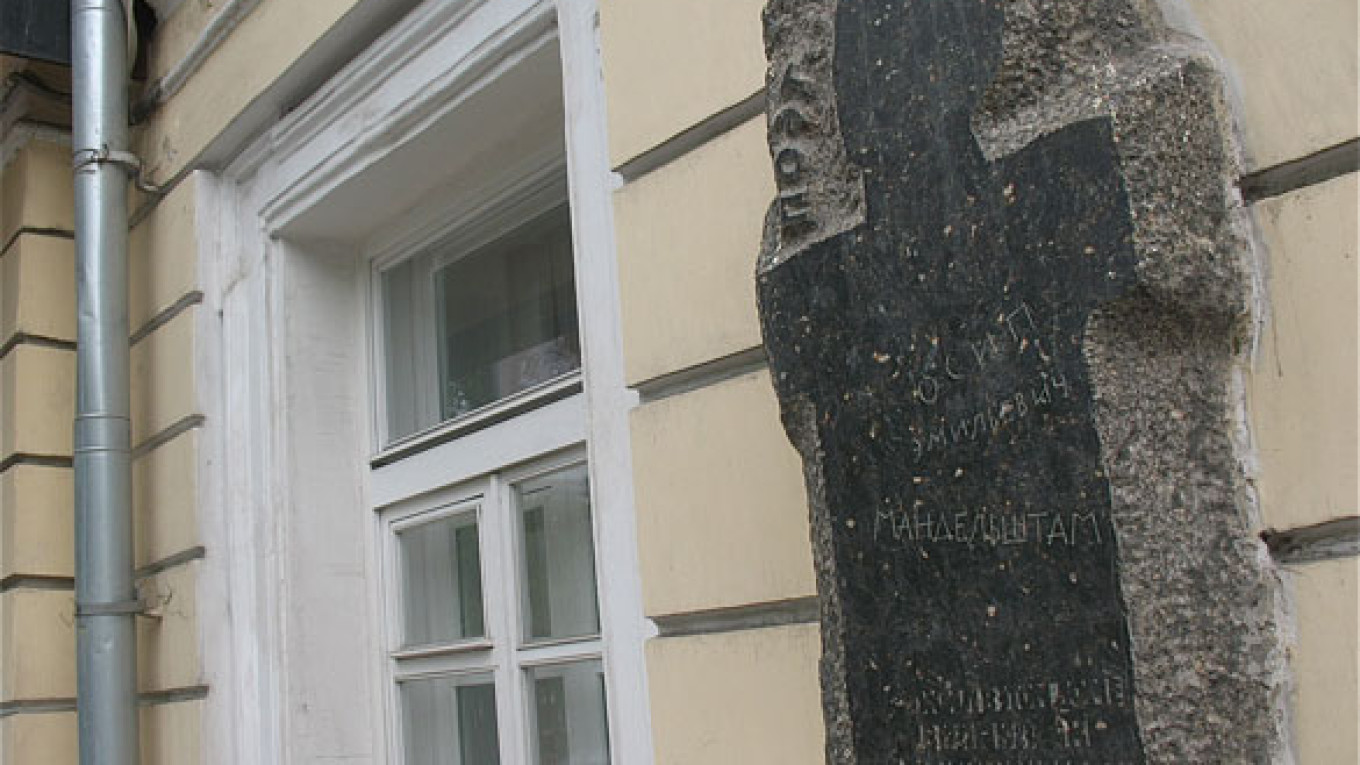
Osip Mandelstam was one of Russia’s finest poets of any age. He was subtle, introspective and independent-minded. The latter brought tragedy, as he was arrested twice in the 1930s, the second arrest leading to his death by an unknown cause at the age of 46.
Mandelstam lived at 23 Tverskoi Bulvar twice, once from 1922 to 1923, just after returning to Russia from Europe, and again from 1932 to 1933, just before his first arrest. The plaque honoring his memory at this address is a little odd, for its shape seems to suggest a Christian cross, while Mandelstam was of Jewish heritage. Still, the rough-hewn simplicity of the monument is quite effective.
One of Mandelstam’s neighbors for a short while was the great novelist, short-story writer and playwright Andrei Platonov. He was a resident of 23 Tverskoi Bulvar from 1931 to 1951, when he died at the age of 52.
These last 20 years of Platonov’s life were extremely difficult. Although he was never arrested, by the 1930s his work was either attacked or totally ignored by the establishment. The average Soviet citizen had no idea that such a writer even existed, even though Platonov wrote some of his most memorable short-stories and essays during this period.
Alexei Diky was one of the most prominent theater artists of the early Soviet years. He studied at the Moscow Art Theater in the first decade of the 20th century, and he either acted or directed at the Art Theater’s studios for nearly 20 years. He also was an active participant in the work of the Moscow Jewish Theater in the 1920s.
It was Diky’s production of Dmitry Shostakovich’s opera “Lady Macbeth of the Mtsensk District” that was famous for evoking Stalin’s wrath against the composer. The phrase damning the opera, as written in Pravda on January 29, 1936, was “chaos instead of music.” Nowadays, people are more likely to know Diky because of his performances in heroic roles in the cinema, such as his handling of the title role in “Kutuzov,” the 1943 film about the general who defeated Napoleon.
Even that would be hard to prove judging by the plaque noting that he lived at 19/29 Tverskaya Ulitsa from 1949 to his death in 1955. It is broken and utterly neglected in a dusty corner right by Moscow’s central McDonald's restaurant. Moreover, if you look closely, you will notice that the bust of Diky actually looks more like Stalin, whom the actor once portrayed in the patriotic film “The Battle of Stalingrad.”
Just up the street, at 25/9 Tverskaya Ulitsa, is a reminder that from 1951 to 1969 the painter Alexander Deineka made his home a few blocks away. Deineka was one of the founders and most prolific practitioners of the Soviet monumental style of art. His paintings of factories and armed conflict were highly theatrical, with numerous scenes simultaneously jostling for attention on very large canvases. If the topics of his works often seemed mundane or predictable, the artist’s execution of them rarely was.
Standing in the shadows of the monstrous and garish Olimpiisky stadium is an attractive building that was originally constructed in the first half of the 19th century. You cannot see it, however, from the street, for an old wooden fence still protects the inhabitant ― now a museum ― from prying and curious eyes.
This once was the home of the great Russian actor Mikhail Shchepkin.
It was Shchepkin who memorably claimed that “theater is a cathedral ― be holy in it or get out,” thereby helping to establish the importance and moral high ground that this artistic genre has had in Russia ever since.
Shchepkin, who was born in 1788 in the Kursk region and died in 1863 in Yalta, spent most of his last four years in the house behind the wooden fence at 47 Ulitsa Shchepkina. As nondescript as it may be, even that fence gives an idea of what Moscow’s old wooden architecture once looked like.
If you want to see the interior of the recently renovated building, which now houses the Shchepkin Museum, stop by during working hours (Wed. to Sun., noon to 7 p.m.). Anatoly Ledukhovsky, a director whose actors perform at the museum during the theater season, tells me there is a clunky air-conditioner in the basement…
A Message from The Moscow Times:
Dear readers,
We are facing unprecedented challenges. Russia's Prosecutor General's Office has designated The Moscow Times as an "undesirable" organization, criminalizing our work and putting our staff at risk of prosecution. This follows our earlier unjust labeling as a "foreign agent."
These actions are direct attempts to silence independent journalism in Russia. The authorities claim our work "discredits the decisions of the Russian leadership." We see things differently: we strive to provide accurate, unbiased reporting on Russia.
We, the journalists of The Moscow Times, refuse to be silenced. But to continue our work, we need your help.
Your support, no matter how small, makes a world of difference. If you can, please support us monthly starting from just $2. It's quick to set up, and every contribution makes a significant impact.
By supporting The Moscow Times, you're defending open, independent journalism in the face of repression. Thank you for standing with us.

Remind me later.