

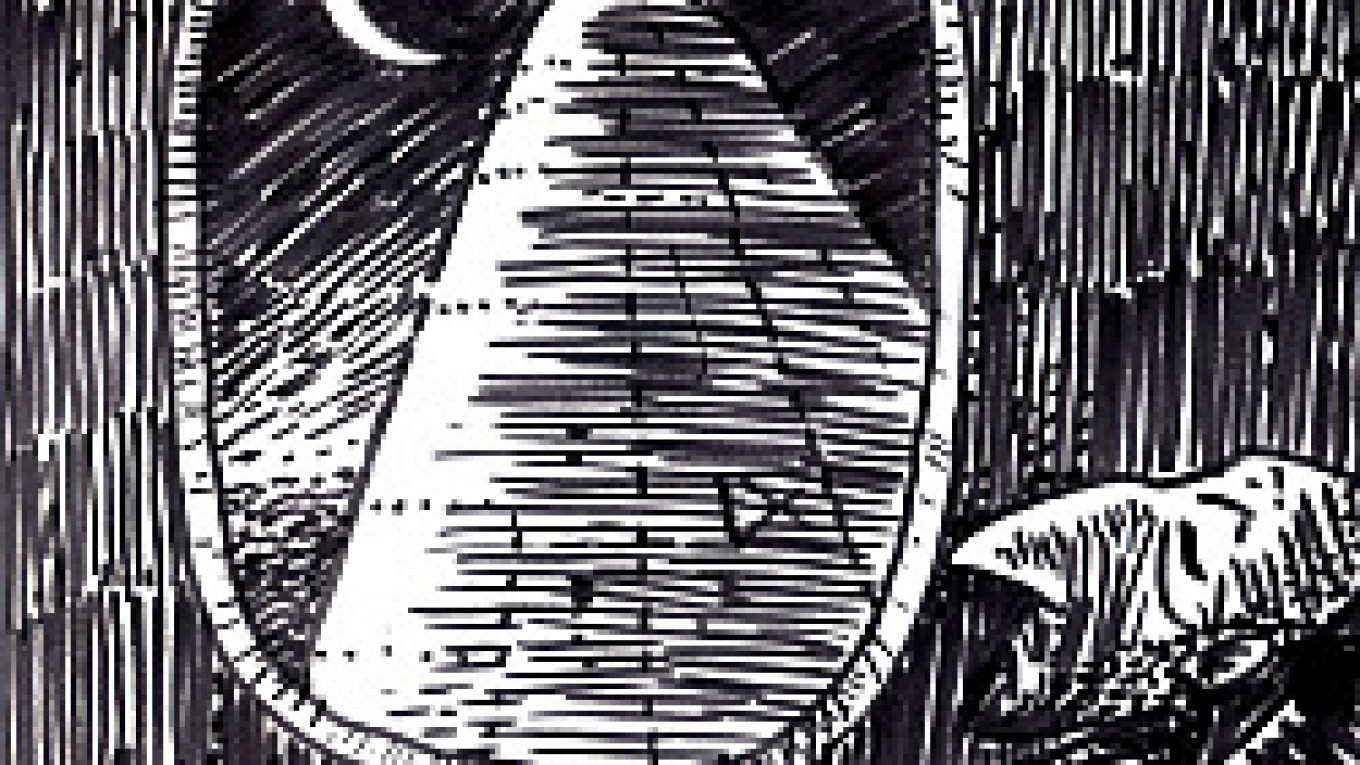
Brodsky has put on display envelopes and scraps of papers covered with jottings that he made while talking on the phone. One torn-off sheet has seven sketches of a human leg. A topographical plan of a house he's building is hung upside down and covered with bananas. Underwhelming as the exhibits are, however, they do give a few clues to Brodsky's unique architectural style.
"These drawings accumulate, and I never throw them away," Brodsky said in an interview Tuesday at his office, which is on the top floor of a Shchusev wing called the Ruin, the barely navigable shell of a historic building with no windows or heating. "Some are not related to my work. Others are kind of related to it."
For someone so acclaimed -- he was the only Russian at last year's architecture exhibition at the Venice Biennale -- Brodsky has built surprisingly few projects. Although he graduated from architectural school in 1978, he didn't construct anything for 20 years. Instead, he made etchings of fantastical, seemingly impossible structures, and later moved onto art installations. In 1997, he put a canal and gondolas in New York's Canal St. subway station.
Since then, he's designed a scattering of small-scale buildings in and around Moscow. The 95 Degree Landing Stage restaurant, which since 2000 has stood on stilts above the Pirogovskoye reservoir, was his debut project -- its name refers to the angle the stilts are placed at, which causes the whole building to lean slightly to one side. He also designed a house for art gallery owner Marat Guelman, and the interior of the club Apshu, which is in a cellar with white-painted brick walls and cozy small rooms.
Common to many of these projects is the use of unworked or old building materials, which are nevertheless chosen with great care. The restaurant, for example, is made of rusty sheet metal and roughly hewn timber, and has a rough, unvarnished feel. If he's renovating an existing structure, as he did at the Vinzavod contemporary arts center in a former wine store, he changes as little as possible -- almost as if he doesn't want to leave his mark.
"I try not to destroy," Brodsky said. "If I'm building in the countryside, I try not to do anything that will ruin the landscape. If I'm in a town, and I am supposed to demolish something good, I try not to do it."
These same values can be glimpsed at the exhibition. Like the tiny changes he makes during renovations, the bits of paper, covered in plexiglass, barely stand out in the dramatic Ruin. The scraps are ragged and old, but, along with his building materials, they were carefully saved and have found a new use.
The unprepossessing pencil and felt-pen drawings -- an invoice covered with doodles of pipes, a whole page of what appear to be chocolates and macaroons -- might also be important.
"I see in them his infinite taste," said David Sarkisyan, the director of the Shchusev, who offered Brodsky an office there four years ago. He added that Brodsky has become a living exhibit: "You preserve in museums things that are either typical of their time, or pre-eminent. Brodsky is pre-eminent."
"Brodsky Live: From the Collection of the Architecture Museum" (Brodsky Live: Iz Kollektsii Muzeya Arkhitektury) runs to Nov. 30 at the Shchusev Architecture Museum, located at 5 Vozdvizhenka Ulitsa. Metro Biblioteka Imeni Lenina. Tel. 291-2109, 290-0551.
A Message from The Moscow Times:
Dear readers,
We are facing unprecedented challenges. Russia's Prosecutor General's Office has designated The Moscow Times as an "undesirable" organization, criminalizing our work and putting our staff at risk of prosecution. This follows our earlier unjust labeling as a "foreign agent."
These actions are direct attempts to silence independent journalism in Russia. The authorities claim our work "discredits the decisions of the Russian leadership." We see things differently: we strive to provide accurate, unbiased reporting on Russia.
We, the journalists of The Moscow Times, refuse to be silenced. But to continue our work, we need your help.
Your support, no matter how small, makes a world of difference. If you can, please support us monthly starting from just $2. It's quick to set up, and every contribution makes a significant impact.
By supporting The Moscow Times, you're defending open, independent journalism in the face of repression. Thank you for standing with us.

Remind me later.