

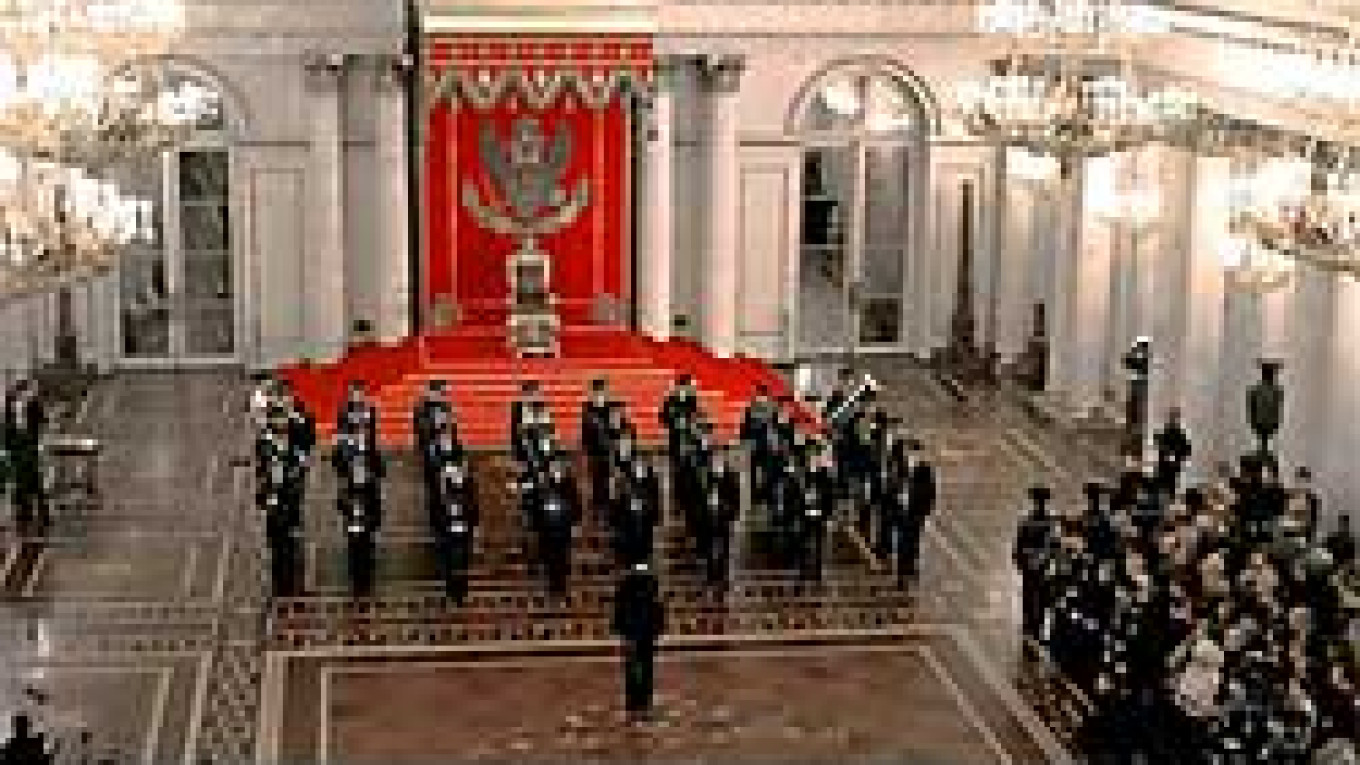
The St. George throne room was unveiled in a pomp-filled ceremony in the ornate palace on the Neva River, now home to the renowned Hermitage Museum. The museum paid for the painstaking six-year restoration.
The hall?€™s centerpiece is the gold throne, topped with a double-headed eagle, the tsarist state emblem. Together with a foot stool, it stands on an imposing platform covered in velvet and topped with a canopy sporting huge ostrich feathers.
The ceremony came amid heated national debate over the symbols of today?€™s Russia and the legacy of the Soviet regime. The State Duma on Friday voted overwhelmingly to grant President Vladimir Putin?€™s request to reinstate the tune of the Stalin-era Soviet anthem and a tsarist flag and eagle as the country?€™s state symbols ?€” but to keep the tsarist eagle as the state emblem and keep the pre-communist tricolor flag.
Putin backed the bill, saying it would unite a society still deeply divided about decades of communist rule.
St. Petersburg Mayor Vladimir Yakovlev suggested Saturday that the restored throne room, like the parliament vote, was part of Russia?€™s effort to celebrate the positive aspects of its troubled history.
The throne room was designed in the late 18th century by Jacomo Quarengi, architect of many of Russia?€™s most famous imperial monuments.
The Bolsheviks stripped the room during the Revolution in 1917, and removed the double-headed eagle from the throne, RTR television reported.
Tsar Nicholas II was exiled to Siberia with his family and later executed in one of the most brutal, symbolic events of the turbulent period. The family?€™s remains were found in 1991 and reburied in St. Petersburg in 1998.
The Hermitage spent years researching the original room in preparation for the restoration.
Among dignitaries at Saturday?€™s ceremony were Yakovlev and Prince Dmitry Romanov, a descendant of the royal Romanov dynasty.
"I feel we are moving forward," Romanov told RTR. "I wasn?€™t born in Russia, but in my heart I am Russian and I feel we are seeing a transition."
A Message from The Moscow Times:
Dear readers,
We are facing unprecedented challenges. Russia's Prosecutor General's Office has designated The Moscow Times as an "undesirable" organization, criminalizing our work and putting our staff at risk of prosecution. This follows our earlier unjust labeling as a "foreign agent."
These actions are direct attempts to silence independent journalism in Russia. The authorities claim our work "discredits the decisions of the Russian leadership." We see things differently: we strive to provide accurate, unbiased reporting on Russia.
We, the journalists of The Moscow Times, refuse to be silenced. But to continue our work, we need your help.
Your support, no matter how small, makes a world of difference. If you can, please support us monthly starting from just $2. It's quick to set up, and every contribution makes a significant impact.
By supporting The Moscow Times, you're defending open, independent journalism in the face of repression. Thank you for standing with us.

Remind me later.