

Sergei Naidyonov is not one of the first names that comes to mind when you think about Russian drama and theater. In fact, I would be surprised if his name were to come up in the top 1,000.
Naidyonov wrote over a dozen plays between 1901 and his death in 1922. He had a hit with his first play, “Vanyushin’s Children,” an expose of a rigid, traditional Russian family cracking up and breaking down. Diminishing returns on subsequent plays did see him have productions mounted at the Moscow Art Theater, the Maly, the Alexandrinsky and other major houses.
“Prodigal Son,” the writer’s first play staged at the Art Theater, was performed 31 times in 1905, entirely respectable for that era. “Walls,” his next play there, closed after just 10 showings in 1907.
But, with the exception of one-off revivals of “Vanyushin’s Children” and a drama called “Aunt Anya’s Romance,” Naidyonov’s work has virtually been invisible over the last two decades.
That was true, at least, until the young director Yekaterina Polovtseva took the bold step of staging Naidyonov’s “The Pretty One” on the small Drugaya Stage of the Sovremennik Theater.
Polovtseva, a student of Sergei Zhenovach’s directing studio at the Russian Academy of Theater Arts, was apparently drawn to the painful story of a young woman trapped in a society that wishes only to control and use her.
Whether or not that is enough of a reason to justify this revival is questionable.
Naidyonov was a liberal-thinking playwright, and the vast majority of his plays tackle head-on some serious social or political ill. Using the language of the time — “Pretty One” was written in 1907 — this is a piece that addresses “the woman question.” Sasha, the wife of a respectable husband and, eventually, the lover of other less respectable individuals at a Black Sea resort, undergoes an education that could easily be termed “the school of very hard knocks.”
The tale is interesting for its time because it clearly takes the side of the oppressed heroine. It is not at all a cautionary tale to wayward women, but is rather a direct challenge tossed at a paternalistic social structure.
Perhaps this is why Polovtseva felt little compulsion to instill the work with a contemporary viewpoint. Aside from adding a few excerpts from Anton Chekhov’s story “The Lady With a Lapdog,” the director essentially mounted a historically and stylistically faithful rendition of a 100-year-old play.
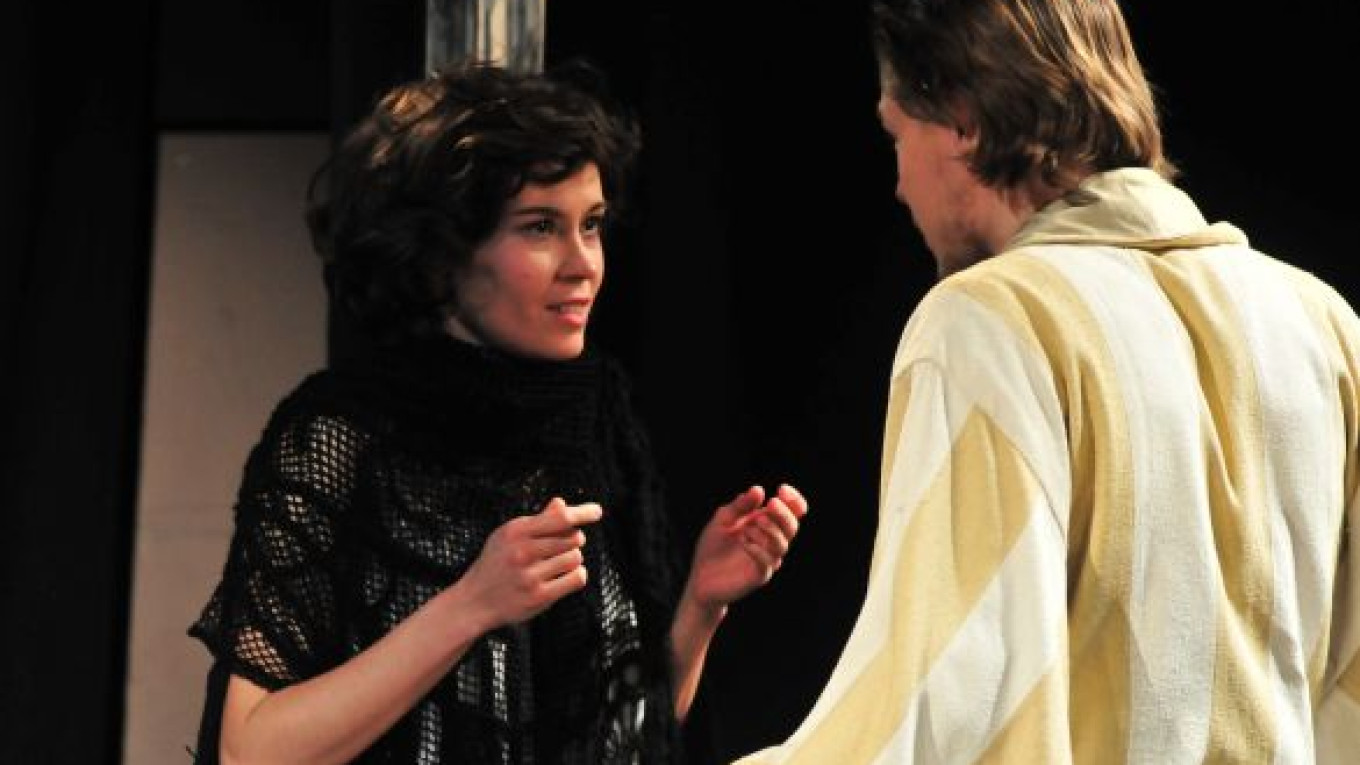
Alexei Votyakov’s set offers up a resort-town boardwalk that runs the full length of the theater space, breaking the audience into two segments. This puts every spectator up close and intimate with each of the performers. Votyakov’s costumes are beach-comfy beige, light and full of drapes and folds.
Klavdia Korshunova brings a psychological depth to her performance of Sasha. She easily runs the gamut of emotions, from carefree gaiety to bitter despair and anger.
Right away one sees Sasha chafing against her husband’s stiff propriety. It is no rebellion at first, but it is no surprise when rebellion comes. This is a resort town; people’s guards are down and their morals have been set aside to be accessed at a more convenient time and place. Sasha is intrigued by the relaxed behavior of her new friends, for it smacks of freedom, something she doesn’t know at all.
What she doesn’t realize is that the friendly matron Kovylkova (Inna Timofeyeva) is little more than a procuress who hopes to hold on to her younger lover Kolb (Nikita Yevremov) by throwing him into Sasha’s arms for awhile. Kolb’s interest in Sasha is no less crass and his concern for her is non-existent. Other men on the prowl are the painter Lenivtsev (Ilya Drevnov) and his friend, the landowner Kramer (Oleg Zima).
Kramer tries his best to support Sasha after she has fallen miserably, but the harder he tries, the bigger a mess he makes.
Polovtseva staged this story of a “fallen woman” with an even hand. Under her guidance, Kramer is anything but a predator, whereas Sasha’s husband Yegor (Sergei Girin) may be weak and limited, but he has a sincerity and warmth that defies attempts to label him despotic.
One can’t help but think, however, that this play required a thorough rethinking rather than a subtle, neutral approach.
Historically, “Pretty One” is interesting for what it reveals about early 20th-century Russian society. As drama, however, it is tired and predictable. That remains true even despite the admirable performance by Korshunova.
“The Pretty One” plays Thurs. at 7:30 p.m. on the Drugaya Stage of the Sovremennik Theater, located at 19 Chistoprudny Bulvar. Metro Chistiye Prudy. Tel. 628-7749. www.sovremennik.ru.
A Message from The Moscow Times:
Dear readers,
We are facing unprecedented challenges. Russia's Prosecutor General's Office has designated The Moscow Times as an "undesirable" organization, criminalizing our work and putting our staff at risk of prosecution. This follows our earlier unjust labeling as a "foreign agent."
These actions are direct attempts to silence independent journalism in Russia. The authorities claim our work "discredits the decisions of the Russian leadership." We see things differently: we strive to provide accurate, unbiased reporting on Russia.
We, the journalists of The Moscow Times, refuse to be silenced. But to continue our work, we need your help.
Your support, no matter how small, makes a world of difference. If you can, please support us monthly starting from just $2. It's quick to set up, and every contribution makes a significant impact.
By supporting The Moscow Times, you're defending open, independent journalism in the face of repression. Thank you for standing with us.

Remind me later.