

Few names in Russian literature are as resonant as that of Marina Tsvetayeva. The myths and realities surrounding this sensitive, tough, unique and, ultimately, tragic figure are compelling.
Daughter of the founder of Moscow’s Museum of Fine Arts. One of the most distinctive poets to emerge during Russia’s Silver Age in the second decade of the 20th century. Emigration to Prague and Paris in the 1920s with her White Russian husband. A life of poverty and isolation after returning to the Soviet Union in the late 1930s. Suicide just months after Hitler invaded the Soviet Union.
That is a telegraphed version of her life.
Her work was spectacular, almost from the very beginning and right to the very end. Tsvetayeva’s rough, chunky verse often contrasted with the more flowing poetry of Russia’s other great woman poet Anna Akhmatova, but that surely was not the best way to consider either of them.
Tsvetayeva was a universe unto herself. Her diction was marked by a high concentration of nouns that came together in brief bursts of declarative phrases. More than any other poet of her time, she was fascinated with theater and she wrote eight full plays in verse.
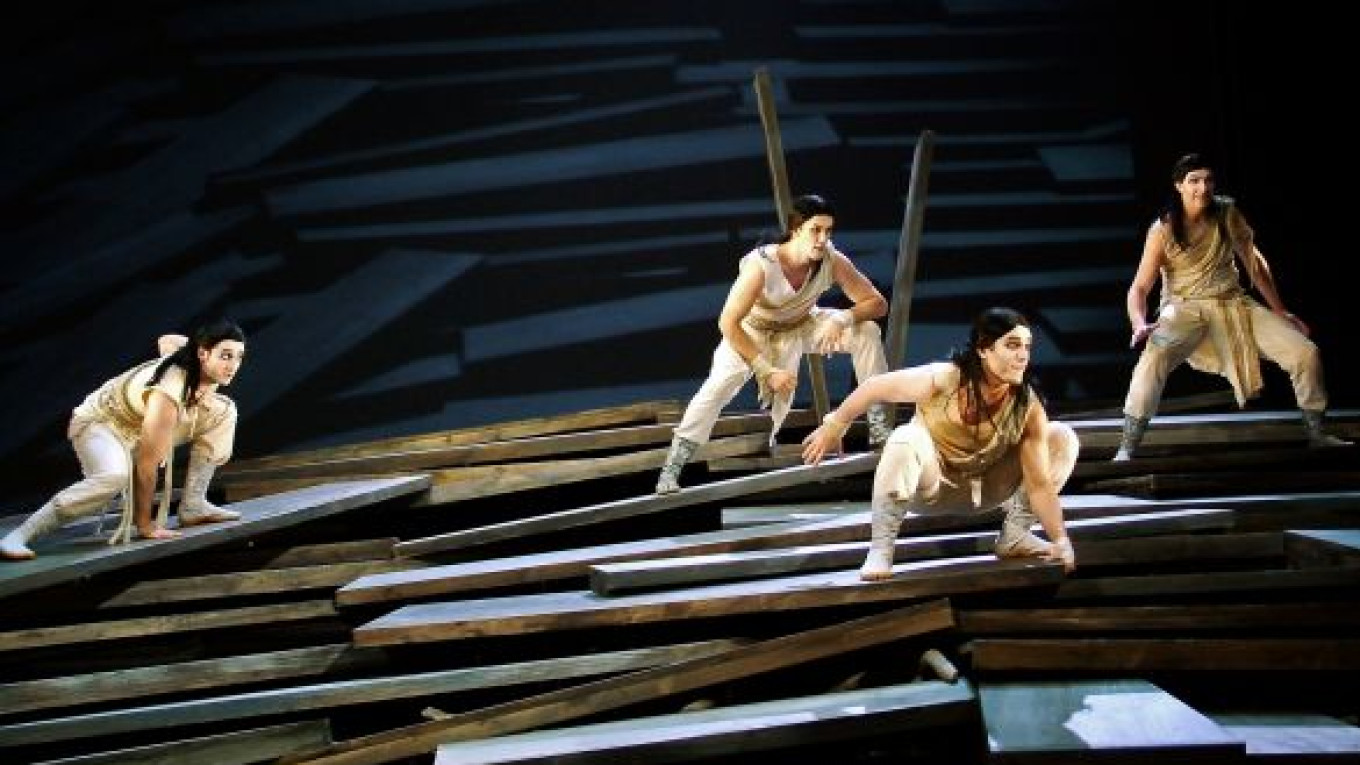
Rarely have these plays been performed at all, let alone successfully. Arguably, the most important production to date is Ivan Popovski’s student production of “The Adventure” in the early 1990s for the group that famously went on to become the Fomenko Studio. Last season Igor Yatsko staged “The Stone Angel” at the School of Dramatic Art, and now the French-German director Lukas Hemleb has mounted “Phaedra” at the Pushkin Theater.
“Phaedra” highlights the problems that anyone runs up against when trying to adapt Tsvetayeva for the stage.
The poet’s work was all about language, images and ideas. But rarely is her style suitable for theater. Throughout the performance of “Phaedra,” I found myself almost ducking to take cover from the staccato gusts and surges of the spoken text. The fascinating, jarring sound combinations, which look magnificent on the page and have such an effect when recited as poetry, actually work against a performer trying to bring the speech alive in a stage play.
As a playwright, Tsvetayeva never developed a feel for dramatic construction and movement. This is particularly true of “Phaedra,” a reworking of the Greek tragic myth about the woman who fell in love with her stepson and accused him of accosting her when he refused to accept her advances. Each scene in Tsvetayeva’s play is something of an expository piece, in which the chorus, Phaedra, her stepson Hippolyte, her nurse or her husband Theseus have their say on given topics.
Tsvetayeva, who wrote this play, her last, in 1927, clearly was fed up with the notion of conflict and intrigues among people. By this time, having lived in the cutthroat world of Russian emigres in Europe for several years, and having watched the cultural and political situation in her homeland grow increasingly worse, she seemed intent in “Phaedra” on backing away from pointing fingers and laying blame.
In Hemleb’s interpretation, Phaedra (Tatyana Stepantchenko) is a faithful wife and unhappy soul, who would never have considered approaching Hippolyte (Alexei Frandetti) without the insistent urging of her nurse (Vera Alentova). The proud rejection of the principled young man brings death and shame upon the entire household, leaving Theseus (Andrei Zavodyuk) to make what sense that he can of the tragedy.
Influenced by others, and crushed by fury and grief, Theseus first blames Hippolyte and then Phaedra. But his moment of revelation comes as he realizes that recognizing the tragedy of losing his son and wife far outweighs the need to determine who was at fault.
This is a world filled with everything imaginable, he concludes. “There is no guilty one. All are innocent.”
How this plays out on the stage of the Pushkin Theater is another thing. Most of the cast struggles not only with Tsvetayeva’s meaty text but also with the task of portraying figures drawn from Greek tragedy.
There is something valiant in Hemleb’s attempt to bring one of the great Russian poets to life on stage. But this “Phaedra” is unlikely to be the production that demonstrates that this can be done with success.
Designer Marina Filatova provided the stylized set of a mountain constructed from wooden planks and backed by a screen that “moves” the action to various locations — such as a forest or an interior — with video images created by Florian Alberge.
“Phaedra” (Fedra) plays Dec. 17 and 18 at 7 p.m. at the Pushkin Theater, located at 23 Tverskoi Bulvar. Metro Pushkinskaya. Tel. 694-1289, 694-1695, www.teatrpushkin.ru. Running time: 2 hours, 10 minutes.
A Message from The Moscow Times:
Dear readers,
We are facing unprecedented challenges. Russia's Prosecutor General's Office has designated The Moscow Times as an "undesirable" organization, criminalizing our work and putting our staff at risk of prosecution. This follows our earlier unjust labeling as a "foreign agent."
These actions are direct attempts to silence independent journalism in Russia. The authorities claim our work "discredits the decisions of the Russian leadership." We see things differently: we strive to provide accurate, unbiased reporting on Russia.
We, the journalists of The Moscow Times, refuse to be silenced. But to continue our work, we need your help.
Your support, no matter how small, makes a world of difference. If you can, please support us monthly starting from just $2. It's quick to set up, and every contribution makes a significant impact.
By supporting The Moscow Times, you're defending open, independent journalism in the face of repression. Thank you for standing with us.

Remind me later.