

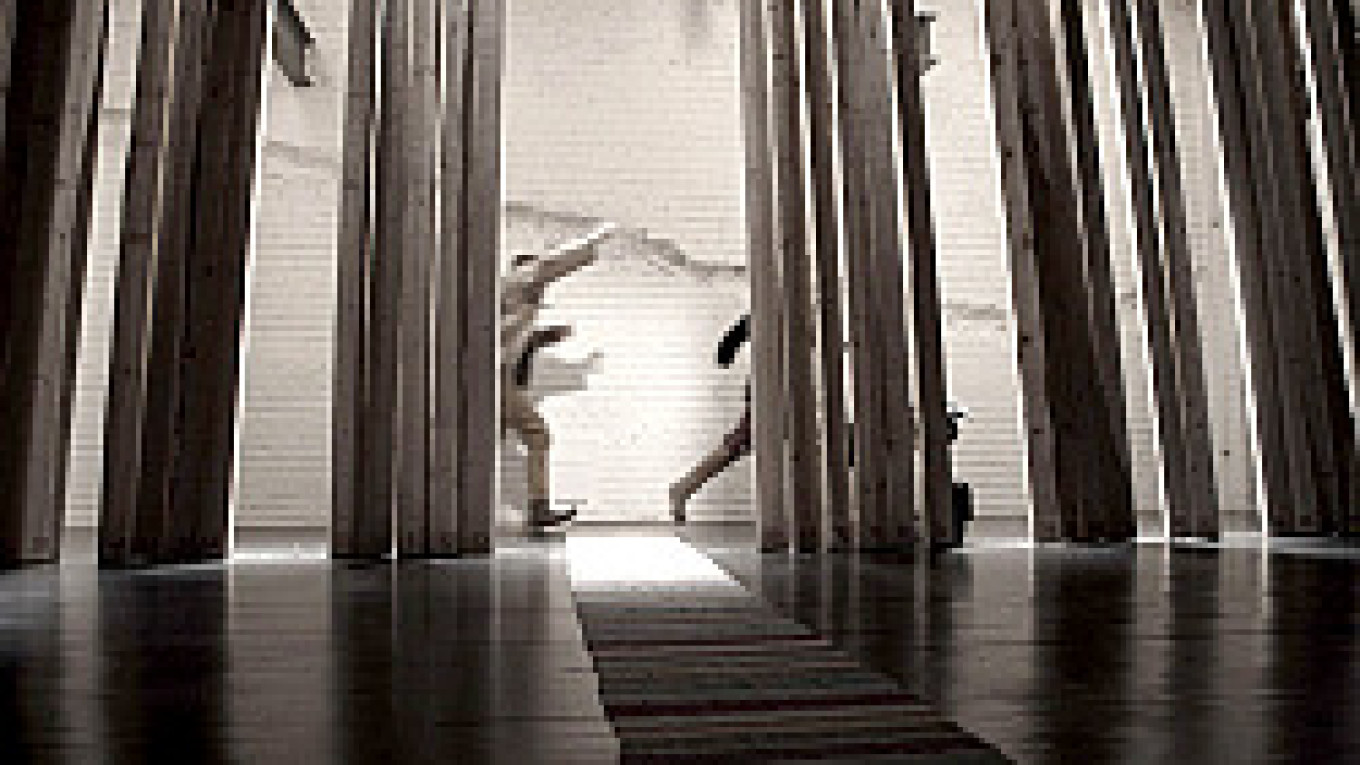
Zhenovach now has unveiled the small stage at his theater for the first time with a dramatization of Andrei Platonov's story, "The River Potudan." As with his Dickens adaptation of "The Battle of Life," which opened the venue last year, this piece seems to have been made for the space in which it plays.
Designer Alexander Borovsky kept his contribution to a bare minimum, allowing the simplicity and atmosphere of the small, brick-walled room seating 40 spectators to speak for itself. Audience members sit on wooden stools around three of the four walls. Enormous, rough-cut wooden planks lean against a high catwalk along the fourth wall.
Studio of Theatrical Art
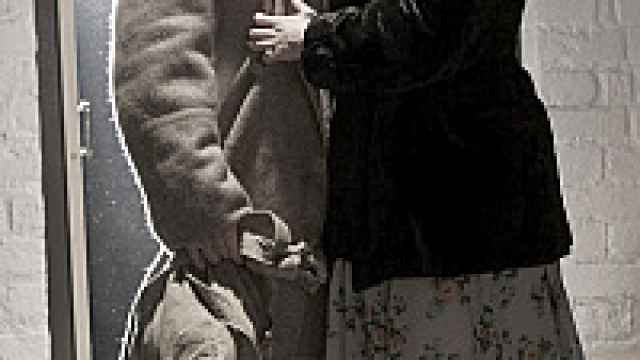
Shibarshin and Shashlova
|  |
| |
Wood and bricks and flesh and blood — it is all there is on this stage for the entire performance. That and the very subtle lighting by Damir Ismagilov that plays on a rough trough crudely gouged out of the back wall. This would appear to be a suggestion of the River Potudan, the place where the young Nikita goes for walks when he is courting his neighbor Lyuba and the place where she apparently tries to end her life when she thinks their marriage has failed.
The intimacy that Zhenovach and his cast bring to this show is almost unsettling. The most private of moments — preludes to physical love and the aftermath of love's occasional failures — are so close to us, so open to our gaze, that we wonder if we are overstepping the line of propriety. But as visceral and real as it all is, Zhenovach takes extreme care to keep everything running on a very delicate, even chaste level. This is directorial tightrope walking of the first degree. By drawing us right into the midst of these private lives while also holding us at a comfortable distance, Zhenovach creates a push and pull that makes us feel as though we are a part of the goings-on.
After the end of the Russian Civil War, Nikita (Andrei Shibarshin) comes home to his father (Sergei Kachanov), a carpenter who lost two sons to war and a wife to disease. "I live badly," he says almost apologetically, "but I am alive." Next door there lives a young woman, Lyuba (Maria Shashlova), who lost her family and exists alone on the verge of starvation. Enigmatic and headstrong, she can't help but turn Nikita's head, although his timidity and her habit of staying just out of his reach mean that romance develops very slowly.
A corner is turned when Nikita falls deathly ill with a fever. Lyuba, a medical student, can think of no other treatment than to embrace him tightly to calm and warm him. This long, silent embrace, with Lyuba climbing up on Nikita's lap and wrapping her arms and legs around his back, might as well be an act of love. Surely that is how the stunned Nikita perceives it, and there is no looking back from then on.
The sounds of silence are often staggering in this production, which uses no music at all. The clopping of shoes on the floor, the resonant sound of hands slapping wood, of water dripping in a pail, of clothes rustling, of people breathing, of Nikita sobbing silently but uncontrollably on the floor — all of these sounds and more make up the compelling "score" of the performance. Actors often whisper or mumble as if trying to keep their thoughts private.
When it comes to marriage, however, this couple finds that peace is not built on happiness alone, and even the purest love must stand tests of fire. Nikita's inability to be a proper husband to the wife he adores nearly drives both to their death.
In "The River Potudan," Platonov tells a sad, yearning tale about the fragility and tenaciousness of love. Zhenovach brought it to life with deep and caring understanding, his cast working with an extraordinary and touching sensitivity. This is one of those shows that continues to live on vividly in memory long after the applause has died.
"The River Potudan" (Reka Potudan) plays Tues., March 17, 24, 25 and 27 at 7 p.m. at the Studio of Theatrical Art, located at 21 Ulitsa Stanislavskogo, Bldg. 7. Metro Taganskaya. Tel. 662-4646. www.sti.ru. Running time: 1 hour, 40 minutes.
A Message from The Moscow Times:
Dear readers,
We are facing unprecedented challenges. Russia's Prosecutor General's Office has designated The Moscow Times as an "undesirable" organization, criminalizing our work and putting our staff at risk of prosecution. This follows our earlier unjust labeling as a "foreign agent."
These actions are direct attempts to silence independent journalism in Russia. The authorities claim our work "discredits the decisions of the Russian leadership." We see things differently: we strive to provide accurate, unbiased reporting on Russia.
We, the journalists of The Moscow Times, refuse to be silenced. But to continue our work, we need your help.
Your support, no matter how small, makes a world of difference. If you can, please support us monthly starting from just $2. It's quick to set up, and every contribution makes a significant impact.
By supporting The Moscow Times, you're defending open, independent journalism in the face of repression. Thank you for standing with us.

Remind me later.