

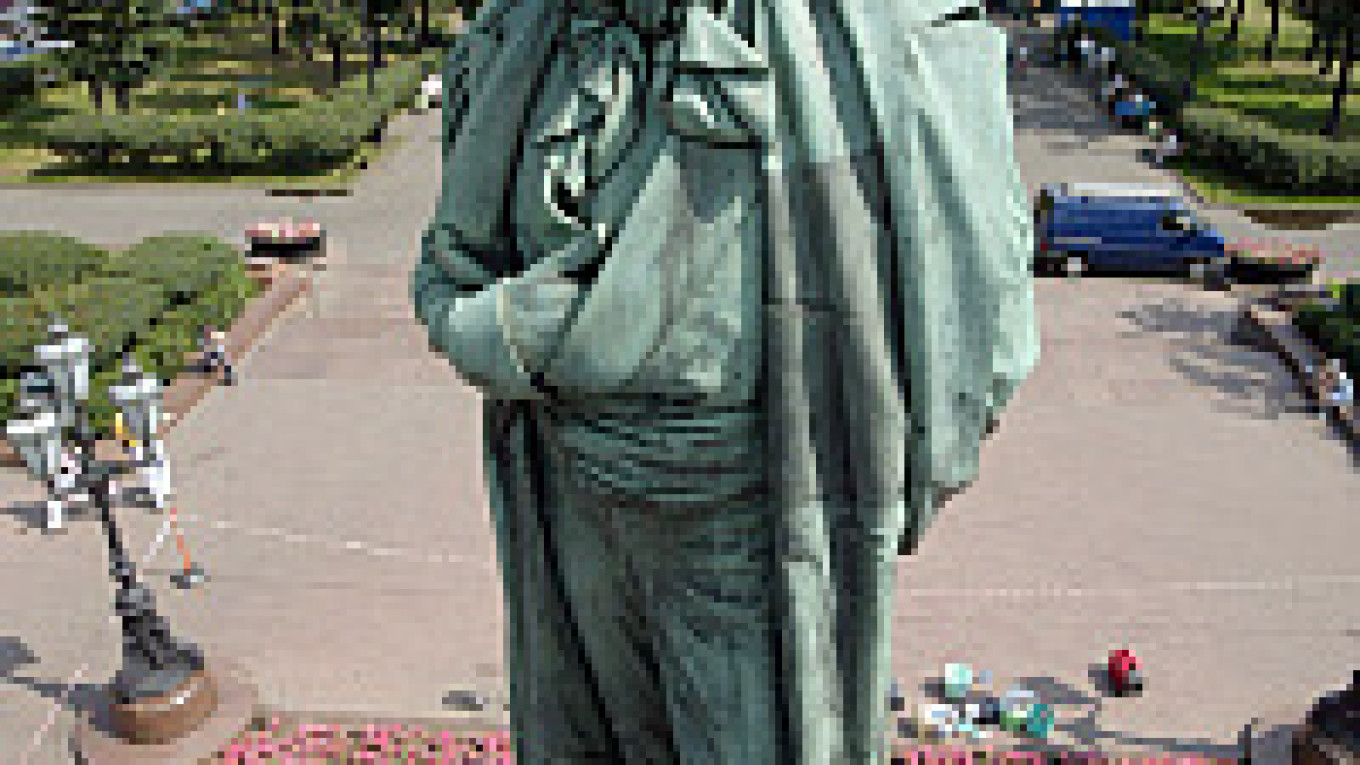
Soon, he warns, this will all disappear.
Soon, if the city has its way, the statue of the great man will vanish for a few years as a huge underground shopping mall and a tunnel linking Strastnoi Bulvar and Tverskaya Ulitsa are built under the historic square.
The new development is slated to be part of a superhighway free of traffic lights connecting the Kremlin and Sheremetyevo Airport.
"They have practically given up the best land in the city," said Shchinkorenko, a self-described financier and one of 20 core members of the protest group Pushkin Square.
Members say they have the backing of thousands of other city residents, including actor and director Nikita Mikhalkov, singer Boris Moiseyev and former NTV television newscaster Mikhail Osokin.
All of which confuses the project backers. They say the building, blasting, tunneling and resurfacing beneath Pushkin Square will not have any visible impact on the statue or its surroundings -- once home to the 17th century Strastnoi convent; protests and poetry readings in the 1960s; and many demonstrations in the post-Soviet era.
The project, they add, will also help unclog Moscow's already congested streets, and will reduce pollution in a city drowning in car fumes.
"I do not understand why people are protesting," said Alexei Vvedensky, head of the city department overseeing special construction projects. "Maybe they are used to sniffing [car fumes]." Referring to the 2000 terrorist attack near the square's metro station, which killed 13 people, Vvedensky added: "Maybe they like walking on narrow walkways where that bomb went off."
Haluk Bozoglu, vice chairman of TLC Tverskoi, the company overseeing the $200 million project, observed: "Any construction disturbs a neighborhood." But he added that they would try and take residents' worries into consideration. People must also bear in mind, however, that some of these protesters are "professional agitators."
Protesters counter that the developers and city officials are breaking federal and city laws, ignoring Muscovites' views and violating one of the city's most romantic and literary nooks, long a meeting place for friends and lovers.
"Pushkin Square has always been a place that suffers," said David Sarkisyan, the director of the Shchusev Architecture Museum, which catalogues the square's architectural evolution. "It is the solar plexus of Moscow."
Worse yet, protesters say, the new tunnel will do little to alleviate traffic. They say the city, often accused by environmentalists and preservationists of ramming through corrupt building projects, is just looking to cash in on a booming real-estate market and enrich a few well-connected insiders.
The money for much of the project comes from the Turkish company Gunal, which is paying for the tunnel connecting the two thoroughfares in exchange for the right to build the 95,000square-meter shopping center, including an underground parking lot with 900 spaces, under the square.
While much of the debate has centered around the square, attention must also be paid to the earth below, says Alexei Klimenko, an architectural expert who advises the city government. Shifting groundwater and unstable subsoil make construction possibly dangerous, Klimenko said. Also, city officials have yet to complete a geological survey of the site.
Many protesters question the economic viability of a below-ground shopping center at Pushkin Square, and there are concerns that the project will destroy what's left of the archaeological remains of Strastnoi Convent.
Above all, protesters are angry at the way the project has been forced through. "The way they decide things is ... practically criminal," Sarkisyan said, saying that an open tender should have been completed for the project.
Vvedensky, seeking to assuage concerns, said blueprints for the shopping center, which originally showed it rising three stories above ground, were being revised. "It will not touch the top of the square," he said.
The city's chief builder, Vladimir Resin, buttressed Vvedensky, saying the square would look exactly the same after the shopping center was built.
Supporters expect the project to be approved by city officials, including architectural advisers, next month.
Shchinkorenko, standing in the shadow of the poet casting his gaze over the traffic on Tverskaya, was not mollified. "We have never been involved in politics, but we are being forced to because we are being cheated," he said. "The powers that be do not consider us people. They are spitting in our face."
A Message from The Moscow Times:
Dear readers,
We are facing unprecedented challenges. Russia's Prosecutor General's Office has designated The Moscow Times as an "undesirable" organization, criminalizing our work and putting our staff at risk of prosecution. This follows our earlier unjust labeling as a "foreign agent."
These actions are direct attempts to silence independent journalism in Russia. The authorities claim our work "discredits the decisions of the Russian leadership." We see things differently: we strive to provide accurate, unbiased reporting on Russia.
We, the journalists of The Moscow Times, refuse to be silenced. But to continue our work, we need your help.
Your support, no matter how small, makes a world of difference. If you can, please support us monthly starting from just $2. It's quick to set up, and every contribution makes a significant impact.
By supporting The Moscow Times, you're defending open, independent journalism in the face of repression. Thank you for standing with us.

Remind me later.