

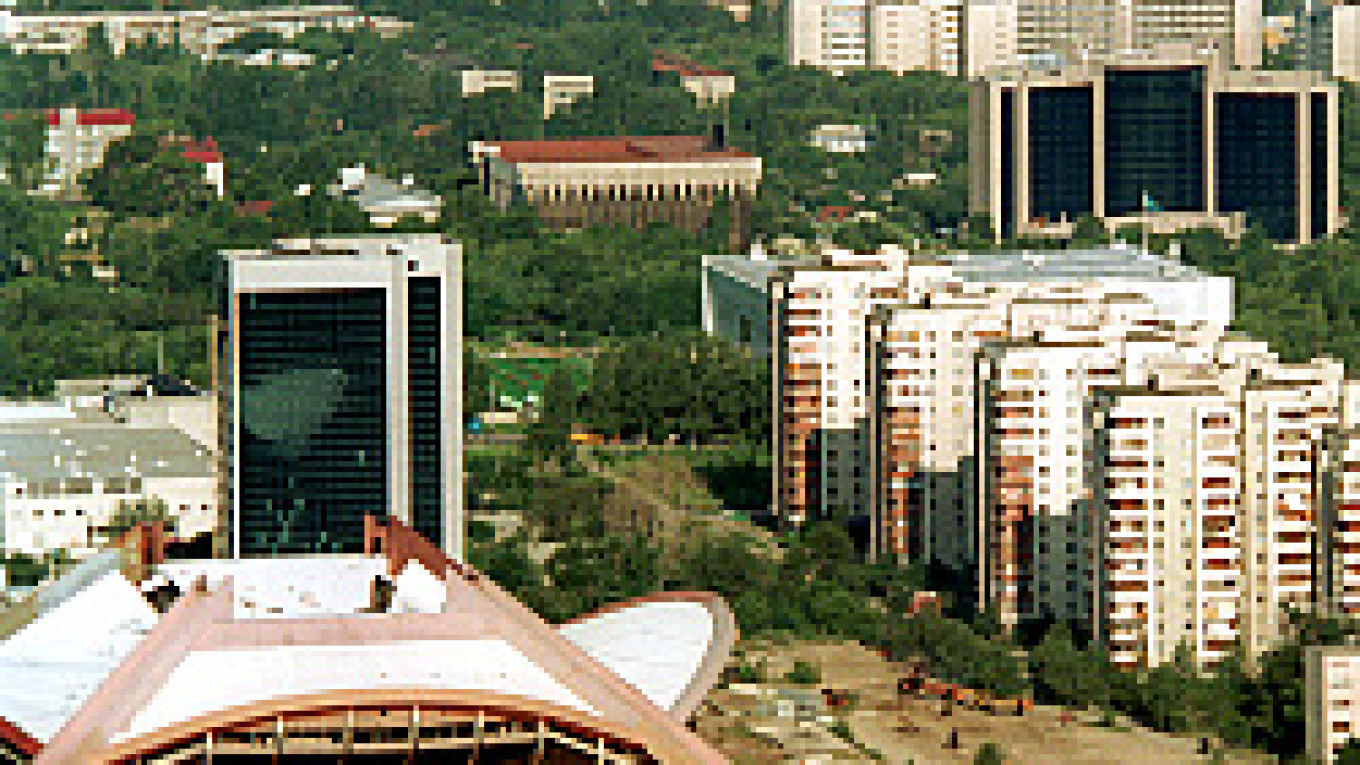
Infused with newly flowing oil money, Kazakhstan's largest city is flush with nightclubs and exotic restaurants. The city's main boulevards are lined with English-language signs; boutiques sell everything from Armani to gem-encrusted Vertu cell phones, and cafes serve the latest in overpriced coffee concoctions.
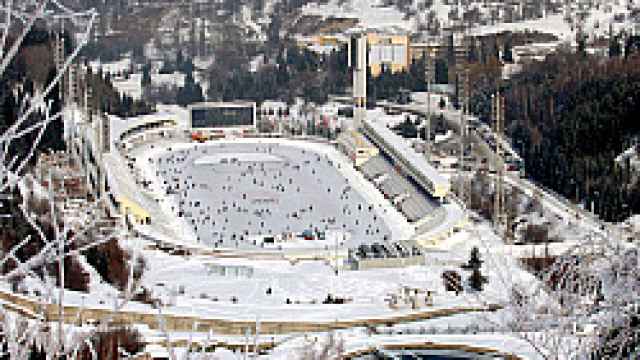 Anatoly Ustinenko / Itar-Tass Skaters on the ice rink at the high-altitude Medeo winter sports complex, which also attracts skiers with its nearby slopes. |  |
| |
In short, Almaty is no longer a hardship outpost for the diplomats and the oil industry executives who still dominate the city's visitor logs. Although the overwhelming percentage of visitors continues to be businesspeople, some have begun extending their stays to spend a weekend skiing above the Medeo winter sports complex, to visit nearby nature preserves (among them, the Charyn Canyon, which in breadth and sheer drama compares favorably to the Grand Canyon), or just to explore the city of nearly 2 million people. "Almaty feels raw, sketchy, and that can be fascinating," said Brooke Arnao, the online video director for Money-Media, a New York publishing company, who stayed for a weekend after a conference.
But although the forested streets and urban parks create pleasant, verdant scenes in summer, the city has little of the Silk Road charm of neighboring cities like Samarkand and Bukhara in Uzbekistan. Much of Almaty's architecture dates from the 1960s and '70s, not a celebrated time in Soviet design. Still, there are several worthwhile city pilgrimages.
Gennady Popov / Itar-Tass A restaurant on the mountain highway to Medeo. | |
| |
But Almaty's emergence as a tourist destination is just beginning. There are few "official" taxis. Some museums are dilapidated. Many local tour operators, like David Berghof of Stantours, focus on the city as the best gateway to a Silk Road tour. "Almaty has become a convenient starting point," he said, "with a well-functioning infrastructure."
For those who do stick around, encounters with the city's polyglot population will bring them in contact with the legacy of the Soviet gulag -- many of Almaty's residents are the descendants of the sprawling prison system, a good part of which was built in Kazakhstan. Striving immigrants from other Central Asian countries work in cafes and stores, and the city's restaurants reflect its diverse population. Fragrant Uighur cuisine is informed in equal parts by Uighur's roots in western China and its ethnic connections to Turkey. Numerous restaurants offer excellent interpretations of ethnic Russian and Ukrainian cuisines, and a lamb and noodle dish called beshbarmak is a good introduction to the country's more regional nomadic kitchen.
Meanwhile, the bulk of Kazakhstan's oil reserves have yet to be tapped. What will this incipiently wealthy country look like in 10 years' time -- the Dubai of Central Asia, perhaps?
A Message from The Moscow Times:
Dear readers,
We are facing unprecedented challenges. Russia's Prosecutor General's Office has designated The Moscow Times as an "undesirable" organization, criminalizing our work and putting our staff at risk of prosecution. This follows our earlier unjust labeling as a "foreign agent."
These actions are direct attempts to silence independent journalism in Russia. The authorities claim our work "discredits the decisions of the Russian leadership." We see things differently: we strive to provide accurate, unbiased reporting on Russia.
We, the journalists of The Moscow Times, refuse to be silenced. But to continue our work, we need your help.
Your support, no matter how small, makes a world of difference. If you can, please support us monthly starting from just $2. It's quick to set up, and every contribution makes a significant impact.
By supporting The Moscow Times, you're defending open, independent journalism in the face of repression. Thank you for standing with us.

Remind me later.