

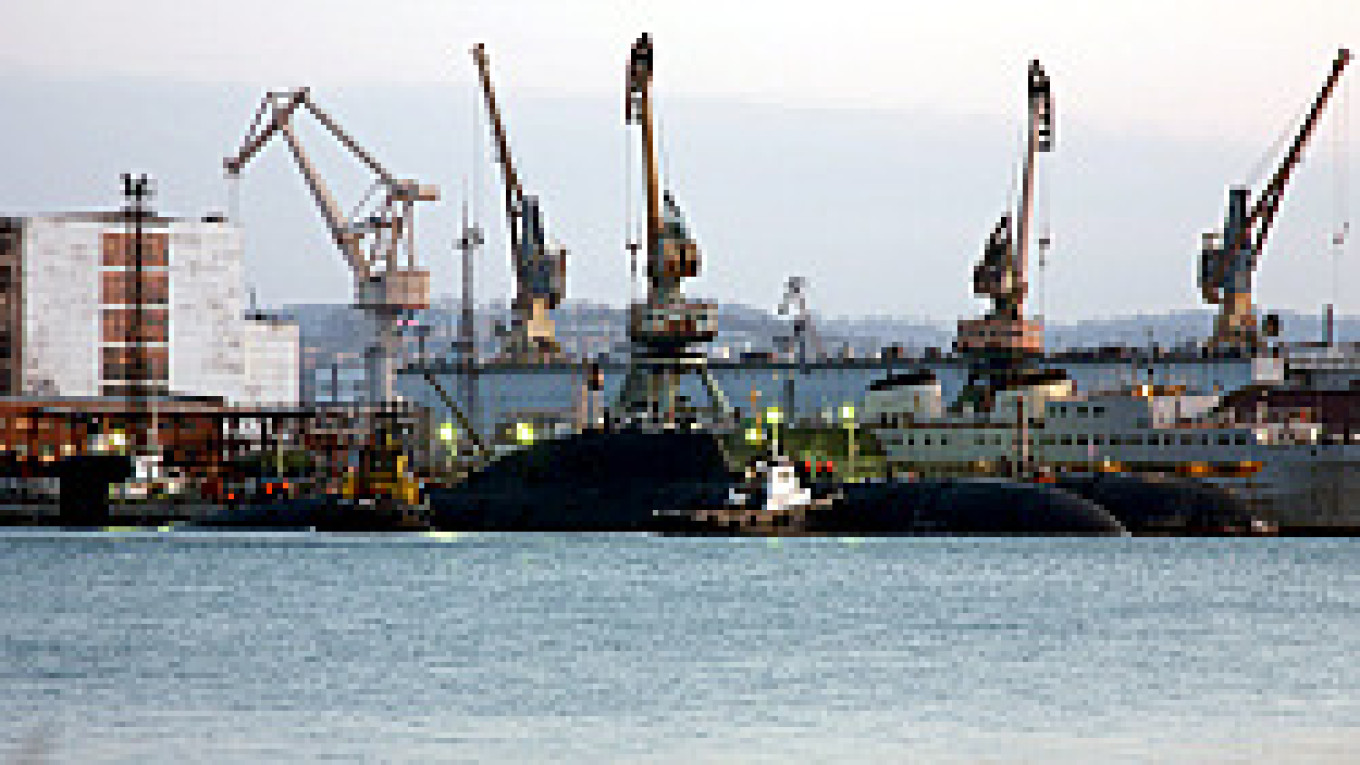
The news came amid reports in the Indian media that the vessel in question had been undergoing tests prior to being leased to the Indian navy.
Three naval personnel and 17 civilian specialists died after inhaling chemical gases released when the firefighting system was erroneously activated as the submarine sailed through the Sea of Japan, off Russia's east coast, Navy spokesman Igor Dygalo said Sunday.
He said the nuclear reactor that powered the submarine was working normally and that the radiation level on board was within allowable limits.
It was unclear Sunday what had triggered the system. Dygalo said a commission of experts and investigators from the General Prosecutor's Office would examine the submarine before reporting on the cause of the accident.
Twenty-one people were hospitalized after inhaling the chemicals, Dygalo said, adding that they were all out of danger.
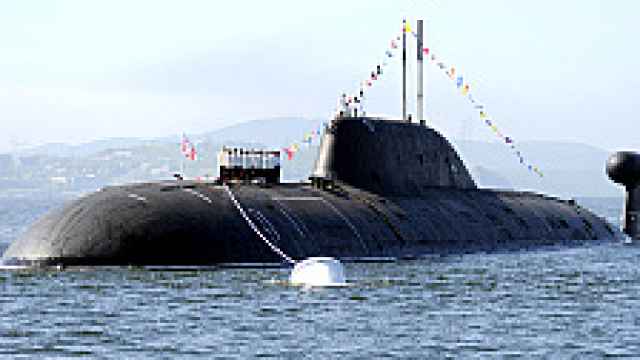 Yuri Maltsev / Reuters What is believed to be an Akula-class sub seen at July training in Vladivostok. |  |
| |
The submarine returned to its temporary Bolshoy Kamen port in the Primorye region, on Sunday morning, about 10 hours after the accident.
Dygalo said 208 people were aboard, including 81 sailors, when the accident occurred. He did not provide a name or any other details for the submarine, saying the vessel had yet to be commissioned.
Vladimir Markin, spokesman for the Investigative Committee under the Office of the General Prosecutor, said Sunday that medical examinations indicated that the victims had inhaled Freon, a gas most commonly known for its use in refrigerators and air conditioners.
He said employees at the shipyard that assembled the submarine were among those killed, Interfax reported. Markin did not name the shipyard.
Pacific Fleet military prosecutors opened an investigation Sunday into possible violations of naval regulations that could have led to the deaths.
|
The accident was the Navy's deadliest since an explosion in 2000 sank another nuclear submarine, the Kursk, in the Barents Sea, killing all 118 crewmen on board.
"Such deadly accidents, but of a smaller size, that occur from time to time on nuclear-powered vessels have already become a norm for the Russian Navy," said Konstantin Makiyenko, a defense industry analyst with the Center for Analysis of Strategies and Technologies, a think tank.
Both Makiyenko and Alexander Khramchikhin, an expert at the Institute of Political and Military Analysis, both said neglect in following safety regulations was the likely cause for the accident.
"I believe the civilians from the plant were likely to blame," Khramchikhin said. "They were in charge of the submarine at that moment."
In late October, Russian media, including state-controlled RIA-Novosti, reported that a new submarine, the Nerpa, a Project 971 Shchuka-B attack submarine (NATO classification Akula-class) built at the Amur Shipbuilding plant, had begun its sea tests. A source at the plant confirmed the report Sunday, RIA-Novosti reported.
The source said plant engineers and builders were on board when the accident occurred. Construction of the Nerpa began in 1991, but was stalled through the 1990s for lack of financing.
The Indian media has long reported, and continued to report Sunday, that construction of the Nerpa was resumed with Indian funding after Russia agreed to lease the submarine to the Indian navy for $650 million on its completion, citing top Indian military officials. The submarine was to be named Chakra-2 and join the Indian navy in the second half of 2009, the reports said.
Serdyukov said in late September that Russia does not export nuclear submarines.
India, Russia's biggest arms customer over the last two decades and a traditional ally in Asia dating to Soviet times, leased a nuclear submarine from Moscow from 1988 to 1991.
Khramchikhin maintained that the submarine that suffered the accident was, indeed, the vessel earmarked for the Indian navy.
"There is no other," he said.
One defense analyst, speaking on condition of anonymity because of the sensitivity of the issue, said it was unlikely the accident would scare India away from the deal, as none of the submarine's most critical systems -- weapons and propulsion -- were revealed as faulty.
A Message from The Moscow Times:
Dear readers,
We are facing unprecedented challenges. Russia's Prosecutor General's Office has designated The Moscow Times as an "undesirable" organization, criminalizing our work and putting our staff at risk of prosecution. This follows our earlier unjust labeling as a "foreign agent."
These actions are direct attempts to silence independent journalism in Russia. The authorities claim our work "discredits the decisions of the Russian leadership." We see things differently: we strive to provide accurate, unbiased reporting on Russia.
We, the journalists of The Moscow Times, refuse to be silenced. But to continue our work, we need your help.
Your support, no matter how small, makes a world of difference. If you can, please support us monthly starting from just $2. It's quick to set up, and every contribution makes a significant impact.
By supporting The Moscow Times, you're defending open, independent journalism in the face of repression. Thank you for standing with us.

Remind me later.