

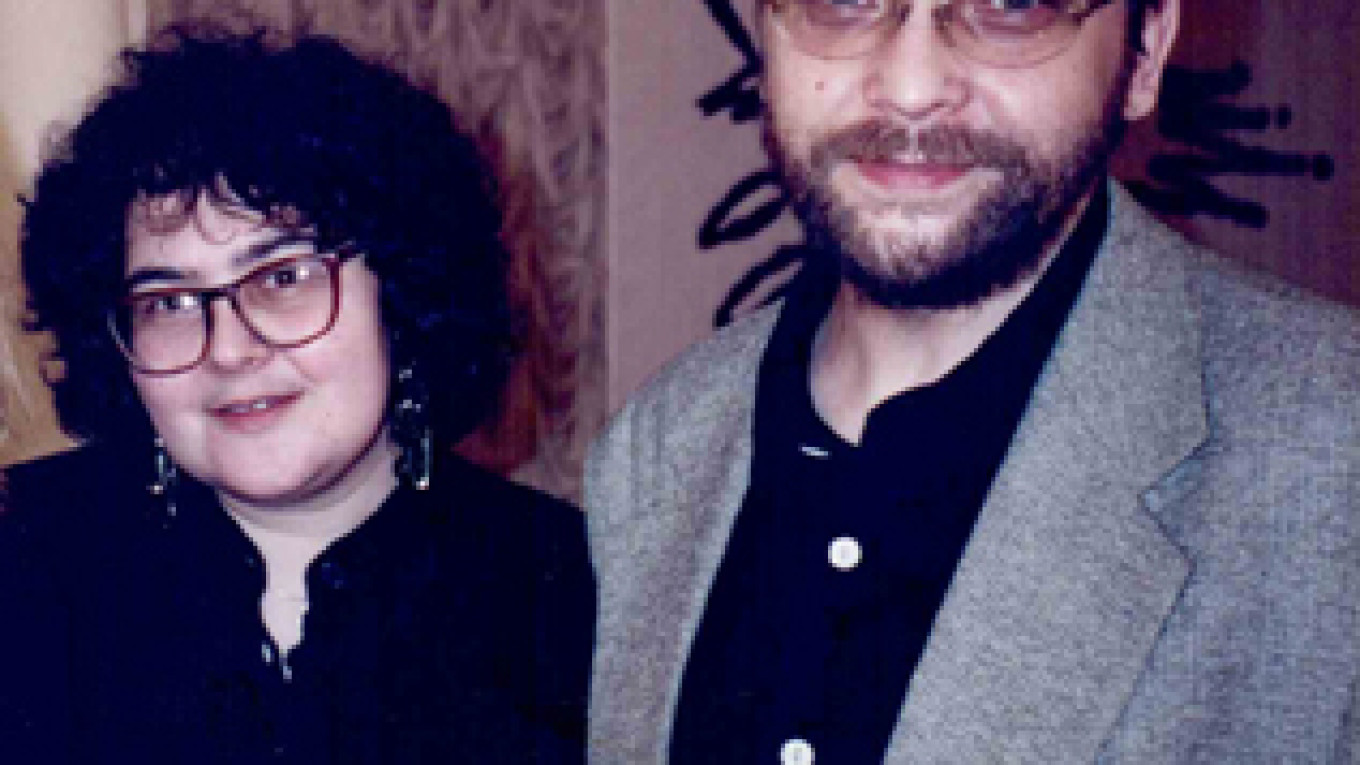
I first heard the news on Sunday from playwright Vyacheslav Durnenkov, who clearly was saddened by the news.
"It's hard to believe New Drama is finished," he told me. "It has meant so much."
The first public announcement seems to have come from Ugarov late Saturday night in a terse note on his LiveJournal blog. He wrote that he and his wife Gremina had dinner with Boyakov and that they "closed the New Drama Festival forever."
"It's not because of the crisis," Ugarov added. "It's because we couldn't reach an agreement."
On Sunday, Gremina added a LiveJournal entry in which she clarifies the situation, insisting that the independently-run Lyubimovka playwriting festival will continue and that there will still be new play festivals.
Interestingly enough, I lately have heard many in the theater community suggesting that the whole movement of contemporary drama in Russia has run aground. The hopes many had that new plays would overtake the established playhouses and remake Russian theater have never materialized. Right or wrong, this has caused many to talk about the end of "new drama" as a broad movement.
Perhaps the end of the New Drama Festival is a kind of historical necessity.
Durnenkov, whose dramas have been staged at the Moscow Art Theater, the Yermolova Theater and other houses in Moscow, spoke frankly about the narrowing of possibilities that writers feel these days.
"I feel like no other theaters exist aside from Teatr.doc and the Playwright and Director Center," he said, speaking for himself and many of his colleagues who have been constant participants in the new drama movement. "We never really did make a go of it in other theaters. People really don't know what to do with the plays by the 'punk-rockers' coming out of Teatr.doc."
The number of major writers launched or aided by the New Drama Festival and its partners like Teatr.doc, the Playwright and Director Center, Praktika and others, is staggering. Durnenkov, his brother Mikhail Durnenkov, Maksym Kurochkin, Yury Klavdiyev, the Presnyakov brothers and Ivan Vyrypayev are just a few of the major names that have come onto the scene as a result of New Drama.
But the festival, after experiencing exponential growth in its first three years, never got it together after the divorce from the Golden Mask. It became little more than a brand name whose chief purpose was to promote the brand name itself, not the product it represented.
Despite some of the doomsday talk we are hearing and will continue to hear in the near future, the end of the New Drama Festival in no way signals the death of new writing for Russian theater. My inbox is filled to overflowing with new plays by interesting writers, famous and unknown. But it must be said: The death of New Drama unquestionably marks the end of an era.
A Message from The Moscow Times:
Dear readers,
We are facing unprecedented challenges. Russia's Prosecutor General's Office has designated The Moscow Times as an "undesirable" organization, criminalizing our work and putting our staff at risk of prosecution. This follows our earlier unjust labeling as a "foreign agent."
These actions are direct attempts to silence independent journalism in Russia. The authorities claim our work "discredits the decisions of the Russian leadership." We see things differently: we strive to provide accurate, unbiased reporting on Russia.
We, the journalists of The Moscow Times, refuse to be silenced. But to continue our work, we need your help.
Your support, no matter how small, makes a world of difference. If you can, please support us monthly starting from just $2. It's quick to set up, and every contribution makes a significant impact.
By supporting The Moscow Times, you're defending open, independent journalism in the face of repression. Thank you for standing with us.

Remind me later.