

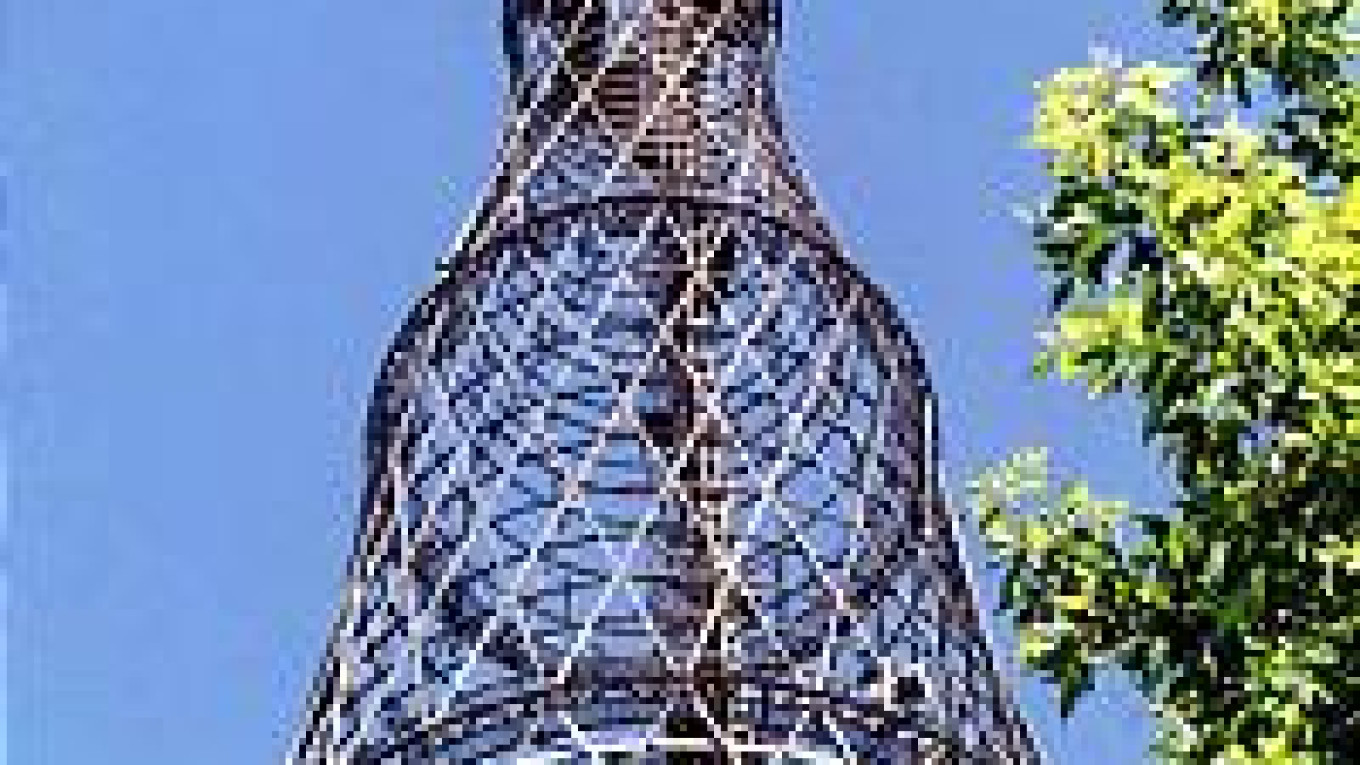
Now, of course, the 152-meter radio tower is all but forgotten, overshadowed on the city skyline by Stalin's seven sister skyscrapers and the 514-meter Ostankino television tower. But in 1922 it was not only the first major construction project commissioned by the fledgling communist government, but also the tallest structure in the city.
This feat of technical know-how was designed by one of the most talented Russian engineers of his day, Vladimir Shukhov, who first earned a name for himself in the late 19th century when he designed the stained-glass roof for Red Square's GUM department store. This grand construction had no analogies the world over, earning Shukhov well-deserved recognition. But his real fame followed a few years later when his designs were shown at the All-Russian Industrial Expo in Nizhny Novgorod in 1896, where Shukhov first displayed the prototype for his radio tower.
His futuristic designs were an immediate success, especially the 32-meter steel tower. Composed of straight steel rods, this hyperbolic tower was two times lighter than any of its contemporaries and thus twice as economic to build. It took nearly three decades before its prototype was built on Ulitsa Shabolovka, but before the Bolshevik Revolution similar smaller Shukhov towers were built throughout the country, most of them serving as water towers or lighthouses. His engineering team was also responsible for the construction of some 400 bridges throughout the Russian Empire.
When the communists took over, the firm where Shukhov had been working was nationalized and he was named its director. Quick to recognize the power of the mass media, the Soviet government commissioned Shukhov to build a radio tower to replace one that had been destroyed by fire in 1919. The engineer originally designed a 350-meter high tower ?€” 40 meters taller than the Eiffel Tower, yet three and a half times lighter. Unfortunately, due to the limited financial resources of the fledgling Soviet government, a smaller, 152-meter version was built instead.
The tower was not only revolutionary in its design, but in its construction technology as well. Shukhov introduced a means of raising the tower without building freestanding scaffolding upon which the workers could stand. Instead, each section of the tower was assembled on the ground and then lifted by a pulley system to be set over the lower level. This system not only saved time, but it was presumably safer. Nevertheless, three construction workers lost their lives when one of the layers fell while it was being lifted.
It was no accident that the first construction project commissioned by the Soviet government was a radio tower. In order to spread the propaganda of the world's first workers' state, the tower was equipped with broadcasting equipment that was more powerful than the transmitters in Paris, Berlin and New York combined. From this tower the Communist International began broadcasts in various languages that could be received within a radius of more than 1000 kilometers.
The tower was not only a great political success, but a popular one as well. Muscovites came to marvel at the structure that was twice as high as the imposing Christ the Savior Cathedral, and artists glorified the awe-inspiring new structure. Its image graced the cover of books and collages by artists Alexander Rodchenko, Vladimir Mayakovsky and Boris Ignatovich. It was even the subject of a famous film, "A Man with a Camera," by Dziga Vertov, one of the founders of documentary film in Russia.
In spite of his advancing years, Shukhov, born in 1853, continued to contribute to the Soviet building industry until his death in 1939. He aided Konstantin Melnikov in designing the roof for the constructivist architect's Bakhmetevsky garage, built in 1925. He also constructed two twins of the Moscow radio tower on the Oka River to hold high-voltage cables. Shukhov is also credited with saving Samarkand's famous 16th-century Ulugbeck minaret from toppling.
In recognition of his contribution, the engineer was given the highest praise of the time: the Order of Lenin and a membership in the Academy of Sciences with the honorary title of Hero of Socialist Labor. Yet the fame of his tower was short-lived. By the mid-1930s the tower had lost most of its charm among the party bosses who were preoccupied with a more ambitious ?€” and ill-fated ?€” construction project: the projected 415-meter Palace of Soviets. This Soviet skyscraper, which was to be constructed on the site of the destroyed Christ the Savior Cathedral, would have turned the 152-meter radio tower into a simple hairpin by comparison.
The Palace of Soviets was never built, but Shukhov's tower never regained its significance. It was not until 1963 that the Kremlin decided to pay tribute to its architect. They renamed the street on which the tower stood to Ulitsa Shukhova to commemorate the 110th anniversary of Shukhov's birth.
By that time the tower was already a busy television center from which the first visual broadcasts of the Soviet Union were transmitted in 1954. However, this role was once again diminished after the Ostankino television tower was completed in 1967.
The radio tower is located at the intersection of Ulitsa Shukhova and Ulitsa Shabolovskaya.
Sergei Nikitin is the editor in chief of Stolypino homeward Internet, a web site focusing on Russian culture (www.stolypino.narod.ru). He welcomes comments and questions about Moscow architecture at [email protected]
A Message from The Moscow Times:
Dear readers,
We are facing unprecedented challenges. Russia's Prosecutor General's Office has designated The Moscow Times as an "undesirable" organization, criminalizing our work and putting our staff at risk of prosecution. This follows our earlier unjust labeling as a "foreign agent."
These actions are direct attempts to silence independent journalism in Russia. The authorities claim our work "discredits the decisions of the Russian leadership." We see things differently: we strive to provide accurate, unbiased reporting on Russia.
We, the journalists of The Moscow Times, refuse to be silenced. But to continue our work, we need your help.
Your support, no matter how small, makes a world of difference. If you can, please support us monthly starting from just $2. It's quick to set up, and every contribution makes a significant impact.
By supporting The Moscow Times, you're defending open, independent journalism in the face of repression. Thank you for standing with us.

Remind me later.