

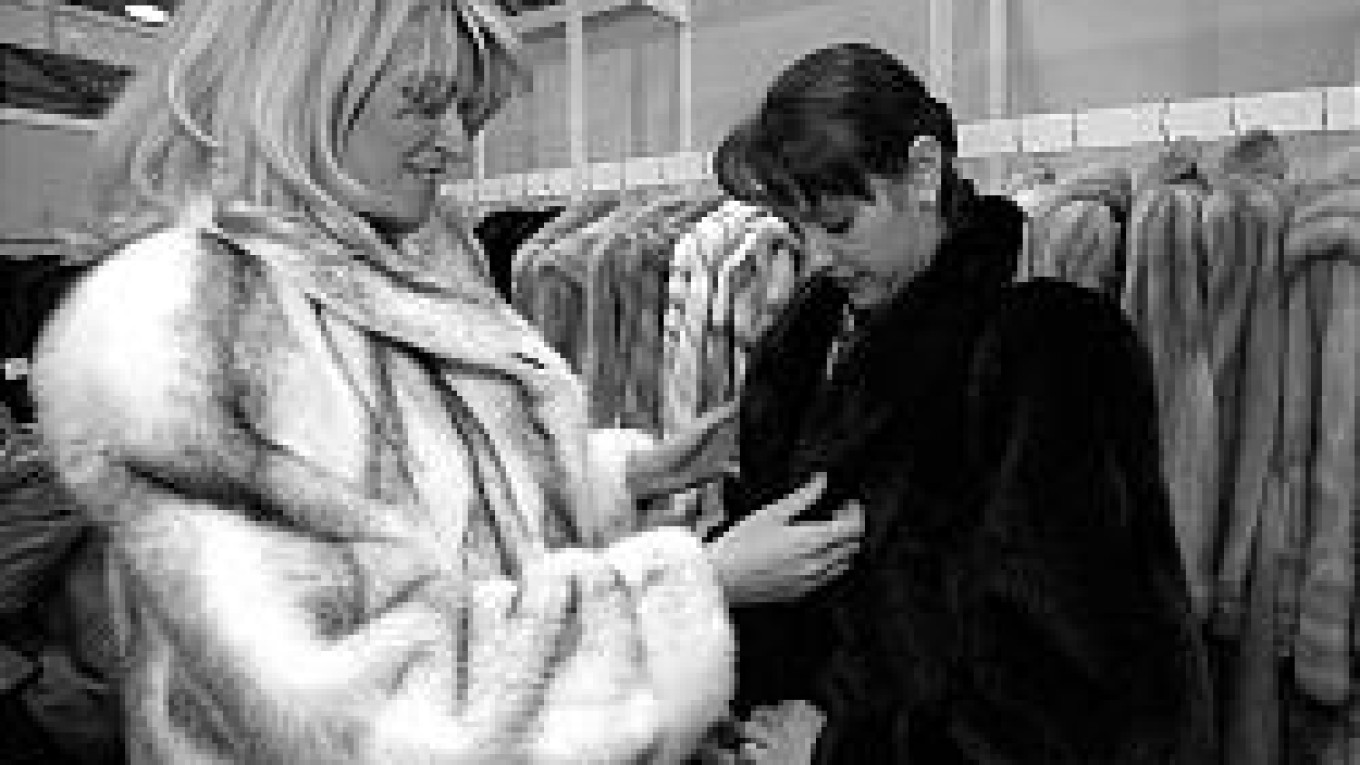
But a closer look at the label of an average Moscow mink reveals a different story. These days, it is more likely to say "Made in Canada" or "Product of Sweden."
Fashion-conscious Russians are shunning local products in favor of superior -- and now cheaper -- foreign designs. More than 70 percent of fur on the domestic market is imported, according to official figures.
And as foreign producers seek new business to compensate for anti-fur campaigns in the West, workers in one of the nation's oldest industries complain they are being squeezed out of a domestic market worth an estimated $2.5 billion annually.
"Today there are fewer and fewer strong farms," said Alexander Kovalenko, technical director of the giant Saltikovsky fur farm just outside Moscow.
"We have to fight to lower production costs if we are to compete with Western producers," he said as he strode past row after row of long, low huts housing cages filled with mink, sables and foxes.
Founded in 1931, Saltikovsky was once the pride of the Soviet fur industry.
It was one of the first specialized collective farms and pioneered new breeding technology in a sprawling complex of wood and brick huts behind a high wall topped with razor wire.
Today, Saltikovsky produces about 108,000 pelts annually. But overheads have soared because it has to import specialist feed for the animals. And its main product, mink, is barely profitable.
To compensate, the farm has experimented in new areas, such as breeding lynxes for zoos and circuses.
Its latest venture is a herd of 100 ostriches.
"There are a few problems," said Kovalenko over a lunch of ostrich liver at the farm's head office.
"Russian restaurants haven't got used to the idea of serving ostrich yet. Maybe it's a bit too exotic. But we had to try something."
Until the mid-1990s, Russia was one of the world's top producers and exporters of fur -- mainly mink, sable and fox -- which generated millions of dollars in hard currency every year.
Some 200 farms used to produce up to 10 million pelts annually, according to the Russian Fur Union.
International traders thronged to annual auctions in St. Petersburg -- one of the world's seven major fur auction centers along with Helsinki, Copenhagen, Oslo, Seattle, New York and Toronto.
Today, there are just 40 or so Russian producers left.
The state no longer offers easy credit or subsidized feed made of leftovers from the poultry and fishing industries.
Many farms cannot afford the imported fodder and medicine to produce top quality pelts. Breeding stock has shrunk. Profits have been stashed overseas rather than reinvested.
And a new middle class of Russians is now free to shop abroad or choose from a range of imported products at home.
Last year, Russia produced some 2.5 million pelts -- a quarter of what it did 10 years ago -- and exported just 250,000, mainly sable and squirrel.
At the same time, the country is importing up to 7 million pelts each year, mainly mink.
Shoppers like Tatyana Markova are delighted.
"The choice is so much better these days," said the 26-year-old fashion designer as she browsed around an upmarket fur shop in central Moscow. "Imported mink is generally higher quality, and with the latest styles."
"Of course I would like to help those Russian farmers, but I only buy a fur coat once every few years -- and am I going to waste my money on something I don't like?"
There is a glimmer of hope for farms like Saltikovsky.
Last winter season, fur made a comeback on the catwalks of London, Paris and Milan in a backlash to the animal rights campaigns of the 1980s and 1990s.
Celebrity fur fans like Jennifer Lopez and Sean "P Diddy" Combs are making it hip again in the West, while new markets are emerging in the East, especially China.
Annual global sales of fur garments rose 10.8 percent to almost $11 billion in 2001-02, according to the latest figures from the International Fur Trade Federation.
And while Russian mink is out of favor, its sable is still considered the finest in the world.
After several years in the doldrums, the St. Petersburg auctions are starting to pick up again.
The one in February this year attracted 100 buyers from across the globe and sold $10 million worth of pelts -- 25 percent more than last year.
Saltikovsky is trying to adapt by boosting output of sable and cutting down on mink and loss-making fox.
But even with market conditions perking up, Russian farms need more credit, technical upgrades and government support to give foreign producers a run for their money.
"Who knows? Maybe after 10 or 20 years we will have to close," said Kovalenko, who has worked on the farm for 20 years.
"But that is the new way, isn't it? You have to be flexible, or you will die."
A Message from The Moscow Times:
Dear readers,
We are facing unprecedented challenges. Russia's Prosecutor General's Office has designated The Moscow Times as an "undesirable" organization, criminalizing our work and putting our staff at risk of prosecution. This follows our earlier unjust labeling as a "foreign agent."
These actions are direct attempts to silence independent journalism in Russia. The authorities claim our work "discredits the decisions of the Russian leadership." We see things differently: we strive to provide accurate, unbiased reporting on Russia.
We, the journalists of The Moscow Times, refuse to be silenced. But to continue our work, we need your help.
Your support, no matter how small, makes a world of difference. If you can, please support us monthly starting from just $2. It's quick to set up, and every contribution makes a significant impact.
By supporting The Moscow Times, you're defending open, independent journalism in the face of repression. Thank you for standing with us.

Remind me later.