

Since then, Zhenovach has staged works by Nikolai Leskov, Ivan Goncharov, Nikolai Gogol, Andrei Platonov and a handful of non-Russian writers —Charles Dickens and Sholom Aleichem. Most of these shows have been adaptations of prose, and that is true of the theater’s latest production — “Three Years,” a novella by Anton Chekhov.
Zhenovach’s style is deceptive. He has a light, even gentle, touch. He has chosen actors blessed with charm and charisma and has trained them to work in a quiet, homespun manner. They interact with one another and address the audience as individuals who are deserving of, and capable of inspiring, trust and affection. A Zhenovach show is always one in which the audience is drawn into a warm and personal relationship.
Aye, but there’s the rub. The vast majority of Zhenovach’s productions tell tales of loneliness, isolation, frustration and despair. The tender embrace he offers a spectator is genuine, but the blow he delivers to the solar plexus is no less so.
Chekhov, in this light, is a good fit. His plays and, especially, his prose works never pull punches. The influential philosopher Lev Shestov once wrote, “Chekhov was doing one thing alone: by one means or another, he was killing human hopes.”
That may seem an excessively harsh observation — at least until you become acquainted with “Three Years.” You almost have to wonder if Shestov had this specific piece in mind when he was defining the nature of Chekhov’s literature.
“Three Years” tells the story of Muscovite Alexei Laptev (Alexei Vertkov), a man approaching his mid-30s who has never quite known love or life. He is wealthy, thanks to his father (Sergei Kachanov). He has had a couple of flings with women, one with a certain Polina (Maria Shashlova) being the longest-running. He has a brother (Sergei Abroskin) and a sister (Anastasia Imamova) that he adores, and he even has a friend or two. But life is passing him by like an express train, and there is nothing he can do to get on it.
Hope for salvation appears in Laptev’s life thanks to Yulia (Olga Kalashnikova), a young woman he meets in the provinces. She is delicate and wholesome and epitomizes everything Laptev believes that he wants and needs. When he blurts out a marriage proposal to her one day on the street, she is so horrified she laughs. But the more she thinks about moving to Moscow, the more she concludes that she was wrong to be so rude.
Thus begins a three-year period, during which Laptev is buffeted by the death of loved ones, betrayal, disillusionment and apathy. Nothing is what he expected it to be, and no matter what steps he takes nothing changes.
Chekhov, of course, was an equal opportunity writer. And, not surprisingly, he paints a detailed and equally unsentimental portrait of Yulia and the demons she confronts. Kalashnikova is superb as the bright-eyed, rather uncomprehending young woman who slowly gains experience and knowledge and may even begin to acquire something akin to wisdom.
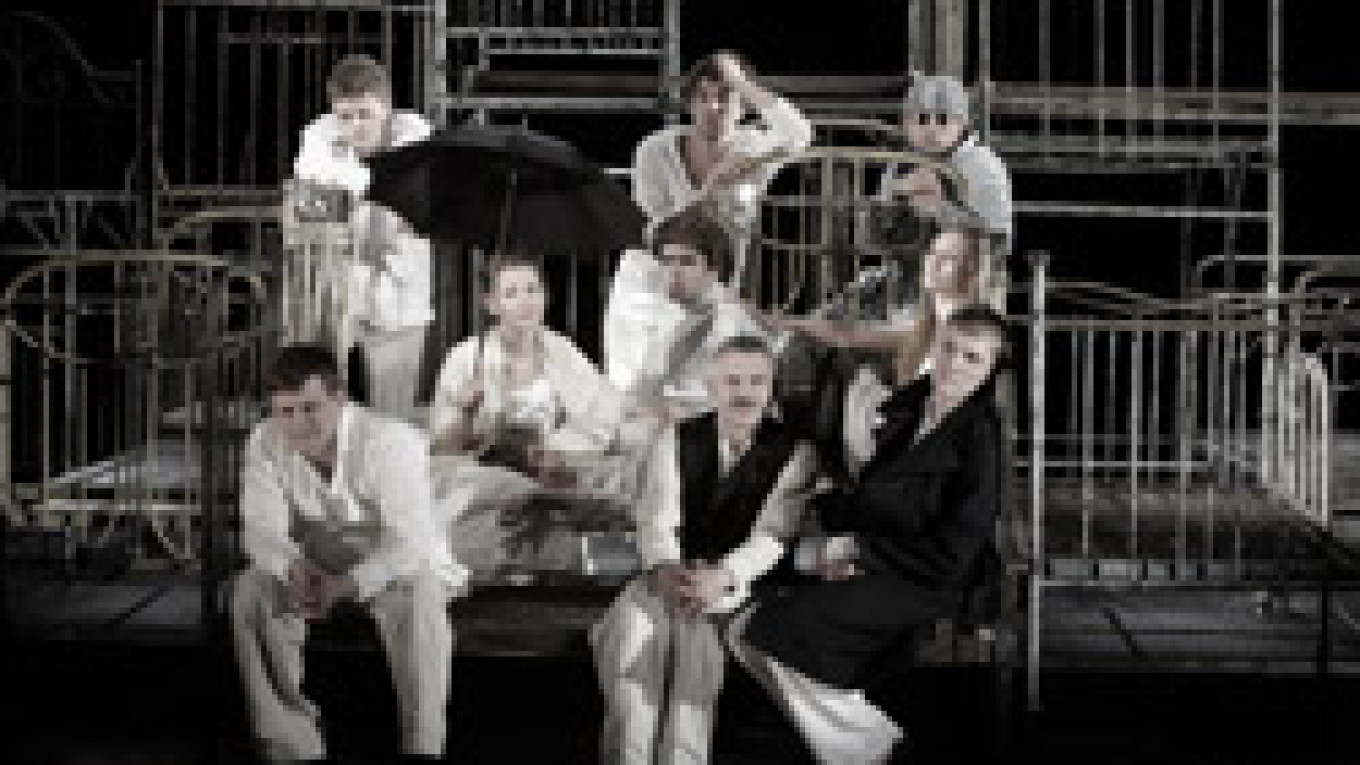
Designer Alexander Borovsky completely covered the stage in brass beds, many of them standing on top of one another. As such, the characters’ feet almost never touch ground. They bounce from one springy bed to another, or more often, merely lie in place.
If the image of the jungle of beds provides food for thought, it is less effective as a working theater design. The fact that the actors are trapped in their places expresses one of the meanings of Chekhov’s tale, but it makes for a static performance. Zhenovach’s dramatization of “Three Years” only breaks free of the set’s physical limitations on occasion.
What works, as always at the Studio of Theater Art, is the human element. The gentle smiles, the ironic gazes, the intimate speech patterns. Less engaging is the stationary, talky nature of the performance. This version of “Three Years” is more literature than it is theater. Chekhov, however, still hauls off and whacks us in the gut.
“Three Years” (Tri Goda) plays Sunday at 7 p.m. at the Studio of Theater Art, located at 21 Ulitsa Stanislavskogo, Bldg 7. Tel. 662-4646. Metro Taganskaya. www.sti.ru. Running time: 2 hours, 55 minutes.
A Message from The Moscow Times:
Dear readers,
We are facing unprecedented challenges. Russia's Prosecutor General's Office has designated The Moscow Times as an "undesirable" organization, criminalizing our work and putting our staff at risk of prosecution. This follows our earlier unjust labeling as a "foreign agent."
These actions are direct attempts to silence independent journalism in Russia. The authorities claim our work "discredits the decisions of the Russian leadership." We see things differently: we strive to provide accurate, unbiased reporting on Russia.
We, the journalists of The Moscow Times, refuse to be silenced. But to continue our work, we need your help.
Your support, no matter how small, makes a world of difference. If you can, please support us monthly starting from just $2. It's quick to set up, and every contribution makes a significant impact.
By supporting The Moscow Times, you're defending open, independent journalism in the face of repression. Thank you for standing with us.

Remind me later.