

That's the kind of answer Henri Bardon got when he asked President Vladimir Putin to redress the loss of $12 million he invested in a Vladivostok grain company.
Bardon, who runs Seattle-based Euro Asian Investment Holding Inc., sent a six-page petition to Putin on July 1. He detailed how his investments in a firm that had a regional monopoly on flour and animal feed when he initially bought into the company were essentially commandeered, making him a shareholder in an empty company.
For three years, Bardon has unsuccessfully pursued his case through the courts and has lobbied the local administration, the State Customs Committee, the local prosecutor's office, the Tax Police and the Federal Securities Commission. He has even brought his plight to the attention of the U.S. Commerce Department, the U.S. Consulate in Vladivostok, as well as several U.S. senators. He characterized his appeal to Putin as his last hope.
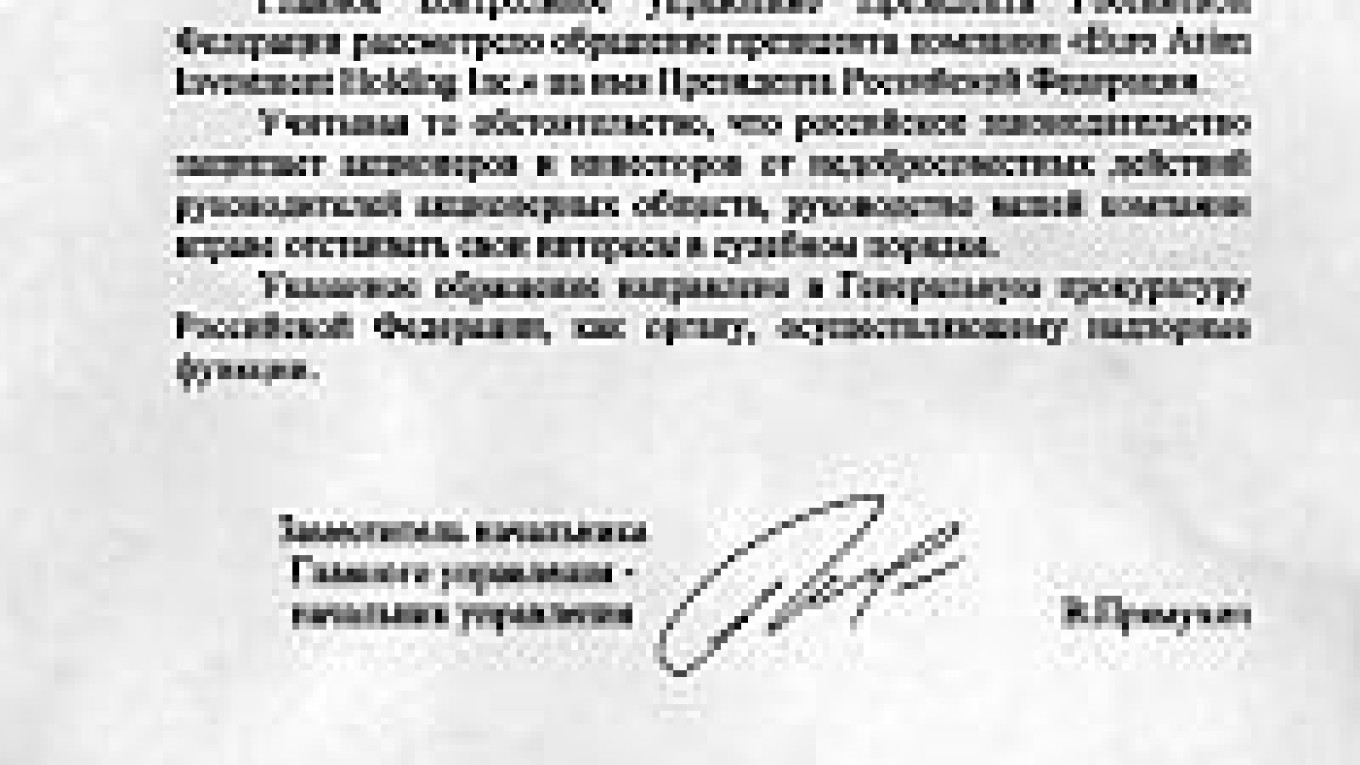
In reply, Putin's control office, a sort of legal comptroller to the president, issued a three-paragraph statement that read:
"The Central Control Department of the president of the Russian Federation has considered the application of the president of Euro Asian Investment Holding Inc. to the president of the Russian Federation.
"Taking into account the fact that Russian legislation protects shareholders and investors from unfair actions of the management of joint stock companies, your company has the right to pursue your interests in court.
"The above application has been forwarded to the Prosecutor General's Office of the Russian Federation as a body performing supervisory functions."
When contacted by telephone, an official at the control department refused to say what prosecutors do with letters received from his department or how many similar cases his office has handled.
An official at the prosecutor's office said the letter would be forwarded to prosecutors in Vladivostok, whom Bardon has already appealed to.
Bardon said the letter seemed like just another example of official buck-passing.
"It appears that it is being referred to the prosecutor. Maybe that is good. Who knows?" he said by e-mail from Seattle. "It is the first such letter we have received from any single authority ... but it's too little too late."
The story began in 1997, when Bardon paid $2 million for a 20 percent stake in Primorkhleboprodukt, or PKP. He and a partner then set up Euro Asian Investment Holdings, or EAIH, to manage the investment and subsequently invested $10 million in working capital.
PKP hit hard times in the aftermath of the August 1998 crisis, as the ruble devalued as rapidly as PKP's debts grew. Bardon went to a regional court in 1999 and obtained a ruling freezing PKP's assets as a safeguard against his investment, but the company's debts continued to grow, reaching some $10 million -- about two-thirds of which was owed to Bardon -- by the start of this year.
On Jan. 31, after months of negotiations, Bardon signed a debt-restructuring deal with PKP under which he would be paid back $3.7 million over four years. He also agreed to unfreeze the assets in exchange for an additional 40 percent stake in the company.
"They told us they needed to use them [the assets] as a collateral for loans to pay off debt," Bardon said earlier this year. PKP was to make the first payment March 31, but the money never came. Nor did PKP not take out any loans or hand over the 40 percent stake. Instead, the company's board on March 11 approved a new valuation of PKP's prime assets and their sale. The properties were priced cheaply and sold quickly.
Bardon now has 20 percent of a company with no assets, and he rents an office in a building he once owned.
Last month, Bardon met with Igor Ivanov, the deputy governor of Primorye, who until last fall served as chairman of the board of directors of Vladkhleb, the company that purchased the biggest asset sold by PKP in the March selloff.
According to the minutes of the meeting, provided by Bardon, Ivanov said, " I am totally prepared to assist you within the limits of my authority, but sorting out business disputes is out of the competence of the regional administration. Such issues must be resolved by court."
Bardon said Ivanov told him that he had pursued the wrong strategy in Primorye, such as applying to the London International Arbitration Court, and blamed him for painting a bleak picture of the region's investment climate.
Next month, Vladivostok will host an international investment forum that is expected to attract hundreds of foreign companies interested in investing in the region, and Ivanov is clearly unhappy with the negative press Bardon's case has generated.
"You are looking at the whole investment potential of Primorye through the prism of one person -- the director of an enterprise of which you are a shareholder," Ivanov said, according to the transcript of the meeting. "As a result of your efforts, a negative impression of the investment climate in Primorye as a whole has formed."
A Vladivostok court is next scheduled to review EAIH's complaint against the sale of PKP's assets Aug. 27.
A Message from The Moscow Times:
Dear readers,
We are facing unprecedented challenges. Russia's Prosecutor General's Office has designated The Moscow Times as an "undesirable" organization, criminalizing our work and putting our staff at risk of prosecution. This follows our earlier unjust labeling as a "foreign agent."
These actions are direct attempts to silence independent journalism in Russia. The authorities claim our work "discredits the decisions of the Russian leadership." We see things differently: we strive to provide accurate, unbiased reporting on Russia.
We, the journalists of The Moscow Times, refuse to be silenced. But to continue our work, we need your help.
Your support, no matter how small, makes a world of difference. If you can, please support us monthly starting from just $2. It's quick to set up, and every contribution makes a significant impact.
By supporting The Moscow Times, you're defending open, independent journalism in the face of repression. Thank you for standing with us.

Remind me later.