

That is less my own personal statement than it is a rephrasing of a dominant theme in Russian drama for the last decade. Plays about teenagers, dropouts, summer camp-goers, high-school students, college grads and preteens have come forth in a flood.
Pavel Pryazhko, a Russian-language playwright based in Minsk, Belarus, has emerged recently as a leading practitioner in this vein. In part, his "Panties" and "Life Is Grand" chronicle young people running up against the realities of the world. In "The Third Period," directed by Filipp Grigoryan for the Joseph Beuys Theater at Fabrika, he takes on the world of young people in a summer camp.
It isn't hard to see why plays like this are common. First, any writer knows that the key to success is sticking to what he or she knows. With so many playwrights entering the field at a relatively young age, it is clear that the hurts, fears and adventures of growing up will play a major part in their work. Second, and this goes to a deeper level, the notion of people waking up to a new world, so to speak, is entirely fitting for the Russian experience of the 21st century. This is a world that is being -- or at least is often perceived to be -- created ex nihilo. What went before is chaos and failure, so now, let's get the party started.
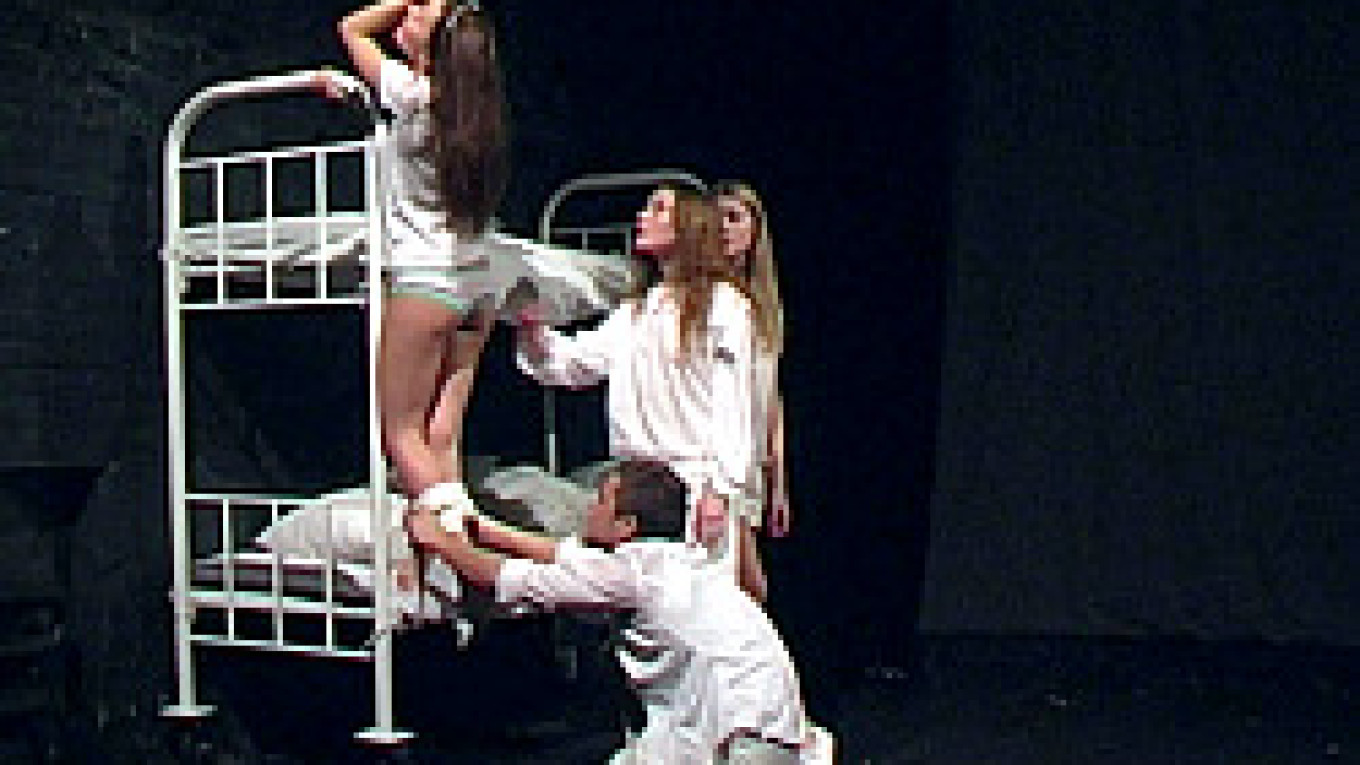
Partying seems to be high on the wish list of the camp-goers in "Third Period." Pranks, drinking, smoking, pillow fights and outwitting camp authorities -- this is pretty much what their time is devoted to.
Joseph Beuys Theater
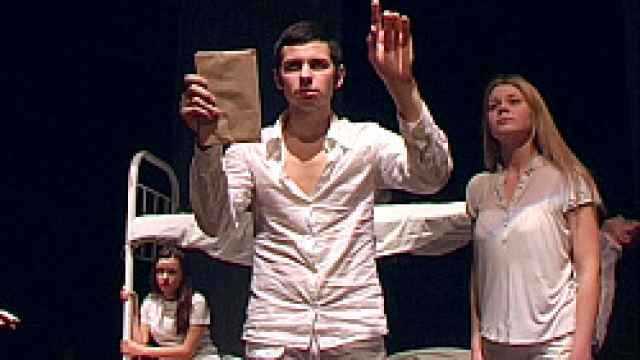
Life at the camp consists of pranks, drinking and outwitting authorities.
|  |
| |
Dima (Donatas Grudovich), a kid of about 14 who proves to have the beginnings of a conscience, admits that he hasn't read anything since he was 6. Marina (Maria Kostikova), one of the more mature girls, gets the whole group involved trying to summon a gnome that they believe commands magical powers. Is Stas right when he says this gnome who steals the kids' belongings is actually a midget from the nearby village? Misha (Oleg Donets), a kid of 9, startles everyone when he barges in with a submachine gun and declares that "Christ made me do it."
Tanya (Margarita Kutovaya) doesn't understand why grown-ups don't want children to go ballistic. "We're kids, what else are we supposed to do?" she asks. "Would you rather we did drugs?"
Grigoryan, who also designed the set and lighting, worked with his production team to frame things in a nonrealistic manner. The often astral-like sound design by THE:NET is an ever-present element giving the action an otherworldly feel. Choreographer Sergei Zemlyansky oversaw the creation of scenes that reinterpret the actions prescribed by Pryazhko. A fight between two young men, for example, is staged as a javelin-throwing competition. Actors often move or interact in synchronized groups of three. On stage are two white bunk beds, a white flagpole and white sheets hanging in back. Perhaps the point is that things aren't quite as sterile as they may seem.
Ultimately, "The Third Period" did not strike me as first-rate Pryazhko, let alone first-rate drama. There is only so far you can go with tales of children playing with temptation and sin before you slip into something childish. Pryazhko's "Panties," a radical and reduced reworking of a Greek-style tragedy, showed me far more insight and invention. His "Life Is Grand," a rather cliched piece laced with obscenities and irresponsible behavior, at least created intriguing character portraits.
"The Third Period" is packing in a young crowd that gets a kick out of the play's shenanigans. Perhaps it speaks to their concerns for now. What I'm curious to see is what will happen to Pryazhko's characters when the writer begins reflecting on his present and future rather than his past.
"The Third Period" (Tretya Smena), a production of the Joseph Beuys Theater, plays Sat. and Sun. at 10 p.m. at Fabrika's Aktovy Zal, located at 18 Perevedenovsky Pereulok, Entrance 1. Metro Baumanskaya. Tel. 499-265-3935. www.aktzal.ru. Running time: 1 hour 35 minutes.
A Message from The Moscow Times:
Dear readers,
We are facing unprecedented challenges. Russia's Prosecutor General's Office has designated The Moscow Times as an "undesirable" organization, criminalizing our work and putting our staff at risk of prosecution. This follows our earlier unjust labeling as a "foreign agent."
These actions are direct attempts to silence independent journalism in Russia. The authorities claim our work "discredits the decisions of the Russian leadership." We see things differently: we strive to provide accurate, unbiased reporting on Russia.
We, the journalists of The Moscow Times, refuse to be silenced. But to continue our work, we need your help.
Your support, no matter how small, makes a world of difference. If you can, please support us monthly starting from just $2. It's quick to set up, and every contribution makes a significant impact.
By supporting The Moscow Times, you're defending open, independent journalism in the face of repression. Thank you for standing with us.

Remind me later.