

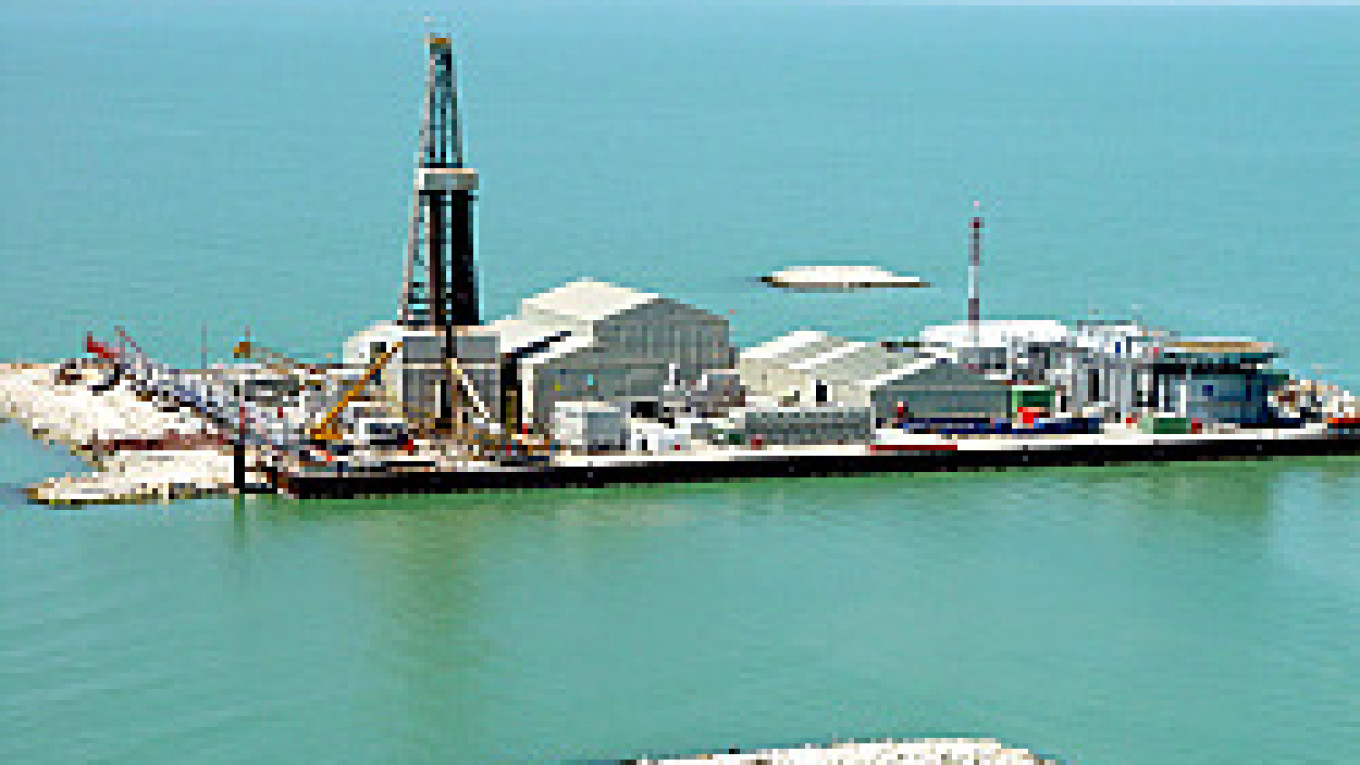
The move by Kazakhstan, mainly citing environmental issues, echoed Russia's dispute with Shell, which ended with the oil firm losing control of a major oil field to Gazprom last year.
Kazakh officials accused the group of a host of violations, including environmental issues and fire safety, but analysts said the key impetus was Kazakhstan's pursuit of higher revenues from the project.
Environment Minister Nurlan Iskakov said Kazakhstan was suspending Kashagan for at least three months.
"The permit for 2007 has been suspended. That is, we are suspending work for three months on our part," he said in televised comments.
Setbacks have pushed the total cost of the project to $136 billion, more than double earlier estimates, the government said. The state has been seeking to increase its share of profit to 40 percent from 10 percent.
The Kashagan consortium also includes Shell, ExxonMobil, Total, ConocoPhillips, Japan's Inpex and the Kazakh state oil company, KazMunaiGaz.
In a related development, the government said Kazakh Energy Minister Baktykozha Izmukhambetov had resigned and "will transfer to another job."
Prime Minister Karim Masimov named Sauat Mynbayev, the former head of state holding company Samruk, as Izmukhambetov's replacement, the government said on its web site.
A senior government source said Mynbayev's mission was to "solve the Kashagan question as quickly as possible." Under his predecessor the consortium announced its latest two-year startup delay to 2010.
"He is known as a tough manager," the source said. "It's obvious that the 'Kashagan story' has grown out of an economic conflict into a political one."
An Eni spokeswoman said consortium representatives planned to meet Kazakh officials Monday to "analyze the situation."
Separately, the Kazakh Finance Ministry's customs committee said it had uncovered customs violations at the deposit concerning imports of two helicopters, and was opening a criminal case against unidentified consortium officials.
Serzhan Duisebayev, acting head of the customs committee, denied that the move sought to put pressure on Eni. "We made this announcement not because we want it to be seen as part of some kind of campaign against the consortium," he said. "All investors are equal for us."
The government also halted construction of a refinery that an Eni unit is building to process Kashagan oil. "Gross violations" of the fire code were uncovered at the construction site Monday, the Kazakh Emergency Ministry said in a statement. The ministry asked a court to uphold its ruling within three days.
Dmitry Lukashov, an oil and gas analyst at Alfa Bank, said the halt to the project was "an attempt to replicate Russia's success with Sakhalin-2.''
Lukashov said Eni had created an opening for the government to raise pressure on the "extraordinarily difficult" project by accepting contract terms that were tough to fulfill. "I think the operator should take part of the blame," Lukashov said.
A Message from The Moscow Times:
Dear readers,
We are facing unprecedented challenges. Russia's Prosecutor General's Office has designated The Moscow Times as an "undesirable" organization, criminalizing our work and putting our staff at risk of prosecution. This follows our earlier unjust labeling as a "foreign agent."
These actions are direct attempts to silence independent journalism in Russia. The authorities claim our work "discredits the decisions of the Russian leadership." We see things differently: we strive to provide accurate, unbiased reporting on Russia.
We, the journalists of The Moscow Times, refuse to be silenced. But to continue our work, we need your help.
Your support, no matter how small, makes a world of difference. If you can, please support us monthly starting from just $2. It's quick to set up, and every contribution makes a significant impact.
By supporting The Moscow Times, you're defending open, independent journalism in the face of repression. Thank you for standing with us.

Remind me later.