

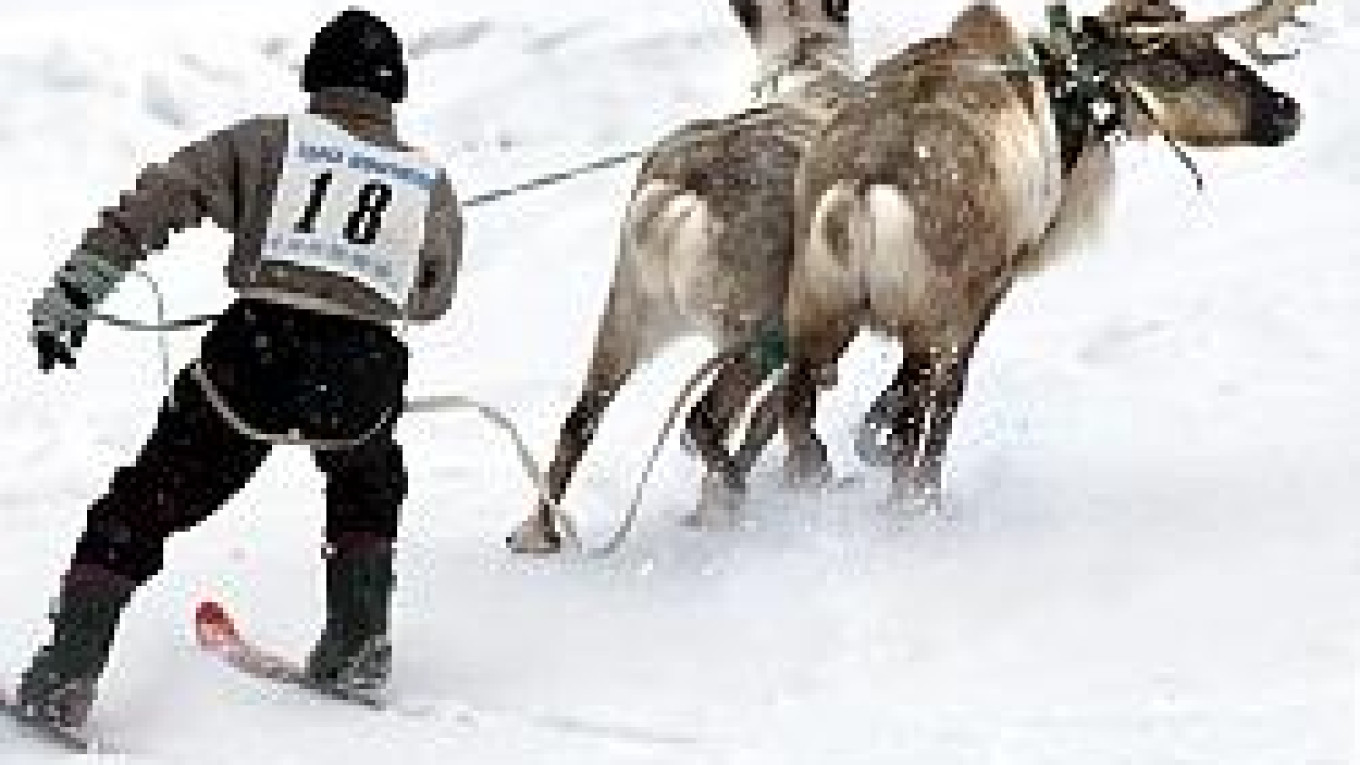
Just under 2 1/2 minutes later, he was back in the same spot after being whisked around the track at 50 kilometers per hour. With rosy cheeks and watery eyes poking out from underneath his circular fur cap, Ivan climbed out of his sleigh and claimed the bronze medal at last week's Reindeer Races, one of the oldest events of the Murmansk region's Northern Games.
"His uncle Ivan Ivanych was champion a number of times," said Nikolai Yuryev, this year's champion, as Ivan rolled in on the sleigh, looking like a bundle of frozen fur. "Blood plays a part. It is reborn. There will be a second Ivan Ivanych."
Ivan, a Komi, and Yuryev, a Saami, represent two of this Arctic region's indigenous people who herd reindeer and live in the tundra for most of the year. For these racers, the Northern Games are a rare chance to carry on traditions passed on by their forefathers, whose nomadic lifestyles were almost eradicated during Soviet times.
Created in 1934 as part of the Soviet government's attempt to promote physical activity, the Northern Games in recent years have developed into an odd mixture of classical winter sports and hybrids of Saami traditions. Under the Soviets, the games concentrated on cross-country skiing. But as communism failed and the Saami slowly returned to herding, reindeer racing crept back into the event's program and, with it, a revival of the Saami culture.
"My grandfather worked with deer, my father did and now I do," Yuryev said. "It is in the blood. You can't explain why. It pulls you."
Now, along with the 50-kilometer, cross-country skiing marathon, which is part of the European circuit, the games include competitions in windsurfing on frozen lakes, soccer on snow and swimming in frozen lakes.
Before the start of the races, herders greeted each other as old friends, comparing each other's animals and ignoring the weather, which switched unpredictably from cold winds to blizzards to blazing sun high up in the Arctic Circle. Traditional harness decorations of colored triangles flapped in the wind, while men pulled on bright red tops and low slung belts with trinkets of bears' teeth and dangling sheath knives.

|  |
| |
"I'm a racer," said Denis Yulin, from Lovozero, the small town used as a base for many of the herders, "I am a Ferrari, or am I a McLaren?''
Controlling a speeding reindeer is not an easy task. In the tundra the sled is usually pulled at a gentler pace than the hectic speeds at which the reindeer sprint around the course. A vague semblance of control is managed with a 3-meter-long stick, called a khorei, with which the driver whacks the reindeer on the bottom.
The championship consists of three races beginning with the 3,200-meter race, which is two laps around the track. But problems can arise when the reindeer get to the second lap, since they aren't used to going around the track twice. Race organizers and other competitors stand ready to run at the reindeer as they approach the second round, shouting and waving khoreis to prod the reindeer round the course for another lap.
The encouragement didn't work for Yulin, whose Ferrari ran off the track, placing him last after the first race.
"The important thing is to hold on," said Galina Chuprova, offering words of motherly wisdom before Ivan's first race.
"I didn't see a thing," Ivan said excitedly after his race, despite falling off a few meters before the finish.
Reindeer are not very public animals and prefer living in packs in the tundra of the Far North. On the day of the races, most of the animals stood huddled together, looking sorry for themselves. Some would occasionally nudge their nostrils into the ground and dig down in search of a small scrap of lichen. None of the reindeer looked like the animals pictured on Christmas cards.
In fact, many of the reindeer were without antlers, while others showed fresh blood oozing from stumps on their heads.
A few reindeer had only one or two horns remaining.
Herders gave a number of reasons for the presence or lack of antlers.
"We cut them off as otherwise you can't get them in the truck," one of the herders said.
Others said some were left with antlers because they were particularly meek animals who needed the protection. Another herder said that it was to keep one group of animals from another.
Yuryev was evidence enough of the danger of the reindeer antlers. His right eye is closed up after he was blinded by a reindeer that turned on him as he was taking it to the slaughterhouse.
Participants in the annual games say that by far the most difficult of all races is a balancing act called the buksirovka, or tow race, where the rider is pulled along on skis by two reindeer.
For the other races, herders say the most important thing is to have a leader among the reindeer to show the others the way.
But leadership was sadly lacking at this year's events. On a number of occasions the reindeer ran around in circles and decided that they would be better off anywhere but on the racecourse. Medics had to be called in when one of the youth competitors was shaken up but not badly hurt after a crash caused by the reindeer's unruly behavior.
The problem is that there were too few deer, said Margarita, a Saami from Lovozero.
"Three or four people use them and they're already going psycho," she said.
But despite Ivan's success, this year was a disappointment for many. The competition only consisted of six races, compared to 18 at Lovozero, one of the main reindeer towns, and prizes were not as big as in previous years. Herders sold reindeer fur slippers and boots on the side as a way of making money.
The Saami are the indigenous people of the north, while the Nenets and the Komi migrated to the Murmansk region from Siberia in the 19th century. Formerly known as Lapps, the Saami number 35,000 people and stretch over Finland, Norway, Sweden and Russia.
The Saami have been in the Murmansk region since at least the seventh century, some say for up to 3,000 years. Despite their long history, few of the Russian Saami remain. As the number of Saami increase in other countries, figures have dropped dramatically in Russia over the last 100 years. Estimates now put their numbers at a stable 1,800, but their future is in doubt.
The group's nomadic lifestyle was largely eradicated in Soviet times as collectivization and repression in the 1930s took their toll on the population. The vast military, especially the navy, put much of the region out of bounds for the Saami herders and fisherman. The process was completed with consolidation in the 1950s and 1960s, which grouped the Saami together and destroyed many settlements. The Soviet government moved one entire village into a block apartment complex in Lovozero.
The average Saami man lives until he is 45, and alcohol is a big problem. Three Saami recently froze to death after falling asleep outside while drunk.
"Earlier they drank a lot," said Tatyana Kirillova, a Russian who is married to a Saami. "It has become a bit better. ... Life has become so tough; it is either vodka or eating."
Although once described as one of the last nomadic people in Europe, they now live a life halfway between Russian and Saami traditions.
For most of the year, the reindeer herders are away in the tundra, tending thousands of reindeer. Still, they are far from being the nomadic people they were.
"It's tough, we go away for a long time," Kirillova said.
"There's practically no civilization. There is electricity but there are difficulties with gas and there's no television," she said.
Most live for the rest of the year in the herders' towns of Lovozero and Krasnoshchelye, outnumbered by other indigenous people and Russians. Only half of the population, perhaps less, speaks the Saami language, and intermarriage is the norm.
Urbanization has not been easy for the Saami.
"When they lived in the middle of the wild it was OK, but in the middle of civilization they feel lost," said Valentina Sovkina, a Saami teacher from Lovozero.
Some things remain, however. Saami children are known to run away from school to help with the calving.
Their problems have increased since the breakup of the Soviet Union, as their livelihood is threatened by an increase in poaching.
"The Buran [snowmobile] has made it a lot easier," said Mikhail Sharshin, a Saami from Lovozero.
Poachers can now reach the wildest part of the tundra on a snowmobile and kill deer in large numbers.
Attacks from wolves and wild dogs add to the problem, and some herds have halved in recent years.
"There's no money and they shoot the deer one by one," said Sharshin.
Instead of going to the lucrative Scandinavian market, via the new Swedish slaughterhouse in Lovozero, the deer is usually sold locally.
You can tell if it is poacher's deer as it is usually very dark meat, journalist Alexander Stepanenko said after serving up a meal of deer and mashed potatoes in his apartment in Murmansk.
The Saami bleed the animals before slaughtering them, giving the meat a much paler color, he said.
A Message from The Moscow Times:
Dear readers,
We are facing unprecedented challenges. Russia's Prosecutor General's Office has designated The Moscow Times as an "undesirable" organization, criminalizing our work and putting our staff at risk of prosecution. This follows our earlier unjust labeling as a "foreign agent."
These actions are direct attempts to silence independent journalism in Russia. The authorities claim our work "discredits the decisions of the Russian leadership." We see things differently: we strive to provide accurate, unbiased reporting on Russia.
We, the journalists of The Moscow Times, refuse to be silenced. But to continue our work, we need your help.
Your support, no matter how small, makes a world of difference. If you can, please support us monthly starting from just $2. It's quick to set up, and every contribution makes a significant impact.
By supporting The Moscow Times, you're defending open, independent journalism in the face of repression. Thank you for standing with us.

Remind me later.