

Nikolai Roshchin may be one of the most meticulous, calculated directors in Moscow. He is not prolific, but each of his productions over the last decade has been exquisitely conceived and executed.
This quality is apparent in “[bokh],” a new piece at Roshchin’s ARTO Theater that Roshchin did not even direct himself. Those honors go to Oleg Gerasimov, one of Roshchin’s long-time actors, who clearly has paid attention to his mentor’s lessons in detail.
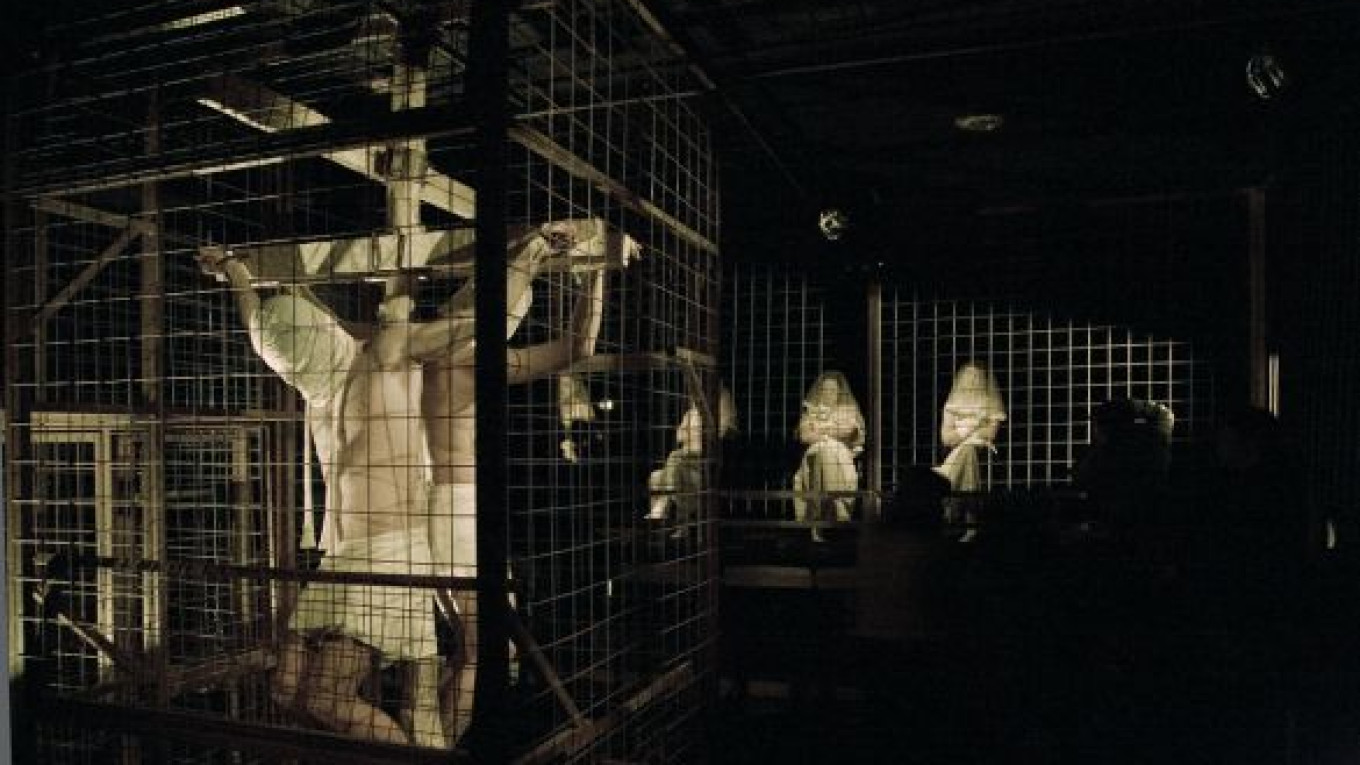
Roshchin himself, however, has left his mark all over this production as the designer. The spatial design of this small production based on Samuel Beckett’s “Waiting for Godot” and the writings of Fyodor Dostoevsky, Leonid Andreyev, Michel de Ghelderode and Indian philosopher Krishnamurti is as radical and effective as any I have seen this season.
This is one of those instances when the design actually becomes a character in the performance. I would even go so far as to say it is the lead character, although that is no slight against any of the performers in this unique show.
Everyone is trapped in something of a jail cell, the audience included. By the time two actors emerge and still another cell is built around them, the small stage at ARTO has been transformed completely. In a real-life echo of Jean-Paul Sartre’s play “No Exit,” a spiritual ancestor of “[bokh],” there is no way of getting out of this cell.
Before the show begins, a disembodied voice announces that if spectators must leave during the performance, they should raise their hand and the actors will stop performing until they have been led out.
The title of the production contains intricacies that would require a minidissertation to explain in full. Suffice it to say that on one hand the title graphically expresses the notion of imprisonment by incarcerating, so to speak, the title word in brackets. The Russian word for a cell, as in prison cell, is “boks.” However, by switching a letter and altering pronunciation, the resulting word references “God.”
Voila: Thus we have the show’s thematic territories of man railing against his Maker as he continues to live in a state of entrapment.
Despite the weighty reputations of the authors of this show’s texts, the symbolism of the visuals and the actions performed in “[bokh]” carry far more significance than the words that are spoken.
Beckett’s Estragon and Vladimir are here waiting for the arrival of Godot, and they must confront the enigmatic Pozzo, who drags around his unfortunate servant Lucky. All seek to make sense of their senseless presence in this cage. Attempts at philosophy are padded out with excerpts from Krishnamurti’s “The Urgency of Change.”
But this is a visceral, visual piece that speaks loudest through its images.
Estragon and Vladimir are less the clowns that Beckett probably had in mind than they are the two robbers who were crucified alongside Jesus Christ. When the two actors silently take the stage, they assume poses on cross-like structures that leave little doubt about the impression that Gerasimov and Roshchin intend to make. Spiritually, I suspect that they also can claim kinship with the central image in Edvard Munch’s famous painting, “The Scream.”
Much of this performance passes in silence. The setting up of the cage and the preparation of the actors as they take their places on the crosses form a remarkably long, wordless prologue — I calculated it at about 20 minutes. That’s in a show that barely lasts two hours.
A team of angel-like characters methodically piece together the cage around Estragon and Vladimir, utterly engrossed in the mundane activity at hand. This leaves us with nothing to do but to ponder at length the implications of being trapped and of men assuming positions on a crucifix.
Similar instances of extended wordless action occur when Lucky attends to Pozzo, setting up his folding stool or delivering other objects to him. Once again, what these characters say seems far less important than the very fact of their richly detailed interaction, colored by Pozzo’s hostile imperiousness and Lucky’s abject subservience.
In any case, these individuals are constantly involved in activities that have consequences, no matter how insignificant or even harmful. Meanwhile, all their attempts at talk appear to leave no trace at all.
There is plenty of humor in this show; Beckett was very funny, whatever else he was. But as is customary for any production involving Roshchin, “[bokh]” is nothing if not a gauntlet tossed at the spectators’ feet.
“[bokh]” plays every Sat. and Sun. at 8 p.m. at the ARTO Theater. 6/1 Sretensky Bulvar, Bldg. 2. Metro Turgenevskaya. Tel. 624-5990, www.artdom.ru. Running time: 2 hours, 5 minutes.
A Message from The Moscow Times:
Dear readers,
We are facing unprecedented challenges. Russia's Prosecutor General's Office has designated The Moscow Times as an "undesirable" organization, criminalizing our work and putting our staff at risk of prosecution. This follows our earlier unjust labeling as a "foreign agent."
These actions are direct attempts to silence independent journalism in Russia. The authorities claim our work "discredits the decisions of the Russian leadership." We see things differently: we strive to provide accurate, unbiased reporting on Russia.
We, the journalists of The Moscow Times, refuse to be silenced. But to continue our work, we need your help.
Your support, no matter how small, makes a world of difference. If you can, please support us monthly starting from just $2. It's quick to set up, and every contribution makes a significant impact.
By supporting The Moscow Times, you're defending open, independent journalism in the face of repression. Thank you for standing with us.

Remind me later.