

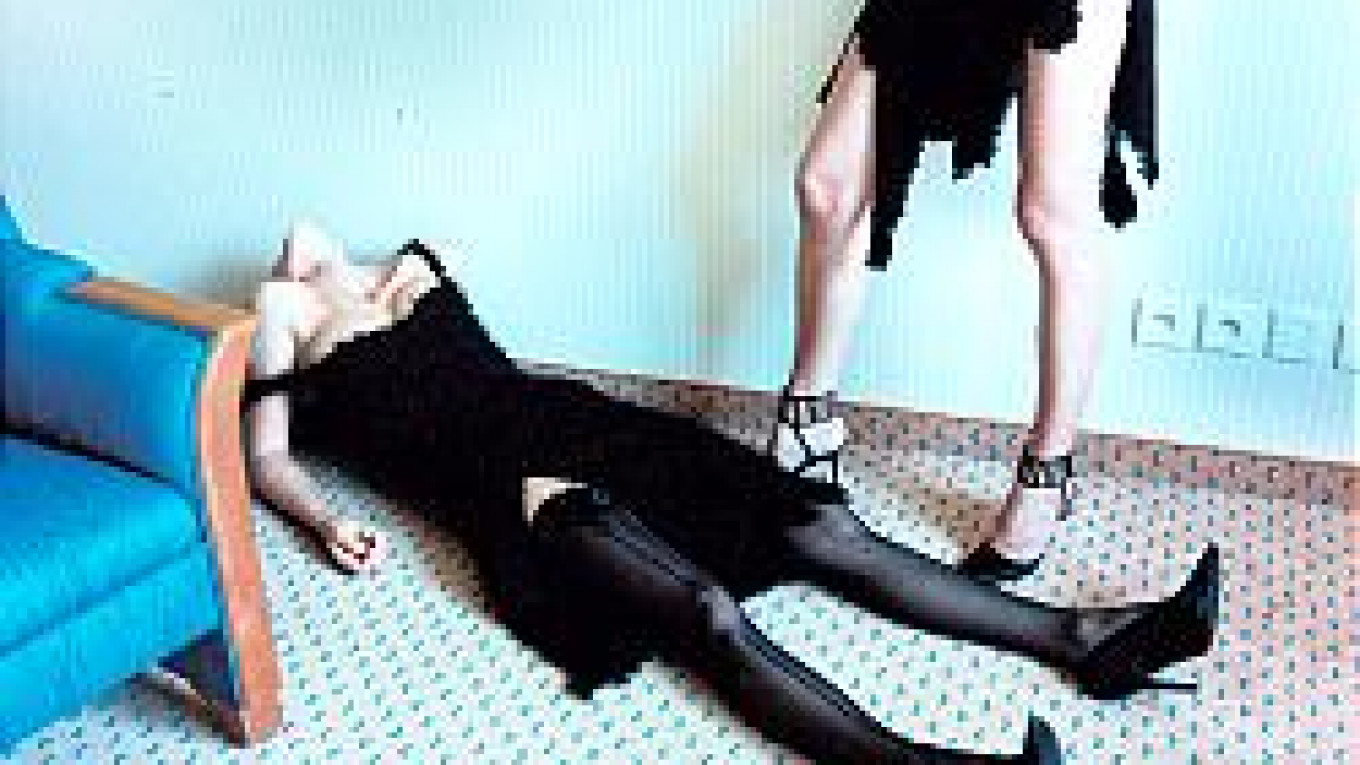
The 82-year-old photographer was in town this week for the first time in more than a decade to launch a retrospective of his work -- scheduled to run until May 31 on three floors of the Moscow House of Photography. Newton and his wife June made several public appearances -- including two receptions and at a master class hosted by Newton -- all of which were crowded by members of the press, local artists, well-wishers and fans.
The House of Photography's exhibit is held under the auspices of Moscow's third biennial Festival of Fashion and Style in Photographs (Moda i Stil v Fotografii), but features a great deal of Newton's portrait photography as well as his fashion shots. Among the celebrities depicted in various photographs in bold black and white are actresses Debra Winger, Sigourney Weaver, Marlene Dietrich and Catherine Deneuve; actor Ralph Fiennes; and fashion designer Pierre Cardin.
The exhibit, "Helmut Newton: A Retrospective" -- which first hung in Berlin's New National Gallery in 2000 -- was compiled by June Newton and also features work from "Autoerotic," a collection of photographs featuring the Volkswagen Beetle and three nude female models that was commissioned by the auto manufacturer in 1999. The limited edition shots were donated by Volkswagen to various prominent galleries, including the State Hermitage in St. Petersburg.
Well-tanned and dressed in a black and white cravat, Newton wore an ironic grin at a press conference Friday, but spoke with gravitas and an accent that bears traces of his Berlin birth. Having spent much of his life in France and lived since 1981 in Monte Carlo, Newton speaks an English that is peppered with occasional French-language exclamations.
Newton -- whose work very often contains nude or near-nude female models in suggestive poses -- has been charged by Western critics for producing work that exploits women and contains sado-masochistic imagery.
In Russia, however, it is Newton's perspective on the female form that has won him fame and adoration, and his R-rated shots are seen as evidence of his ability to transform with his lens female subjects -- sometimes clad in no more than a pair of heeled shoes -- into Earth-bound goddesses.
"The point of my photography has always been to challenge myself, to go a little further than my Germanic discipline and Teutonic nature would traditionally permit me to," he was quoted as saying in the U.S. web magazine Salon.com. "The nudes and bondage shots were my way of going beyond my own bounds.
"Most of my work is meant to be funny. Because I am quite timid myself, I try to determine whether my subject will be receptive to a wild idea before I suggest anything," he said. "I would never force anyone to do anything. I never push very far. I think subjects pose so openly for me because I inspire confidence, or because I'm older than most of them."
At the exhibit opening on Monday, Newton told reporters that, at 82, he still works every day, and used a pocket camera to photograph the many visitors -- although all of them were fully dressed, a fact that did nothing to hide their esteem for Newton and his work.
"Helmut Newton is a great photographer and every Russian photographer who has worked in the fashion industry knows him," said Anita Gigovskaya, publisher of Russian Vogue, at Sunday's master class. "Here in Russia, Newton is one of the best known of the world's photographers."
Several Russian women are rumored to have been photographed by Newton, but none of the shots have ever been displayed publicly. The list of purported subjects includes Aidan Gallery owner Aidan Salakhova, who is said to have been photographed nude and chained to the radiator of a local restaurant; and the wife of a businessman who Newton may have photographed in Morocco. At Friday's press conference, Newton confirmed that he had worked with Salakhova, although he did not provide details about the shoot.
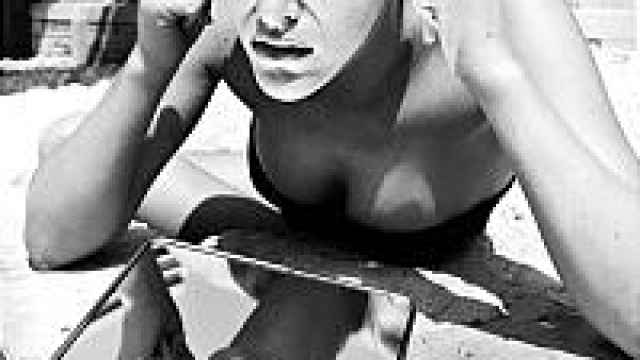 Helmut Newton Newton shot this advertisement in 1998 in Monte Carlo, his home for two decades. |  |
| |
"When Russia had only just begun to open its borders to the outside world, he [Newton] was one of the first to come, in the 1980s. He produced a wonderful series of portraits of underground Russian culture, and was the first to portray Russian culture outside the country's borders," she said. "We are very grateful for his work."
The photographer was born Helmut Neustaedter in Berlin in 1920, the son of a wealthy button manufacturer.
"I bought my first camera with pocket money when I was 12 years old," Newton said at Sunday's master class. "It was a simple box camera, and I've been taking photographs ever since."
Newton added that as a child, he had dreamed of making films and becoming a photographer, but that his father discouraged him, saying that films and photographs were no way to earn a living and that Newton should plan on working in the family business.
As a teenager, Newton said, he was interested primarily in "photos, girls and swimming," and was a champion swimmer, but even then the shadow of Adolf Hitler was already beginning to fall on Newton's life. As a Jew, he was forced to leave high school and at the age of 16, he went to work as a photographer's apprentice at Else Simon's studio. Simon was later deported and died at Auschwitz.
"I'm still very attached to the city of Berlin," Newton said. "[My wife] June and I make frequent trips there and there is a bit of the spirit of Berlin in my work."
In 1938, after the attacks on Jews became explicit in the Kristallnacht, Newton fled to Trieste and then to China. In Singapore he worked for a short time as a photographer for the Singapore Straits Times newspaper, but was fired after two weeks for incompetence. In 1940, he changed his surname to Newton and became an Australian citizen, spending the remainder of the war as a private in the Australian army. After his discharge, he set up a small studio in Melbourne and in 1948 married June, an Australian citizen. She was then an actress, but later took up photography under the pseudonym Alice Springs.
With June, Newton traveled to London, then Paris, where he worked for Paris Vogue from 1960 until the mid 1980s, building his reputation and eventually reaching the height of fashion-world celebrity, with regular commissions from the likes of magazines Jardin des Modes, Marie Claire, Elle and several others.
Despite his work in the fashion industry, however, Newton says he finds inspiration for his work in newspapers, film and art.
"I don't get any inspiration from pictures in magazines. That's all old camels," he said. "What interests me is the daily press, what the photojournalists do, what the paparazzi does -- there are a few geniuses there."
Newton's personal bookshelf, he said this week, is stocked with picture books of the work of German painters Otto Dix, Max Beckmann, Caspar David Friedrich.
"I would really like to photograph like [they painted], but you can't," Newton said. "But I can copy the gestures the women in [their] paintings make."
Among the filmmakers Newton admires are Alfred Hitchcock, Eric von Stroheim, Federico Fellini and Michelangelo Antonioni.
At the master class, Newton, one of the highest-paid photographers in the world, told Russian photographers of the days when he was a low-paid unknown, and advised them not to be ruled by a desire for money.
"If the assignment is interesting, the money isn't important," he said. "If it's an interesting assignment, it will be seen by many people, and become very important in your career.
"Be like a soldier: Know how to shoot. Keep your equipment clean. And when a battle starts, you've got to be able to give your best."
"Helmut Newton: A Retrospective" runs to May 31 at the Moscow House of Photography, located at 18 Ulitsa Ostozhenka. Metro Kropotkinskaya. Tel. 202-0610/7612.
A Message from The Moscow Times:
Dear readers,
We are facing unprecedented challenges. Russia's Prosecutor General's Office has designated The Moscow Times as an "undesirable" organization, criminalizing our work and putting our staff at risk of prosecution. This follows our earlier unjust labeling as a "foreign agent."
These actions are direct attempts to silence independent journalism in Russia. The authorities claim our work "discredits the decisions of the Russian leadership." We see things differently: we strive to provide accurate, unbiased reporting on Russia.
We, the journalists of The Moscow Times, refuse to be silenced. But to continue our work, we need your help.
Your support, no matter how small, makes a world of difference. If you can, please support us monthly starting from just $2. It's quick to set up, and every contribution makes a significant impact.
By supporting The Moscow Times, you're defending open, independent journalism in the face of repression. Thank you for standing with us.

Remind me later.