

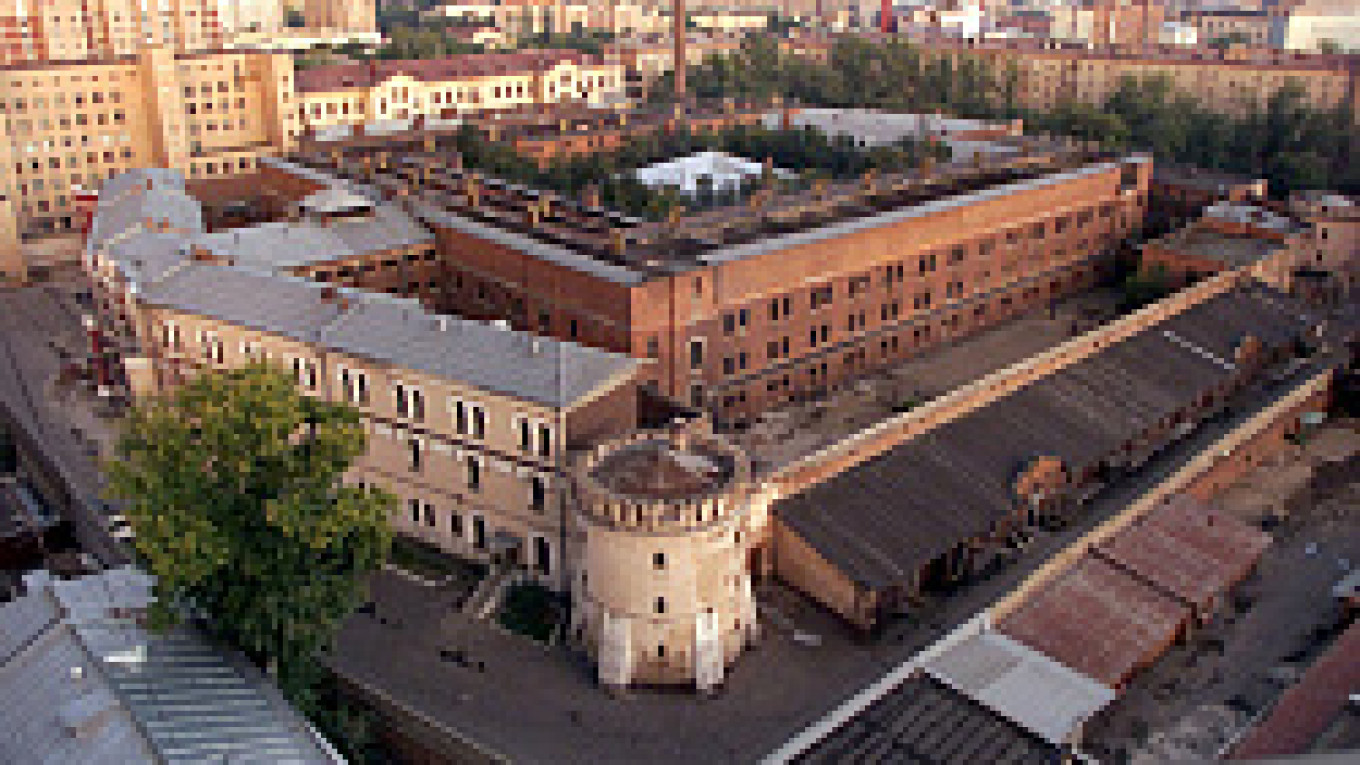
With an eye on improving conditions for prisoners, the Justice Ministry is looking to unload the former fortress, located on a prime three-hectare plot at 45 Novoslobodskaya Ulitsa in central Moscow, the country's top prisons official announced this week.
"We are ready to sell it if we can find a business partner willing to build a similar detention facility in the Moscow region," the official, Yury Kalinin, said in an interview published Wednesday in state-run Rossiiskaya Gazeta.
Getting rid of Butyrka, as the prison is widely known, is part of a ministry effort to improve prisons, Kalinin said. The government has allocated 54 billion rubles ($2 billion) for the 10-year program, which also calls for the construction of 26 new prisons, he said.
No bidders have expressed any immediate interest in owning the prison, which has held the likes of Yemelyan Pugachyov, Harry Houdini and Vladimir Gusinsky. And it was unclear Thursday how much flexibility a new owner might have to turn the dank yellow-brick dungeon into, say, a shopping center or a hotel. Butyrka is on a list of federally protected buildings.
But its sale would mark the end of a legacy that stretches back more than two centuries. Built in 1771 as a barracks for a hussar regiment, Butyrka was quickly remodeled as a prison and in 1774 accepted its first famous prisoner, Pugachyov, the leader of a massive uprising of peasants and Cossacks. One of the prison towers still bears his name.
The last major renovation took place in the early 1800s, when it was rebuilt by Matvei Kazakov, the architect who also designed the First City Hospital and the Senate building.
Unlike the grim Lefortovo prison, which historically has held political prisoners, Butyrka has been home to a mixed bunch of criminals and revolutionaries of all stripes. Among the most famous was Felix Dzerzhinsky, who later went on to found the secret police and served seven years before being freed in the 1917 Revolution. The poet Vladimir Mayakovsky spent a year in the prison in 1909 on charges of disseminating revolutionary propaganda.
Just a year before Mayakovsky was sent there, Butyrka saw its first headline-grabbing jailbreak. The escapee, however, was not a prisoner but the famous U.S. magician Houdini, who took 28 minutes to remove his shackles and chains, climb out of a locked box and sneak out of a barred cell.
Butyrka's last prominent inmate was media magnate Gusinsky, who spent three days there in June 2000. He was released after he signed a document transferring ownership of his media empire to Gazprom.
Butyrka, officially known as Pretrial Detention Center No. 2, is recognized as a historical landmark and is protected by the state.
This fact could pose a problem for future developers, despite the prison's prime location, said Polina Zhilkina, a retail analyst with Jones Lang LaSalle. "Also, the negative connotation that is associated with the prison will be a barrier for developers," she said.
Other protected landmarks, however, have been demolished. The best-known example, perhaps, is the Stalin-era Moskva hotel that once overlooked Red Square. Developers got permission to raze the building and then rebuild it with the same facade. The construction is currently under way.
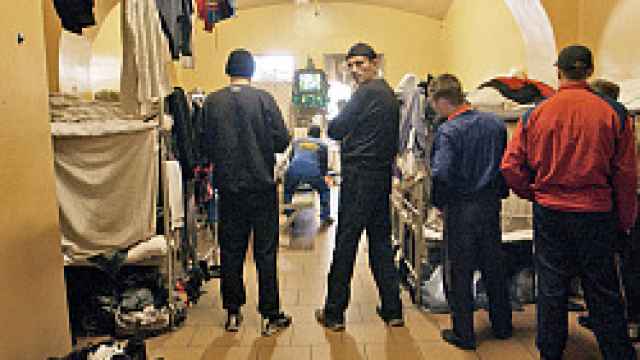 Fyodor Savintsev / Itar-Tass Prisoners standing in a cell. One former inmate likened Butyrka to a dungeon, with its curvy ceilings and brick walls. |  |
| |
"Of all the Moscow prisons, Butyrka really retains the aura of a dungeon with its curvy ceilings and thick brick walls," Korolyov said.
The friendliness and corruption of some prison staff made life there easier, he said. "You could get anything that was forbidden -- cigarettes, alcohol, drugs. You just had to pay," he said.
Korolyov recalled that wardens sometimes notified inmates of upcoming cell inspections to give them time to hide banned goods and occasionally carried letters and other items between cells out of sympathy for the prisoners.
Unlike Lefortovo, which was run until recently by the Federal Security Service and has a regime rigorously enforced by prison officials, Butyrka's population is governed by criminal bosses serving there, said Korolyov and other former prisoners.
"The informal prison law enforced by these bosses is better for the inmates than no law at all. It protects them from bullying by other inmates and helps them survive," said Valery Abramkin, who served in Butyrka for a year in 1980 on charges of disseminating anti-Soviet propaganda. He now heads the Moscow Center for Prison Reform, a nongovernmental group monitoring prisoners' rights.
"Though I was kept in a high-security sector and isolated from other inmates, I managed to send out more articles and letters through friendly wardens than from any other cells where I've been kept," he said. Abramkin was also kept in other cells at Butyrka, and he spent six years in a prison camp in the Altai region, near the Chinese border.
Butyrka jailers tolerated inmates speaking between cells through sewage pipes, which they did by scooping water out of their toilet bowls, Abramkin said.
"Now, there is no need for these means of communication, because some inmates keep mobile phones in their cells," he said, adding that he sometimes calls Butyrka inmates.
Butyrka is also famous for having an extensive system of so-called roads -- a sophisticated web of ropes that connect the windows of nearly every cell. The roads are used to exchange notes, cigarettes and other small items.
"I once watched how busy these roads are from the roof of a nearby building. It was amazing," Abramkin said.
Korolyov said jailers tore down the ropes from time to time but they were put back up very quickly.
In the 1990s, Butyrka was one of the most overcrowded prisons in the country, with up to 70 people crammed in cells designed for 20. Inmates established shifts to sleep, and tuberculosis and other infectious diseases were rampant.
The prison population halved to from 2001 to 2005, and the complex now holds about 4,000 prisoners. The drop was due largely to new laws that made it more difficult to quickly detain people for petty crimes and reduced penalties from prison sentences, Abramkin said.
Still, Korolyov said he spent two months with about 40 inmates in a cell designed for 22.
Butyrka last made headlines in September 2001, when four inmates fled in two consecutive escapes within a month. In the first escape, three convicted murderers broke through the concrete floor of their cell and dug an elaborate tunnel. They were later caught, the last in May 2003.
In the second escape, an inmate showed guards a forged Justice Ministry ID and boldly walked out of the visitors' room, where he had been talking with his mother. The man, who was wearing civilian clothes, had been jailed on charges of illegally carrying a gun and assaulting a policeman. He was caught after two months.
A Message from The Moscow Times:
Dear readers,
We are facing unprecedented challenges. Russia's Prosecutor General's Office has designated The Moscow Times as an "undesirable" organization, criminalizing our work and putting our staff at risk of prosecution. This follows our earlier unjust labeling as a "foreign agent."
These actions are direct attempts to silence independent journalism in Russia. The authorities claim our work "discredits the decisions of the Russian leadership." We see things differently: we strive to provide accurate, unbiased reporting on Russia.
We, the journalists of The Moscow Times, refuse to be silenced. But to continue our work, we need your help.
Your support, no matter how small, makes a world of difference. If you can, please support us monthly starting from just $2. It's quick to set up, and every contribution makes a significant impact.
By supporting The Moscow Times, you're defending open, independent journalism in the face of repression. Thank you for standing with us.

Remind me later.