

President Vladimir Putin watched a Soviet-style military parade, continuing his high-profile support for Prime Minister Viktor Yanukovych in the race.
Yanukovych, Kuchma's chosen successor, is running neck-and-neck with pro-Western liberal candidate Viktor Yushchenko, a former prime minister and Central Bank chairman.
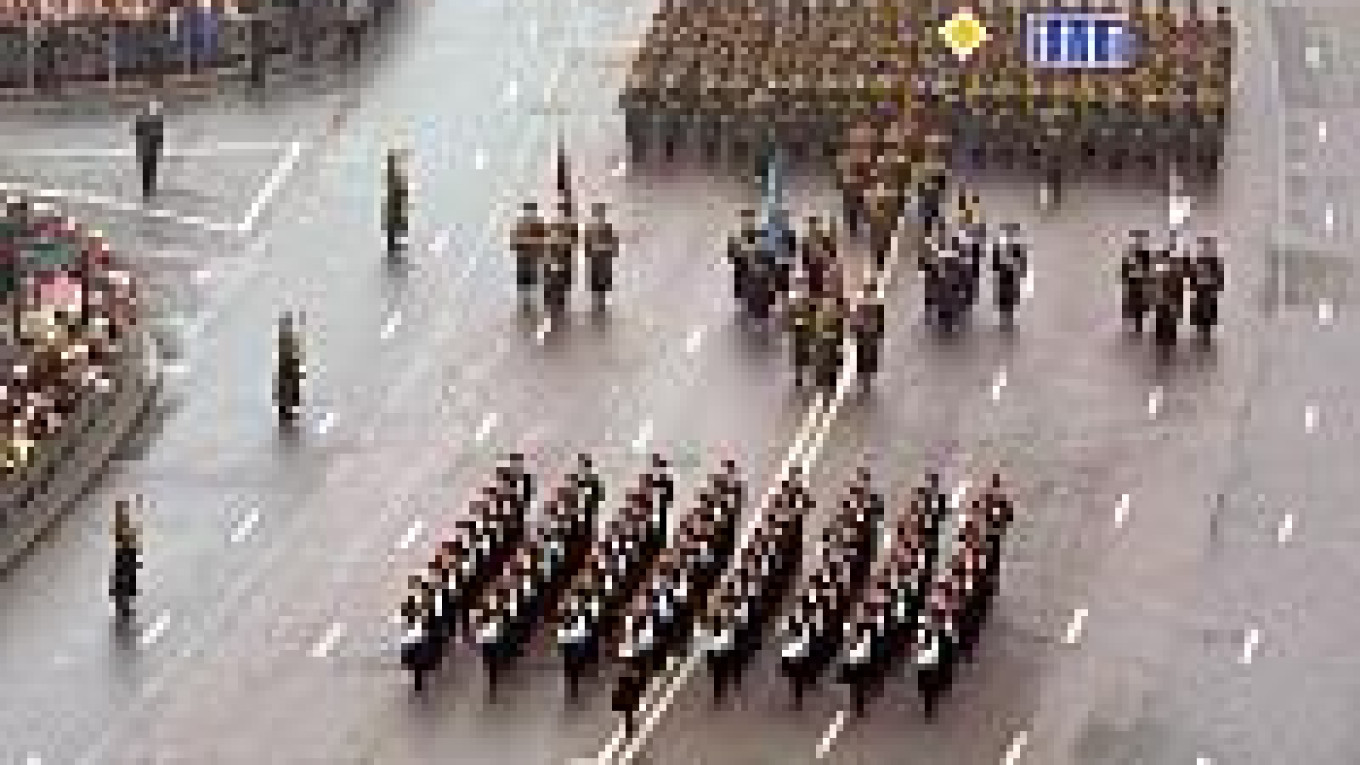
Putin stood alongside Yanukovych and outgoing Ukrainian President Leonid Kuchma as thousands of Ukrainian soldiers dressed in World War II uniforms marched in formation with Soviet flags and tanks along Khreshchatyk, central Kiev's main thoroughfare.
All the streets surrounding Khreshchatyk were closed off, and access to Independence Square, where the viewing stand for the parade was located, was severely restricted. Security service sharpshooters were in place around the parade route, with orders to shoot at anyone suspicious. Hotel residents were told not to watch the parade from their balconies, and even to keep their drapes closed.
A group of about 40 World War II veterans looked on deeply moved, as honor guards atop a vintage T-34 tank held the Soviet hammer-and-sickle flag that had fluttered over the Reichstag to mark the fall of Berlin in May 1945. The flag was brought from Moscow last week amid tight security.
During the parade, Azeri President Ilham Aliyev, one of three CIS leaders in Kiev for the celebrations, stood some distance away from Putin, who stood between Kuchma and Yanukovych, chatting with both. The head of the Russian presidential administration, Dmitry Medvedev, stood between his Ukrainian counterpart, Viktor Medvedchuk, and Yanukovych.
"I like Putin very much, but I don't like that he came here now before the elections," said Nina, a 54-year-old biology teacher. "We know whom he supports -- this is too much. We are getting too much information about Yanukovych. I got three letters from him this week. I'm sick of it."
Over the course of a half-hour, a television crew on Kiev's Independence Square inviting passersby to voice their support for one candidate or another received many pledges of support for Yushchenko, but none for Yanukovych.
"Kiev is for Yushchenko," shouted an old woman, waving a Ukrainian flag.
"Russia is interfering too much," said Alexander Vashenko, 60. "Putin is the Antichrist, he is enemy No. 1."
Vashenko was one of an estimated 100,000 people who marched in Kiev last Saturday in support of Yushchenko and to call for a clean election.
"Traffic police set up roadblocks on the outskirts of Kiev, preventing dozens of cars from entering the capital," Vashenko said. "Otherwise there would have been even more people here."
Alexander Dergachyov, editor of the online newspaper Transparent Policy, a project financed by the Soros Foundation, said that Russian authorities were planning to open polling stations all over the country to allow some 4 million Ukrainians living in Russia to vote. The Ukrainian opposition has protested that the polling stations in Russia could be used to add false votes for Yanukovych.
"So many frauds are planned, but the bulk of it will happen in Russia," Dergachyov said. "Yanukovych can easily get 2 million votes there."
Many young people have complained that their names are not on the lists of registered voters, and the opposition has claimed that voter rolls also contain the names of dead people.
Kiev journalist Volodymyr Ivakhnenko said the authorities had printed a lot more ballots than would be needed. "It is normal that thousands of extra ballots are printed, but this number is too much," he said. "The talk is that millions of extra ballots have been printed, and that many of them are likely to go to Russia."
Margarita, a resident of the Sumskaya region in northeast Ukraine, said the authorities there are paying people for their votes. "Campaigners will receive 400 hryvnas ($90) for every 10 people they get to vote for Yanukovych. Those who vote for him will receive 20 hryvnas. Is it possible to allow things like this to happen?"
The anniversary parade was moved forward from Nov. 6 to Thursday in what the opposition said was an election ploy -- or worse, preparation for a military crackdown. The opposition fears that, under cover of the parade, troops were brought to Kiev to crack down on the opposition.
"Something is brewing," said Oleg Bondarenko, 24, a Yushchenko campaign worker wearing an Our Ukraine bloc orange ribbon. "I know this country. All these soldiers is not a good sign."
Volodymyr Polokhalo, an analyst at the Institute of World Economy and International Relations at the Ukrainian Academy of Sciences, said many people were afraid that violence could erupt from the bitterly fought election.
"People are afraid that there will be a lot of provocations against Yushchenko," he said. "Russian spin doctors have no principles. Western observers are unlikely to understand how the fraud works here. It is difficult for people used to living in democratic countries to understand it."
Some 600 foreign election observers are expected to monitor the vote throughout the country, but Polokhalo said he feared that Europe could recognize the results of a potentially fraudulent election.
Ahead of Thursday's parade, both government and opposition leaders were warning of possible violence, but none occurred.
Kuchma on Wednesday issued a veiled warning to the opposition to avoid violence during the election. "Some people appear determined to drag society into violent conflict in order to satisfy their political ambitions," he told a meeting of officials and veterans.
Yushchenko called on his supporters "to behave themselves absolutely properly and with discipline, to be law-abiding. ... No beer, no vodka and no fights," The Associated Press reported Wednesday.
Yushchenko's campaign manager, Alexander Zinchenko, told online newspaper Ukrainskaya Pravda on Wednesday he had information that the authorities were planning to organize provocations against the veterans during Thursday's parade. Policemen wearing orange ribbons, pretending to be Yushchenko supporters, were likely to organize chaos, he said.
Amid the nervy run-up to Sunday's election, currency exchanges in downtown Kiev appeared to be running out of U.S. dollars, in what some analysts said was a reaction by the authorities to prevent the hryvna from falling.
Igor, a businessman, said he had changed all his money into dollars, when he heard the authorities were planning to raise pensions and wages ahead of the elections.
At one currency exchange, Irina, a Kiev resident, said: "This is already the third exchange I've tried to buy dollars at without success. What's going on in this country?"
A Message from The Moscow Times:
Dear readers,
We are facing unprecedented challenges. Russia's Prosecutor General's Office has designated The Moscow Times as an "undesirable" organization, criminalizing our work and putting our staff at risk of prosecution. This follows our earlier unjust labeling as a "foreign agent."
These actions are direct attempts to silence independent journalism in Russia. The authorities claim our work "discredits the decisions of the Russian leadership." We see things differently: we strive to provide accurate, unbiased reporting on Russia.
We, the journalists of The Moscow Times, refuse to be silenced. But to continue our work, we need your help.
Your support, no matter how small, makes a world of difference. If you can, please support us monthly starting from just $2. It's quick to set up, and every contribution makes a significant impact.
By supporting The Moscow Times, you're defending open, independent journalism in the face of repression. Thank you for standing with us.

Remind me later.