

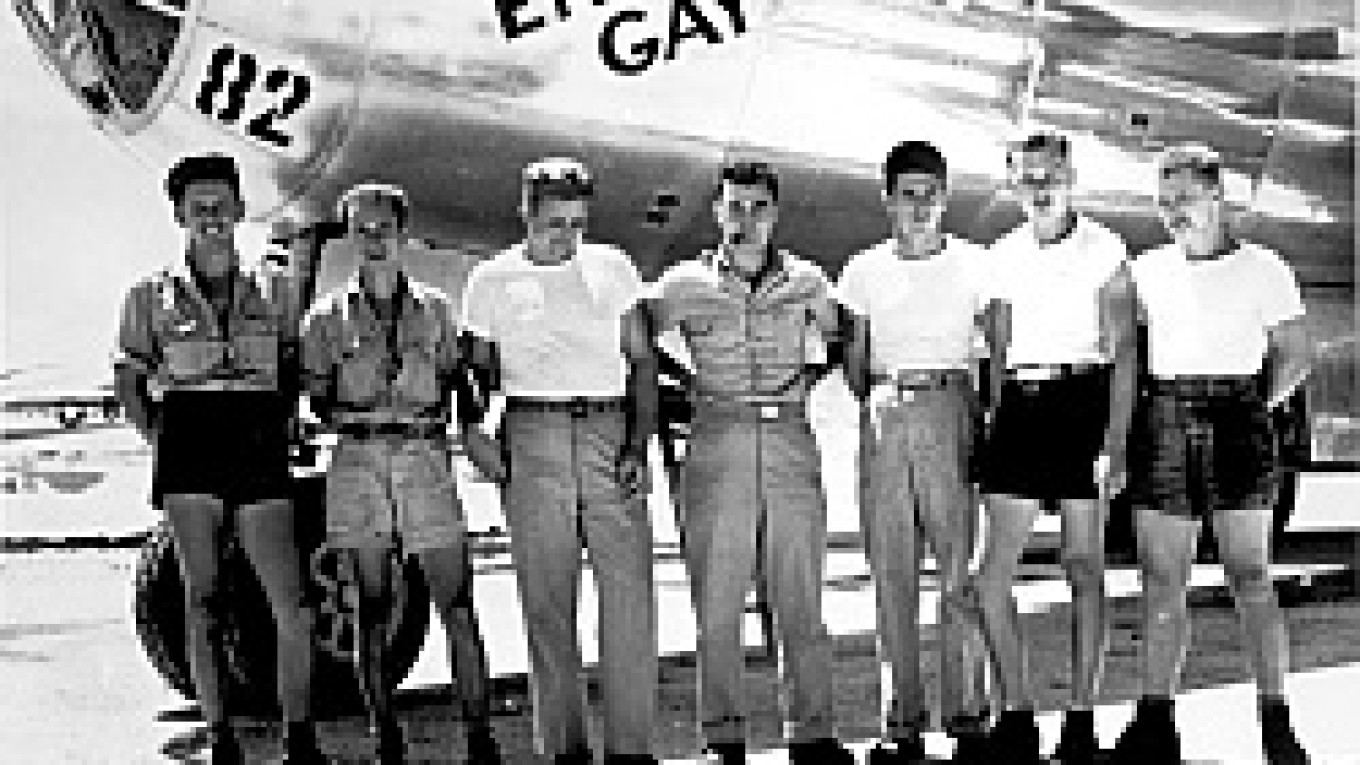
Tibbets died at his Columbus home after a two-month decline in his health stemming from a variety of health problems, said Gerry Newhouse, a longtime friend.
Tibbets had requested no funeral and no headstone, fearing that it would provide his detractors with a place to protest, Newhouse said.
"It's an end of an era," said Newhouse, who served as Tibbets' manager for a decade. "A lot of those guys are gone now."
Tibbets' historic mission in the plane Enola Gay, named for his mother, marked the beginning of the end of World War II. It was the first time man had used nuclear weaponry in conflict.
It was the morning of Aug. 6, 1945, when the plane and its crew of 14 dropped the five-ton "Little Boy" bomb over Hiroshima. The blast killed 70,000 to 100,000 people and injured countless others.
"I knew when I got the assignment it was going to be an emotional thing," Tibbets told The Columbus Dispatch for a story on Aug. 6, 2005, the 60th anniversary of the bomb. "We had feelings, but we had to put them in the background. We knew it was going to kill people right and left. But my one driving interest was to do the best job I could so that we could end the killing as quickly as possible."
Tibbets, then a 30-year-old colonel, never expressed regret over his role. It was, he said, his patriotic duty -- the right thing to do.
"I'm not proud that I killed 80,000 people, but I'm proud that I was able to start with nothing, plan it and have it work as perfectly as it did," he said in a 1975 interview.
A Message from The Moscow Times:
Dear readers,
We are facing unprecedented challenges. Russia's Prosecutor General's Office has designated The Moscow Times as an "undesirable" organization, criminalizing our work and putting our staff at risk of prosecution. This follows our earlier unjust labeling as a "foreign agent."
These actions are direct attempts to silence independent journalism in Russia. The authorities claim our work "discredits the decisions of the Russian leadership." We see things differently: we strive to provide accurate, unbiased reporting on Russia.
We, the journalists of The Moscow Times, refuse to be silenced. But to continue our work, we need your help.
Your support, no matter how small, makes a world of difference. If you can, please support us monthly starting from just $2. It's quick to set up, and every contribution makes a significant impact.
By supporting The Moscow Times, you're defending open, independent journalism in the face of repression. Thank you for standing with us.

Remind me later.