

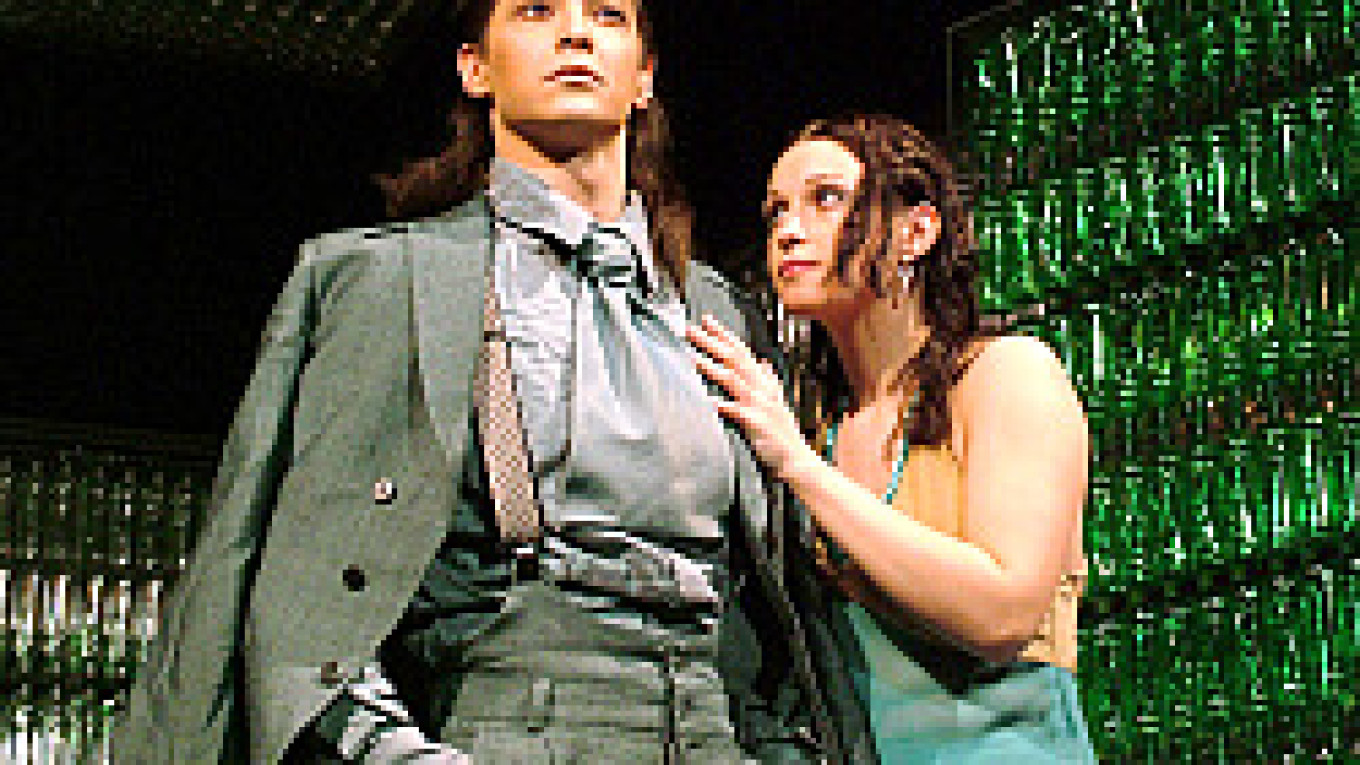
This highly schematic piece leaps forward quickly in time, each scene illustrating a single incident in the lives of Julia and her husband Fernando Krapp before moving on. The Latvian production team, headed by director J. J. Jilinger and designer Martinis Vilkarsis, gave it a slick visual look dominated by semitransparent walls, the bricks of which are actually empty plastic bottles. Depending on the lighting designed by Pyotr Dontsov, the walls reflect mood as they turn various shades of blue and green. The overall impression is of a house of glass, with even the decorations on a glassy table being glass figurines. Choreographer Inga Krasovskaya focused her energies on the character of Julia, who often waltzes across the stage or strikes balletic poses.
Krapp (Alexander Arsentyev) is a mysterious millionaire who apparently resolved to buy the most beautiful woman in town for his wife. He convinced Julia's poverty-stricken father (Viktor Vasilyev) to take her for a walk in the town park one day where he viewed her from afar then wrote her a letter proposing marriage. None of the romantic folderol in Krapp's letter fools the headstrong Julia (Alexandra Ursulyak), who sees right through the deal her father cut with this stranger. She is furious and swears that she will never marry him. Next stop: wedding.
The union of Julia and Fernando is a battle of wits from the start. Both play games with each other and themselves, jockeying for leverage. Julia deals with rumors that Fernando murdered his previous wife. He wants her to see him as a self-made man. "I have no parents," he says. "I gave birth to myself."
From time to time, there are signs that feelings of affection may be growing between the two. In any case, that is the impression each wishes to make. He picks her up and spins her, but is this an act of passion or a way to demonstrate his power over her? She often asks him to say he loves her, but he refuses. He doesn't believe in kisses, pillow talk or signs of affection. He does not hide an affair that he has with a milkmaid in the country, insisting that Julia should understand that her "elegance" in making love makes her look good in any comparison with his cruder lover.
It is not surprising that temptation rears its head when a young count (Alexei Frandetti) begins visiting the couple's home. What is not clear is why he is there. Is he someone Fernando has sent as a test, or is he courting the lady of the house on the sly?
Almost all of the "whys" remain open-ended questions. Even when Fernando accuses Julia of suffering from mental delusions and attempts to have her committed to the care of doctors, answers as to what has transpired are not fully forthcoming.
In Jilinger's production, everything is seen as if through a gossamer veil. The eerily lighted walls, Julia's dancing movements and sing-song voice, the bombastic declarations of her father and the understated but otherworldly mannerisms of the count — all of this adds up to an aesthetic of psychological hyperbole. That sensation is heightened by the abrupt forward leaps in time — events do not unfold naturally but are presented as an accumulation of accomplished facts. Julia resists marriage; Julia marries. Julia resists having an affair; Julia has an affair.
"Letter of Happiness" is steeped in sensations of the surreal. Everything is off-kilter, from the lighting and actors' movements to the personalities of the characters. Fernando gives the impression of being a sick man — a closet tyrant and sadist who lurks menacingly behind declarations that his wife is free and independent. Julia is inscrutable — a strong, intelligent woman who allows herself to be victimized at every turn.
Jilinger's production is strong on aesthetics but weak in what might make Dorst's strange story compelling. This "experiment at melodrama," as the program calls it, is often a lifeless look at two sphinx-like characters. The final hints that Fernando and Julia find common ground in love are entirely unconvincing.
"Letter of Happiness" (Pismo Schastya) plays Fri., May 22 at 7 p.m. at the Pushkin Theater. 23 Tverskoi Bulvar. Metro Pushkinskaya. Tel. 694-1289, 650-1896. www.teatrpushkin.ru. Running time: 1 hour, 40 minutes.
A Message from The Moscow Times:
Dear readers,
We are facing unprecedented challenges. Russia's Prosecutor General's Office has designated The Moscow Times as an "undesirable" organization, criminalizing our work and putting our staff at risk of prosecution. This follows our earlier unjust labeling as a "foreign agent."
These actions are direct attempts to silence independent journalism in Russia. The authorities claim our work "discredits the decisions of the Russian leadership." We see things differently: we strive to provide accurate, unbiased reporting on Russia.
We, the journalists of The Moscow Times, refuse to be silenced. But to continue our work, we need your help.
Your support, no matter how small, makes a world of difference. If you can, please support us monthly starting from just $2. It's quick to set up, and every contribution makes a significant impact.
By supporting The Moscow Times, you're defending open, independent journalism in the face of repression. Thank you for standing with us.

Remind me later.