

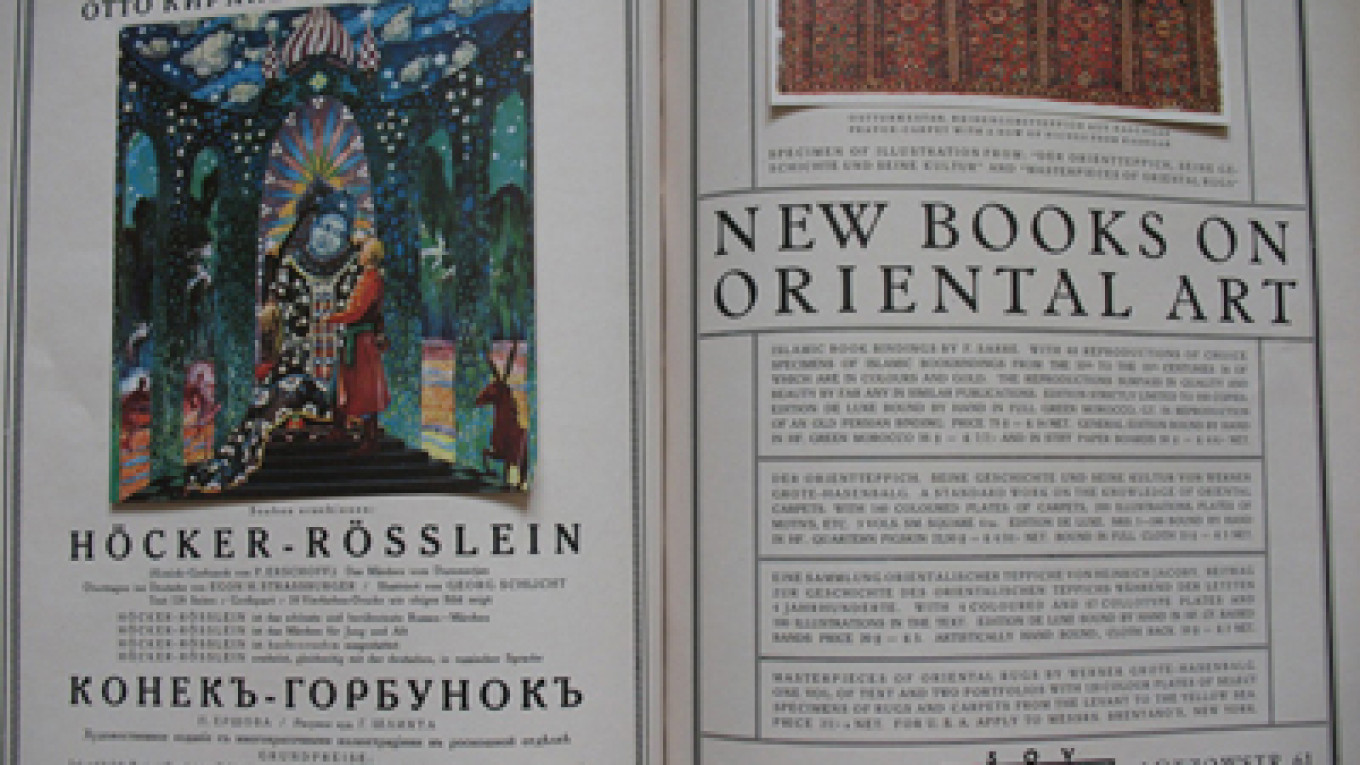
Perhaps the most obvious example of the lengths to which the publisher Alexander Kogan went in order to achieve high quality is a pair of full-page advertisements placed in issue number 10 in 1923. Both ads are graced by detailed, full-color illustrations on plates. Now that’s what I call making an effort to impress potential clients.
The reproductions of paintings by Kustodiyev, Somov, Bakst and others are invariably done in deep, rich color with impeccable accuracy and detail. This is not a slap-dash, off-set printing job.
The collection of authors published and topics covered is endlessly impressive. Poetry by Vladimir Sirin (Vladimir Nabokov) stands next to prints by the great fairy-tale illustrator Ivan Bilibin. A short story by Boris Pilnyak is accompanied by a photograph of a marble sculpture by S. Yuryevich (whose first name I have not been able to verify). An article describing an excursion to Africa taken by the painter Alexander Yakovlev is illustrated with color plates of paintings he did during his travels.
We also find high-quality photographs, some on plates, that I assume have now become rare. These include a portrait of the great Russian painter Ilya Repin sitting with the violinist Cecilia Hansen, for whom Prokofiev wrote a violin concerto in the 1920s; and one of the great choreographer Mikhail Fokin (Michel Fokine) dancing with his wife Vera in “The Marquise” in what appears to be an outdoor setting. I cannot help but mention also a series of photos of the famous ballerina Anna Pavlova. Nearly 100 years after these photos were taken and some 85 years since they were published, the dancer of the images still exudes grace and charisma.
Go to the photo gallery to see these and several other pages from various issues of “Zhar-Ptitsa.”
A Message from The Moscow Times:
Dear readers,
We are facing unprecedented challenges. Russia's Prosecutor General's Office has designated The Moscow Times as an "undesirable" organization, criminalizing our work and putting our staff at risk of prosecution. This follows our earlier unjust labeling as a "foreign agent."
These actions are direct attempts to silence independent journalism in Russia. The authorities claim our work "discredits the decisions of the Russian leadership." We see things differently: we strive to provide accurate, unbiased reporting on Russia.
We, the journalists of The Moscow Times, refuse to be silenced. But to continue our work, we need your help.
Your support, no matter how small, makes a world of difference. If you can, please support us monthly starting from just $2. It's quick to set up, and every contribution makes a significant impact.
By supporting The Moscow Times, you're defending open, independent journalism in the face of repression. Thank you for standing with us.

Remind me later.