

Peter Brook has been called England’s greatest theater director by enough people that it just may be true. But in a career that has spanned six decades and has seen him work in virtually every continent, he has become much more than merely a British director.
Brook?€™s Russian connections, for example, are deep and strong. It is no exaggeration to say his tours to the Soviet Union with “Hamlet” (1955) and ?€?King Lear?€? (1964) had an enormous and lasting impact on Russian theater and cinema. Grigory Kozintsev?€™s famous films of ?€?Hamlet?€? (1964) and ?€?Lear?€? (1972) are only the tip of the iceberg. Many years later, in 1989, Brook?€™s tour to Moscow with ?€?The Cherry Orchard?€? created a massive rush on tickets and pushed ticketless gate-crashers to new levels of ingenuity in order to see the show.
None of this is a coincidence. Brook?€™s own Russian background is well-documented. His parents Simon and Ida Bruk emigrated from the Soviet Union to England in the early 1920s. His cousin Valentin Pluchek was one of the Soviet Union?€™s top directors, running the popular Satire Theater from the 1950s until the turn of the century. The pull of Brook?€™s heritage continued to act upon him even when it came to choosing a wife. Natasha Parry, the actress Brook wed in 1951, was the daughter of a British father and a Russian mother.
But as I learned at an extraordinary public meeting with Brook in Wroclaw, Poland, in the last week of June, the Russian component of Brook?€™s sensibility is pervasive not only in his life but in his perception of himself as an artist.
During an ad-libbed, 75-minute lecture in the jam-packed large hall of the Wroclaw Puppet Theater, Brook repeatedly came back to the Russian influences that have shaped him. This means primarily, though not exclusively, the work of the great experimental directors Konstantin Stanislavsky and Vsevolod Meyerhold.
Brook was in Poland for a festival, The World as a Place of Truth, which honored the memory of the great Polish director and visionary Jerzy Grotowski as an event of the UNESCO-sponsored ?€?Year of Grotowski.?€? The afternoon discussion, hosted by the Grotowski Institute and the American-Polish cultural organization Arden2, began with a screening of ?€?Brook by Brook,?€? a film by Brook?€™s son Simon. This homey, low-key portrait of the artist at rest with his family shows the ever-smiling director as he reminisces about his family, his background and his life in theater and cinema.
Being Russian is one of the most important things that defined his character, Brook suggests in the film. He would have been someone vastly different if he ?€?hadn?€™t been born in 1925, hadn?€™t read Shakespeare and hadn?€™t been Russian.?€?
?€?Because of my Russian heritage, I feel very British and not so British,?€? he declares. ?€?It makes me open to many cultural influences.?€?
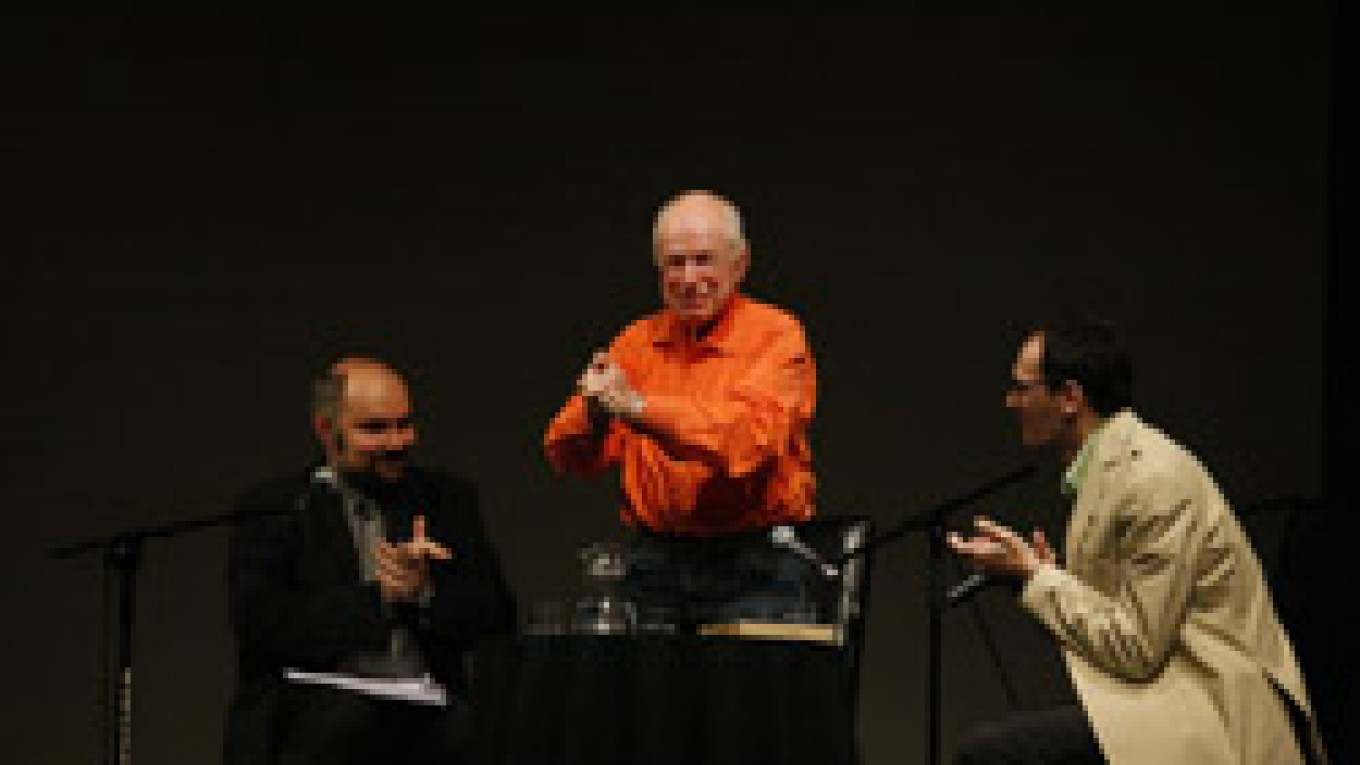
When ?€?Brook by Brook?€? concluded and the real Brook took the stage sporting a bright orange shirt, boredom was the last thing on anyone?€™s mind. The audience greeted him enthusiastically after the director and festival host Jaroslaw Fret said simply, ?€?Ladies and gentlemen, I?€™ll say nothing. Peter Brook is with us.?€? The tumult was replaced by dead silence when the guest took his seat at a table and leaned forward into his microphone to speak. In sharp contrast to the easy-going figure answering his son?€™s questions in the film, the live Brook was intense and focused. Beginning with an excursion into the notion of the ?€?dead old word ‘idealism?€™?€? in art and life, he quickly moved on to such topics as religion, abortion and freedom.
It was a reference to Fyodor Dostoevsky?€™s novel ?€?The Brothers Karamazov?€? that brought the speaker around to the topic of theater. Referring to that novel?€™s character of the Grand Inquisitor as a ?€?warrior for God,?€? Brook paused and then noted that Jerzy Grotowski was a ?€?warrior of theater.?€? By then, Stanislavsky and Meyerhold were not far from his thoughts.
?€?The great discovery of Stanislavsky,?€? suggested Brook, ?€?was to look scientifically?€? at the art of the actor. As the great Russian physiologist Ivan Pavlov studied reflexes in animals, Stanislavsky studied ?€?memory and neurology, allowing an actor to know something about his work.?€?
Meyerhold, Brook continued, ?€?took science in a different direction.?€? By exploring what happens when the human body is ?€?made totally expressive?€? and body gestures ?€?do not copy everyday movements,?€? Meyerhold created biomechanics, a system of physical actor training.
Until Grotowski came along in the 1960s and ?€?took things infinitely farther,?€? the discoveries of Stanislavsky and Meyerhold in the early 20th century were ?€?enough to keep people busy for half a century,?€? Brook quipped.
A Message from The Moscow Times:
Dear readers,
We are facing unprecedented challenges. Russia's Prosecutor General's Office has designated The Moscow Times as an "undesirable" organization, criminalizing our work and putting our staff at risk of prosecution. This follows our earlier unjust labeling as a "foreign agent."
These actions are direct attempts to silence independent journalism in Russia. The authorities claim our work "discredits the decisions of the Russian leadership." We see things differently: we strive to provide accurate, unbiased reporting on Russia.
We, the journalists of The Moscow Times, refuse to be silenced. But to continue our work, we need your help.
Your support, no matter how small, makes a world of difference. If you can, please support us monthly starting from just $2. It's quick to set up, and every contribution makes a significant impact.
By supporting The Moscow Times, you're defending open, independent journalism in the face of repression. Thank you for standing with us.

Remind me later.