

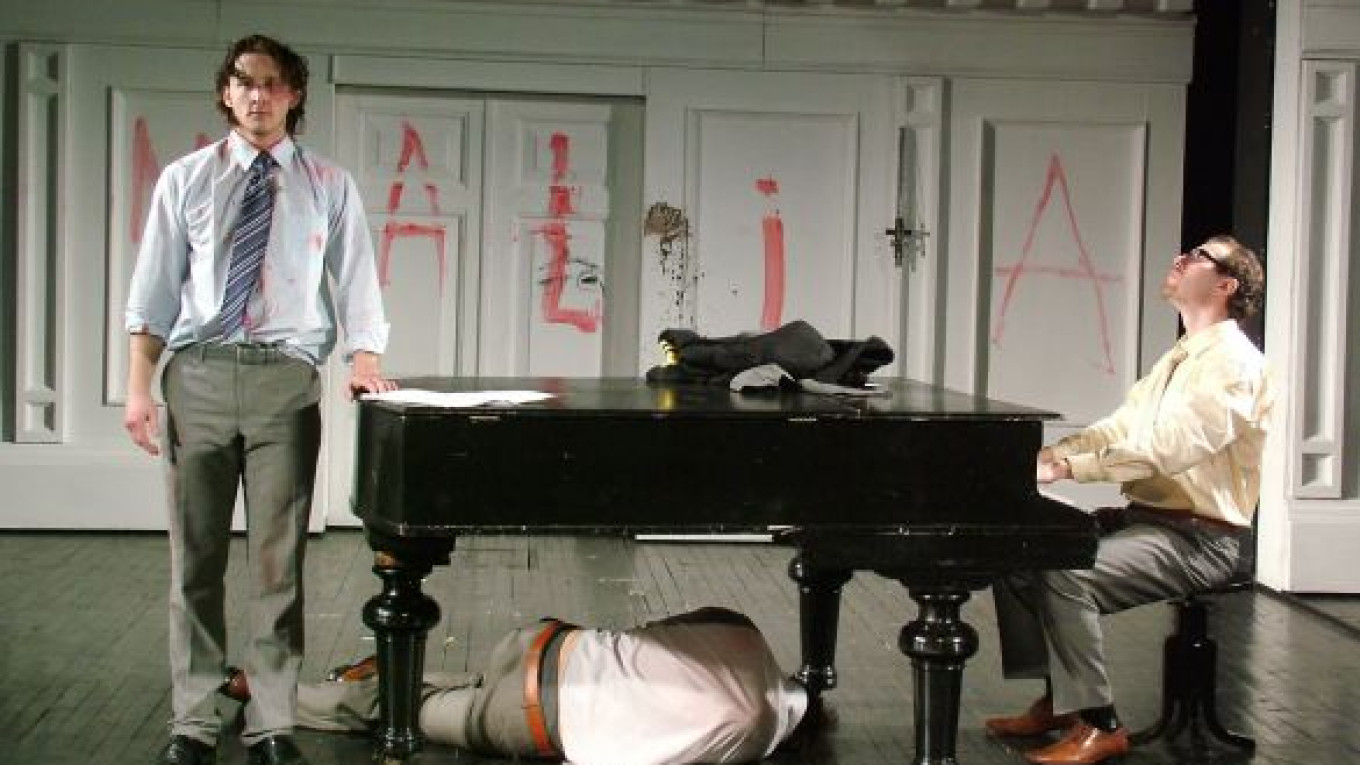
The dramatic theater debut of director Vasily Barkhatov in the final days of 2009 was a relatively understated event. The reputation of this wunderkind in his mid-20s was established by eye-catching opera productions at the Helikon Opera, the Rostov Musical Theater and, most prominently, the storied Mariinsky Theater in St. Petersburg.
A production of Friedrich Schiller’s drama “The Robbers” in Moscow’s tiny affiliate of the Pushkin Theater hardly seemed a big event. But all things are relative, and there is nothing understated about Barkhatov’s take on “The Robbers.”
Frankly, I don’t recall the last time that I’d seen a Moscow production as inventive, bold and dynamic.
Still, let’s avoid dithyrambs by adding that the director’s audacity does not always contribute to the production’s success. The show’s pacing often bogs down or is lost altogether. Some digressive scenes seem pointless or counterproductive. The generous inclusion of songs by Franz Schubert sometimes enhances, sometimes obscures, the goings-on.
But in the grand scheme of things this is nit-picking at best. The fact is this: Barkhatov staged a smart, fascinating, ultramodern, and entirely unexpected version of a play that has gathered a good deal of dust over the centuries.
Schiller, surely drawing inspiration from the subplot of the brothers Edgar and Edmund in Shakespeare’s “King Lear,” wrote a recognizably Germanic and romantic play about two out-of-control siblings who make a mess of their lives and destroy more than their aging father’s peace of mind.
The source of the familial conflict is — what else? — the inheritance. Younger brother Franz (Yevgeny Plitkin) sets his father against older brother Karl (Vladimir Motashnev) by fabricating tales about Karl’s activities and falsifying correspondence. Franz also has his eye on his brother’s sweetheart Amalia (Anastasia Lebedeva), who was taken in by the family and dotes on the increasingly ill and irritable old patriarch Maximilian von Moor (Yury Rumyantsev).
When Karl learns that he has been disinherited, he explodes in bitterness and anger. Seeking revenge not only on his heartless father but on the unjust society that his father represents and the indifferent universe of which he is a part, he resolves to become a marauding brigand. He is joined by a band of friends, and thievery, mayhem and murder become their business and their lifestyle.
One of the band’s shining moments is robbing a church and instigating a riot during which 83 people are killed.
Barkhatov set the story in modern days. His costume designer Alexandra Polidi clothed everyone in contemporary dress, and designer Zinovy Margolin set the action in a transformable space dominated by a white wall that moves up and down the stage, sometimes coming to rest right at the feet of spectators in the front row. Modern technology is everywhere in evidence — computers, the Internet, Skype broadcasts, video cameras, cell phone text messaging, electronic doors zipping open and zipping closed.
By bringing in a comic YouTube video of “robbers and killers” and a so-called blooper video of “silly suicide bombers,” Barkhatov clearly denies that this play has anything to say about modern terrorism. Karl and his cohorts are little more than a group of fraternity brothers run amuck, children of privilege thumbing their nose at the rest of the world.
It is these videos, some running for a very long time, that occasionally stop the show’s forward momentum. On the other hand, the brashness of it all contributes to the sense that this is a show that responds to the world we inhabit.
Cinematic images of Stalin in his coffin, John F. Kennedy being shot and a Jewish star fashioned out of black ribbons are other historical and cultural images that Barkhatov tosses into the mix, thus yanking Schiller’s play out of its origins in the late 18th century.
There are wisps of moments in the course of this tale when one is tempted to think of redemption or justice. But they pass quickly, like bad dreams or New Year’s resolutions.
Amalia’s love and constancy surely imply some positive force, although there isn’t the vaguest shadow of sentimentality in that. Karl is furious when learning that one of his gang members killed a child, but he never considers changing his ways. And Karl’s trusted friend Schweizer (Igor Teplov) proves to be a man of his word to the death, but that, too, only means more bloodshed.
Barkhatov’s production of “The Robbers” is an ironic and theatrically inventive take on a tale of excess and cynicism. It makes me want to see more from this director.
“The Robbers” (Razboiniki) plays Fri., Sat. and Sun. at 7 p.m. at the Pushkin Theater affiliate, located at 3/25 Sytinsky Pereulok. Metro Pushkinskaya. Tel. 650-1896, www.teatrpushkin.ru. Running time: 2 hours, 35 minutes.
A Message from The Moscow Times:
Dear readers,
We are facing unprecedented challenges. Russia's Prosecutor General's Office has designated The Moscow Times as an "undesirable" organization, criminalizing our work and putting our staff at risk of prosecution. This follows our earlier unjust labeling as a "foreign agent."
These actions are direct attempts to silence independent journalism in Russia. The authorities claim our work "discredits the decisions of the Russian leadership." We see things differently: we strive to provide accurate, unbiased reporting on Russia.
We, the journalists of The Moscow Times, refuse to be silenced. But to continue our work, we need your help.
Your support, no matter how small, makes a world of difference. If you can, please support us monthly starting from just $2. It's quick to set up, and every contribution makes a significant impact.
By supporting The Moscow Times, you're defending open, independent journalism in the face of repression. Thank you for standing with us.

Remind me later.