

Sberbank and VTB own or hold mortgages on nearly every building going up in the Moskva-City business district, an unexpected outcome of the financial crisis that has forced the state banks to add the risky portfolio of real estate to their traditional business of lending.
The shift provides an insight into the depth of the banks’ loan exposure ahead of the crisis last fall, and it raises questions about their vulnerability in delving into a sector usually left to developers and construction companies.
At the same time, the two banks are shouldering the grandiose dream that Moskva-City will help turn Moscow into an international financial center.
The rising business district, located on the banks of the Moscow River just five kilometers west of the Kremlin, carries a total price tag of $15 billion, and $9 billion has been invested so far, said an official with City Management Company, which oversees the undertaking.
“Practically all the projects are being financed by Sberbank or VTB,” said Sayan Tsyrenov, an analyst with Cushman & Wakefield Stiles & Riabokobylko, referring to the buildings under construction at Moskva-City. “And it’s quite likely that projects started with the help of these two state banks will be finished.”
Industry watchers are worried about VTB’s and Sberbank’s exposure to real estate.
“Moody’s rating agency is particularly concerned because of Russian banks’ exposure to the real estate and construction sectors, be it through loans or repossessed collateral,” said Moody’s analyst Yevgeny Tarzimanov.
Those loans accounted for a high 40 percent of Sberbank’s Tier 1 capital and more than 100 percent of VTB’s at the end of last year, he said.
“We believe that the probability of default in these sectors ranges from 25 percent to 45 percent, or two times higher than for other types of corporate lending,” Tarzimanov said.
When Sberbank and VTB started extending millions of dollars in loans to Moskva-City developers, they hardly expected to be repaid in square meters. The single exception is the West Tower of the Federation Tower skyscrapers, built by Mirax Group to serve as VTB’s headquarters.
But the developers took a severe jolt when the crisis abruptly cut their financial flows, and they started relinquishing assets or freezing work.
One major developer, Capital Group, not only managed to restructure a $400 million debt but also received an additional $180 million by giving Sberbank 60,000 square meters of space in the twin City of Capitals skyscrapers — called Moscow and St. Petersburg — towers with offices, stores and apartments. The project is now practically complete, with Capital Group putting the final touches on the buildings’ lobbies.
Capital Group manages the 288,700-square-meter property, which includes 101,000 square meters of apartments, under an agreement signed with Sberbank Capital, the bank’s investment branch set up last year, in part to handle its real estate assets. Capital Group spokeswoman Dinara Lizunova welcomed Sberbank’s involvement, saying, “This is a hallmark project for us.”
Sberbank officials refused to comment on Sberbank Capital for this article. Sberbank and VTB have called themselves “strategic partners” of the developers.
Sberbank Capital’s main job is probably to package its properties financially, making them ready for sale, property consultants said. “There is no reason for banks to keep an unfinished building on their balance sheets, and they will keep investing,” said Vladimir Pinayev, a director with Jones Lang LaSalle. “The banks will start selling the acquired property when the market is on the rise.”
VTB, meanwhile, has taken over Imperia, a twin-building complex with offices, apartments, shops and a water park that developer MCG has been constructing with VTB loans for the past two years. “The last loan tranche allotted for this project was disbursed in June,” VTB spokesman Sergei Kopytov said.
VTB also owns 58,600 square meters of the West Tower of Mirax’s twin-building Federation Tower complex — which it has always wanted for its headquarters — and will move in next year, Kopytov said.
“The entire space is for VTB offices,” Kopytov said.
A Mirax official said the Federation Tower Management Company, which is part of Mirax, manages the entire Federation Complex under a deal with VTB.
If arrangements where banks control the finances and developers manage the property prove successful, many more could follow.
“Banks probably won’t have any other solution than to take over square meters in the skyscrapers, and we might see more of this in the coming year and a half,” said Sergei Dyomin, general director of Snegiri Development, whose own project, City Palace, is frozen.
City Palace, a 48-floor skyscraper long awaited by Muscovites for its 2,000-square-meter wedding palace, is a 50/50 venture between Snegiri and Inteko, controlled by Yelena Baturina, wife of Mayor Yury Luzhkov. Dyomin said the companies invested $30 million each into the project before freezing it because of “unfavorable market conditions,” which he said would last for at least another year.
“If I knew that in one year the situation would stabilize, I would finish the structure, and we’d find the resources,” he said.
The current troubles buffeting Moskva-City are something of a hallmark of the project itself, which has suffered a series of ups and downs since first being proposed by Soviet architect Boris Tkhor in 1991.
Tkhor proposed the creation of the business district as Moscow’s answer to London’s Canary Wharf, Paris’ La Defense and New York’s Lower Manhattan. The district, he said, should symbolize the new Russia, inspired by winds of freedom and private entrepreneurship.
Then-Mayor Gavriil Popov supported the proposal, and a 60-hectare industrial zone in the historical Presnya district was set aside for 4 million square meters of offices, apartments and leisure and transportation facilities. Demolition teams quickly tore down 20 old factories, including several concrete producers, that stood in the area.
Tkhor faced a dilemma with the concept for Moskva-City. He felt that the district had to somehow resemble the Kremlin but at the same time distance itself so as not to detract from the architectural heart of historical Moscow.
To make it look like the Kremlin, Tkhor proposed that its highest skyscraper be called the Russia Tower and be surrounded by other tall buildings, mimicking the imposing Ivan the Great Bell Tower, which sits in the conceptual center of the Kremlin.
Over the years, Moskva-City’s management structure changed several times, and Tkhor, who won an architectural award for his Moskva-City concept, left in 1995 after he was demoted in a shakeup.
The first construction work started that year, and the Moscow city government has been a key investor in its infrastructure ever since, constantly adapting it to Moscow’s realities.
“This year, the Moscow government had to cut its budget for road infrastructure by two-thirds, and it has a goal of finishing two road projects that were started last year,” said a City Hall spokesman, referring to plans to connect the North Entrance — the main street into Moskva-City — to the intersection of Zvenigorodskoye Shosse and the Third Ring Road.
The spokesman also said a city department has been created to help Moskva-City developers get access to money to finish their projects. “Its key role is to attract additional financial resources, primarily through bank credits for problem developers,” the official said.
But while the department scrounges around for money, work is at a standstill at many sites. A visit reveals gaping pits filled with wooden planks and idle construction equipment.
The three main projects have been frozen at the pit stage — all of which failed to get support from VTB or Sberbank, according to an official construction site report prepared by the City Management Company, which supervises infrastructure and security at the site in cooperation with the Moscow city government and developers.
The frozen pits include City Palace, ST Group’s Russia Tower and the Transport Terminal, a critical transfer point between Moscow’s metro lines and other public systems and planned high-speed lines to the city’s airports.
The finished projects include one of Mirax’s Federation towers, the City of Capitals, the Naberezhnaya Tower, the Northern Tower, Tower 2000 and the Bagration pedestrian bridge. Finished infrastructure projects include a new autonomous thermoelectric power station with a capacity of 232 megawatts.
City Management Company vice president Dmitry Grankin said seven of the initially planned 24 skyscrapers have opened, with a combined 700,000 square meters of space, and another 1.5 million square meters will be finished within the next 12 months.
“The initial plan was to gradually increase the activity in the Moskva-City skyscrapers because, otherwise, it would not be possible to supply all the buildings at once with the appropriate infrastructure,” Grankin said. “We advocate sustainable development for the Moskva-City project.”
Crucial to Moskva-City is the so-called Central Core, a curved complex of low-rise buildings that includes a congress hall, a hotel and the giant Mall of Russia, which is to be built by 2010 by AFI Development. The Central Core is also financed by VTB, with the construction arm of AFI Development being 100 percent mortgaged to the bank.
Grankin showed a map of the gigantic underground infrastructure of interconnected passages that will be built at “Level Minus One” in the Central Core. The passages, spread over two-thirds of Moskva-City, will allow people to access every building in the district.
Meanwhile, Moskva-City resembles a phantasmagorical project, with the shiny windows of completed skyscrapers reflecting the cavernous pits beside them. A Renaissance Capital employee who works in one of the finished skyscrapers said the infrastructure was improving and a cafeteria had opened next door. But he did not like the view of the desolate, gaping pit from his 50th-floor window.
Moskva-City Development | |||
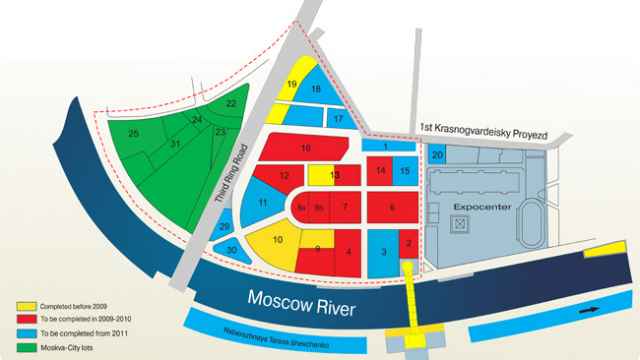 | |||
| Name: Tower 2000 Office Complex
Area: 61,000 square meters Investor: Taken over by city Status: Operational | 2, 3 Name: City Palace, Wedding Palace
Area: 169,000 square meters Developers: Snegiri and Inteko Status: Frozen | 4 Name: Imperia Tower
Area: 281,245 square meters Developer: MosCity Group Investor: VTB Status: To be completed in 2010 | 6, 7, 8 Name: Mall of Russia
Area: 550,000 square meters Developer: AFI Development Investor: 100 percent mortgaged to VTB Bank Status: To be completed by 2010-2011 |
| 9 Name: City of Capitals
Area: 288,680 square meters Developer: Capital Group Investor: Fully financed and partly owned by Sberbank Status: South Tower operational, Moscow Tower and St. Petersburg Tower to be completed in 2010 | 10 Name: Embankment Tower
Area: 265,602 square meters Developer: Enka Group Investor: City Center Investment Status: Operational | 11 Name: Transport Terminal Complex
Area: 228,000 square meters Developer: CiTer Invest Status: Frozen | 12 Name: Eurasia Tower
Area: 208,264 square meters Developer: Bovis Lend Lease Status: To be completed by the end of 2010 |
| 13 Name: Federation Complex
Area: 439,436 square meters Developer: Mirax Group Investor: Financed and partly owned by VTB Status: West Tower operational, East Tower to be completed by 2011 | 14 Name: Mercury Tower
Area: 158,528 square meters Developer: Mercury City Tower Status: Foundation being built, project to be completed in 2010-2011 | 15 Name: Moscow Government Administrative Complex
Area: 636,332 square meters Developer: Moskapstroi Status: To be completed in 2013 | 16 Name: Multifunctional Complex
Area: 396,000 square meters Developer: Lisario Trading Status: Frozen |
| 17, 18 Name: Russia Tower
Area: 500,000 square meters Developer: ST Towers (Russian Land) Status: Frozen — may be turned into parking lot | 19 Name: Northern Tower Complex
Area: 139,323 square meters Developer: Northern Tower Status: Operational | 20 Name: Multifunctional Complex
Area: 180,000 square meters Developer: City Status: Approval pending | 32 Name: Multilevel parking garage beneath the Third Ring Road
Area: 20,130 square meters Investor: City Center Investment Status: To be completed in 2010 |
|
Source: City Management Company | |||
A Message from The Moscow Times:
Dear readers,
We are facing unprecedented challenges. Russia's Prosecutor General's Office has designated The Moscow Times as an "undesirable" organization, criminalizing our work and putting our staff at risk of prosecution. This follows our earlier unjust labeling as a "foreign agent."
These actions are direct attempts to silence independent journalism in Russia. The authorities claim our work "discredits the decisions of the Russian leadership." We see things differently: we strive to provide accurate, unbiased reporting on Russia.
We, the journalists of The Moscow Times, refuse to be silenced. But to continue our work, we need your help.
Your support, no matter how small, makes a world of difference. If you can, please support us monthly starting from just $2. It's quick to set up, and every contribution makes a significant impact.
By supporting The Moscow Times, you're defending open, independent journalism in the face of repression. Thank you for standing with us.

Remind me later.