

Off-stage, that is.
Most recently, the Culture Committee of the Moscow city government made a high-profile move to "reorganize" Anatoly Vasilyev's world-famous School of Dramatic Art. The committee's aim is to take away a building Vasilyev has occupied since 1987 and turn it over to the experimental, youth-oriented Open Stage project. Vasilyev, a reclusive and sometimes abrasive artist, has won an army of devotees over a 33-year career with numerous exquisitely structured productions. He has also earned formidable opponents due to his staunch refusal to play by the common rules of the theater game.
The scandal that has flared around him now has thrown a shrill and uneasy note into the waning days of the season. It is not the only backstage drama of the season by any stretch of the imagination, however.
Things got off to a stormy start last November when a secret plan to restructure federal budget expenditures -- including the way theaters are run and financed -- was leaked to the public. Managers and directors were horrified to learn that the state was preparing, on Jan. 1, to insert its own people into controlling administrative positions at each theater. Of the many potential dangers perceived in this move, not the least was the possibility of a return to censorship, direct or indirect.
The resulting hue and cry helped postpone the implementation of the new measures. In February, President Vladimir Putin and Moscow Mayor Yury Luzhkov had separate meetings with top theater personalities and each promised that no further action would be taken without the input of the theater community. Nevertheless, many still believe an ax is poised to fall.
All this took place in parallel with the trial of Mikhail Khodorkovsky, the former head of the Yukos oil company, on charges of tax evasion. Although this event -- ending with a conviction and nine-year prison sentence in May -- had utterly no connection to theater, it was a spectacle in its own right. Street demonstrations for and against the embattled oligarch, combined with the media confrontation between prosecutors and defense attorneys, made for a colorful and emotionally gripping show.
Now, with the Prosecutor General's Office investigating former Prime Minister Mikhail Kasyanov for the alleged illegal purchase of a private residence, the Khodorkovsky trial has been fitted neatly with a dramatic epilogue. Khodorkovsky was active in financing opposition political parties, while Kasyanov is seen as a possible contender to replace Putin when his term expires in 2008. Could these cases be examples of the state playing hardball with potential rivals?
Whatever the answer, Moscow theater clearly had an ear cocked to the sounds that were blowing in the wind this season. In an extremely rare coincidence, three theaters almost simultaneously revived a 19th-century tragifarce, "The Death of Tarelkin," about corruption, police brutality and government bullying of private citizens. Meanwhile, after more than a decade in which the figure of Josef Stalin was completely absent from theatrical and dramatic works, he again came to life as a character in three different productions.
The Vasilyev-Open Stage brouhaha is another sign that fundamental change is imminent in the theater world. It is uncertain where the next incidents will arise and into what territory they will take us, but what is almost guaranteed is that the status quo will soon be shaken by additional tremors.
The high-stakes nature of these developments is reflected in comments made by the principle parties in the conflict.
Vasilyev has called for the resignation of Sergei Khudyakov, the chairman of the Culture Committee, and has stated repeatedly that if his theater is deprived of buildings No. 18 and 20 on Povarskaya Ulitsa, he will consider "ending the life of the School of Dramatic Theater" after fulfilling his current contract to run the theater through 2007. "I don't know what will come next," he told the newspaper Gazeta earlier this month, "but in these two years I apparently will have to prepare my successor." It is rumored that Vasilyev might leave Russia altogether and work in Europe, where he is highly regarded.
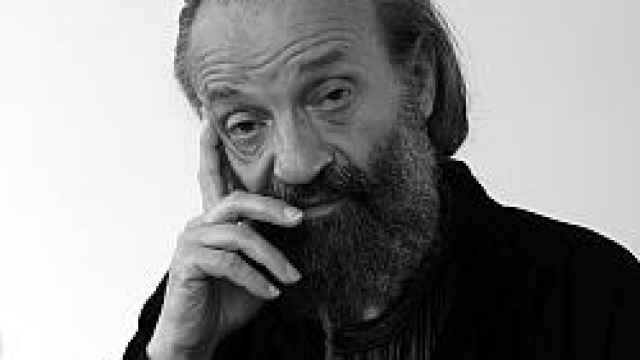
Vladimir Lupovskoy / For MT Anatoly Vasilyev has gained international fame for his carefully crafted productions, but he has also been criticized for not staging enough shows. |  |
| |
According to an official city order signed by Luzhkov in the first week of July, Vasilyev will be deprived of just under 4,800 square meters of rehearsal, performance and dormitory space at two locations: the Povarskaya buildings, where he will lose the most space, and his other physical plant located at 21/28 Ulitsa Sretenka. The Povarskaya location has been the place of genesis for several of Vasilyev's most famous productions in the last 18 years and, as many commentators have noted, it is therefore of notable historical significance. The School of Dramatic Art is to retain control of the 10,284 square meters at 19 Ulitsa Sretenka, a state-of-the-art complex of rehearsal rooms, administrative offices and three stages that was built in 2001.
Speaking for Khudyakov, who was unavailable to comment for this article, his deputy Andrei Porvatov seemed to sound a conciliatory note during a recent interview. Porvatov acknowledged that Vasilyev's work as a director and educator has been "unique" and suggested it is not the committee's intent to push him out of the buildings on Povarskaya altogether. He declared that the changes would be of a purely "administrative" nature; that Vasilyev could continue to use the space, but that he would have to share it with others.
When asked who specifically would be put in charge of the Povarskaya location, Porvatov admitted there is no candidate as of yet. Furthermore, he said, "The directorate has not been created yet and I don't know how the reorganization will be carried out in practice." He granted that the space -- which was specifically devised by Vasilyev and his colleague, the designer and architect Igor Popov, to be used as a school and training center -- is of historic importance. "I think the space will be preserved," Porvatov added.
Boris Yukhananov, a former student of Vasilyev's whose own production of "The Tale of an Upright Man" was performed with success on the Povarskaya stage this season, is not impressed by the official version. He called "insane" the notion of Vasilyev "sharing" a space that he molded with his own specific artistic goals in mind. "A theater is being destroyed," Yukhananov stated in a recent interview. "And I suspect the bureaucrats don't realize this." He pointed out that many great directors, including the Italian Giorgio Strehler and the Russian Vsevolod Meyerhold, were criticized in their time for "creating too few shows" but that quantity is no measure of quality.
Yukhananov pointed to another danger: the corruption of the Open Stage project. "It is monstrously seductive to tell a young, hungry artist that he can step into this space and work," he said. "It is worse than a porno club."
The Open Stage program came about in the early 2000s as a way to finance independent productions by directors whose ideas did not suit the plans of traditional theaters. Porvatov said that approximately 200 applications for grants of up to $20,000 were made each year. Between 50 and 70 applicants are awarded grants. The overall annual budget for the program stands at around 30 million rubles (just over $1 million). Indeed, it has been a great boon to the advancement of many a young director's career.
But will future grantees enter a space that has been developed and used for 18 years by -- and taken from -- one of the world's most celebrated theater artists? A random and unscientific poll of 10 young directors provided intriguing results: Not one said he or she would work in a space that Vasilyev had been forced to vacate.
Vladimir Ageyev, a four-time grantee, echoed the general sentiment. "This is a tragic mistake," Ageyev said in recent interview. "I don't want to blame anyone. But I must ask: Is Vasilyev's theater really the only space the city can find?"
It is likely that the action taken against the School of Dramatic Art is the beginning of a new phase in the development and realignment of post-Soviet theater. Porvatov admitted that the city will soon be "taking inventory" of all the city's theater spaces. "We are already thinking of how to deal with some other theaters," he said.
If so, look for the backstage histrionics to continue next season.
A Message from The Moscow Times:
Dear readers,
We are facing unprecedented challenges. Russia's Prosecutor General's Office has designated The Moscow Times as an "undesirable" organization, criminalizing our work and putting our staff at risk of prosecution. This follows our earlier unjust labeling as a "foreign agent."
These actions are direct attempts to silence independent journalism in Russia. The authorities claim our work "discredits the decisions of the Russian leadership." We see things differently: we strive to provide accurate, unbiased reporting on Russia.
We, the journalists of The Moscow Times, refuse to be silenced. But to continue our work, we need your help.
Your support, no matter how small, makes a world of difference. If you can, please support us monthly starting from just $2. It's quick to set up, and every contribution makes a significant impact.
By supporting The Moscow Times, you're defending open, independent journalism in the face of repression. Thank you for standing with us.

Remind me later.