

I began writing regularly about Moscow theater just over 20 years ago. It was for a pre-Moscow Times publication called The Moscow Guardian — a kind of weekly newsletter for foreigners. But in seven months’ time, a rather frumpy MT logo had replaced the earnest, even more frumpy, Moscow Guardian logo; the stories were printed on real newsprint; and the whole organization moved into a spiffy new office — a bunch of hotel rooms lined up on either side of a single corridor in the Radisson Slavyanskaya Hotel.
I have Betsy McKay and an unnamed heroine to thank for the turn my life took in 1991. The unnamed heroine comes first.
Throughout the first half of 1991, I was going to the theater with some frequency. I had written two articles on commission for an American journal about the theater scene, and that had gotten me into the swing of that particular sport.
One night, when attending a production of the Sibilyov Studio, which performed in an upstairs room at a Culture House not far from Belorussky Station, I was approached by a well-dressed woman who looked vaguely familiar and spoke with a lovely French accent.
“I see you often at the theater,” she said. “Do you ever do anything with it?”
“Oh, no,” I said, wondering what I could possibly “do” with theater. I’ve never memorized more than a single sentence in my life — and that with extreme difficulty — and I have a catastrophic fear of standing in front of people. The only acting I had ever done was when I was 8 years old. Our Spanish class put on a play for our parents, and my role suited me to a T. I lay on a sofa and came down with a stomach ache before rolling around and repeating two or three times, “O, mi estomago! O, mi estomago!”
Oh, my aching belly, indeed. I didn’t have to act. I was so terrified my stomach really did hurt. In fact, I’ve got a nasty case of butterflies even now as I recall that pitiful situation.
So, no, I don’t do anything with theater.
“Well,” the Frenchwoman said in a way that was so cultured and convincing that I couldn’t help but listen carefully, “maybe you’d like to write about it? I am doing some advertising for a new English-language newsletter, and I know they need stories.”
I can’t say I saw light bulbs immediately illuminate a whole future life’s work. But I did say, “Hmm, interesting.”
To my chagrin, I cannot remember the name of this messenger of fate. I am, however, indebted to her for the life I now live.
Betsy McKay was so important at The Moscow Guardian and, later, The Moscow Times, that she even got her own feature story when she left Russia to go home to the United States in 1999.
One line especially stands out for me when I read the piece now: “There were lots of opportunities for aspiring reporters back then. ‘You could just show up at the paper, and you’d be hired right away,’ McKay said.”
Well, yes. You could. I know. I did.
I showed up one early afternoon at the office, which then was located in a back courtyard off of Ulitsa Maroseika.
I found Betsy McKay and introduced myself. I told her what my French guardian angel had said and asked whether she would like me to write something about theater.
Betsy, who is one of the brightest and friendliest people I have ever met, thought for half a second and said, “You know?? ... I’ve got to fill a page. Could you write me something right now?”
Yes, there are days and moments like this. A comet makes the dinosaurs obsolete. An apple falls on Newton’s head. Benjamin Franklin flies a kite in a storm. Betsy McKay asks John Freedman whether he could write her an article.
Right now. That’s what she said, right now.
I was then working on a book. I’d been at it for a year. I had written a dissertation. That took me two. I used to take days to write my mother a letter. I couldn’t possibly sit down and write something right now. I didn’t know that that could be done.
“Sure,” I said. “I can do that.”
Betsy led me down a short corridor to a mostly empty room where one of those old boxy Macintosh computers stood forlornly on a table amid a few stray pieces of paper.
“You can use this,” she said, pointing at the Mac. “I need your copy in three hours. Let me know when you’re done.” And she left the room.
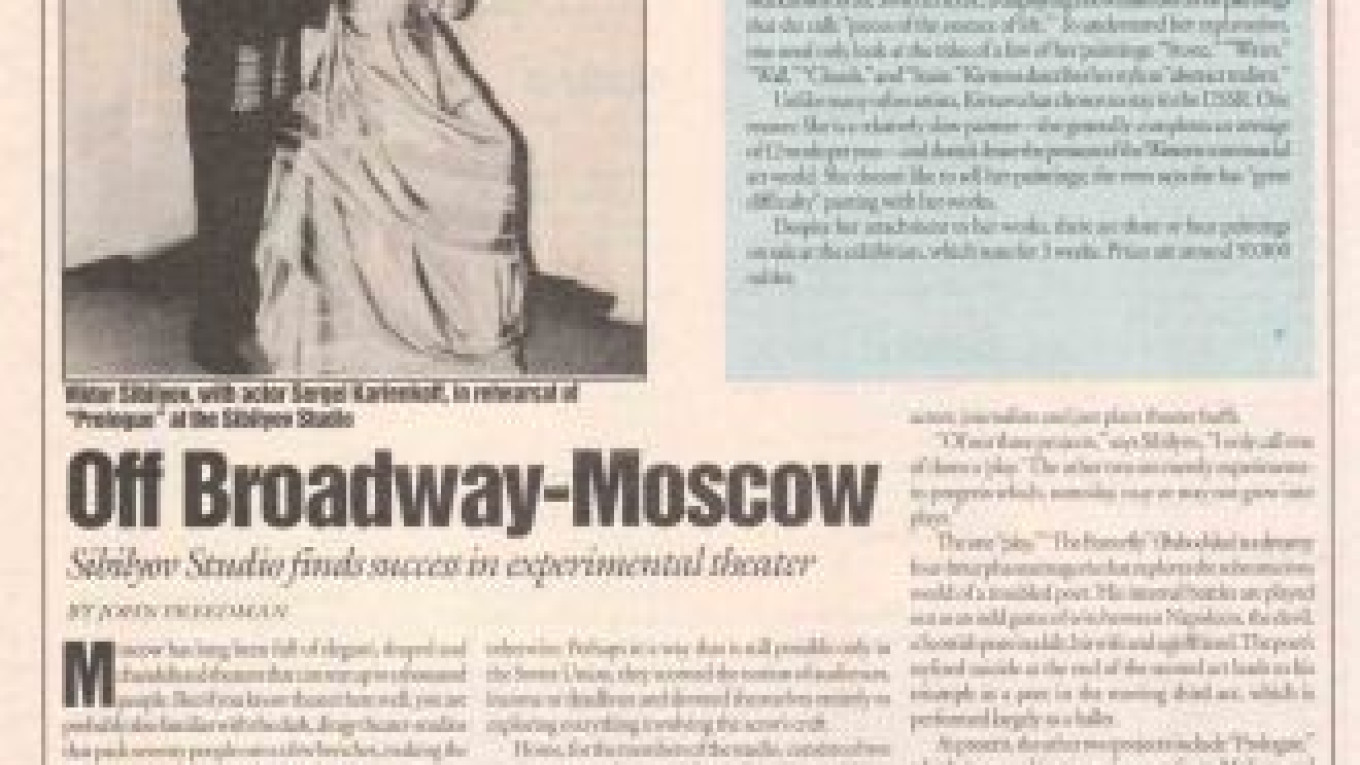
About two hours and 50 minutes later, I filed my first Moscow theater review. When I sat down before the keyboard, I didn’t have the vaguest notion what I would write or what I would even write about. But I put my fingers to the keys, and out came a wobbly, pretentious and woefully amateur review/feature about the Sibilyov Studio.
A few days later, on July 19, 1991, I stopped by to see Betsy again and pick up some copies of the edition carrying my piece, “Off Broadway-Moscow: Sibilyov Studio finds success in experimental theater.” I asked Betsy whether she would be interested in another piece. She said, “Sure.” I wrote it, she published it.
After returning to Moscow from summer vacation in the States — where I watched the first coup unfold on television — I finally made my way back to Betsy McKay. I had a new idea for an article. She published it. And then I had more, and she published those, too.
Obviously, old habits die hard. When I sat down to write this piece, I had only the vaguest notion of what I would write. I thought I might do an overview of those early years, when Moscow and Moscow theater were so very different from what they are today. But I couldn’t get past Betsy McKay and my French messenger of fate.
A Message from The Moscow Times:
Dear readers,
We are facing unprecedented challenges. Russia's Prosecutor General's Office has designated The Moscow Times as an "undesirable" organization, criminalizing our work and putting our staff at risk of prosecution. This follows our earlier unjust labeling as a "foreign agent."
These actions are direct attempts to silence independent journalism in Russia. The authorities claim our work "discredits the decisions of the Russian leadership." We see things differently: we strive to provide accurate, unbiased reporting on Russia.
We, the journalists of The Moscow Times, refuse to be silenced. But to continue our work, we need your help.
Your support, no matter how small, makes a world of difference. If you can, please support us monthly starting from just $2. It's quick to set up, and every contribution makes a significant impact.
By supporting The Moscow Times, you're defending open, independent journalism in the face of repression. Thank you for standing with us.

Remind me later.