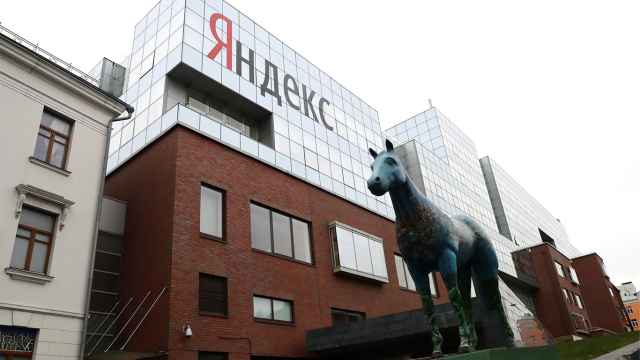
Yandex announced Thursday that it was withdrawing its 2026 financial guidance following a series of Ukrainian drone strikes against its data centers earlier this month, a move that triggered the tech giant’s stock to fall slightly in afternoon trading.
“The company has faced additional external factors making it difficult to assess its financial results for the remainder of the year,” Yandex said in its third-quarter earnings report.
Ukrainian drones hammered Yandex data centers between Oct. 8 and Oct. 11, leading to disruptions in everything from ride-hailing apps, car-sharing services, food delivery and online maps, to email, banking and streaming platforms. Government agencies and private firms whose products use Yandex infrastructure were also impacted.
Yandex said Thursday that it had restored “key features” for users and businesses, but its engineers were still working to bring all of its services back online.
The company previously projected 2026 revenue to grow by around 20%, with adjusted earnings before interest, tax, depreciation and amortization (EBITDA) forecasted at 350 billion rubles ($4.3 billion). The financial impact of the drone strikes on its data centers was not reflected in the third-quarter earnings report.
Yandex said its consolidated revenue reached 411 billion rubles ($5.1 billion) between July and September, a 12% increase year-on-year. Adjusted EBITDA also rose 12% year-on-year to 88 billion rubles ($1 billion), while net profit edged up 2% to 46 billion ($571 million).
The company said its search and AI services revenue rose 4% to 144.7 billion rubles ($1.8 billion) and urban mobility and logistics services 11% to 222.7 billion rubles ($2.7 billion). Personal subscriptions surged 37% to 75 billion rubles ($931.1 million).
Yandex’s stock sank around 1.30% on the Moscow Exchange following its announcement to suspend 2026 financial guidance. It hinted that it could resume publishing guidance in its next earnings report.
Once dubbed “Russia’s Google,” Yandex has gradually expanded its business from a search engine into an all-encompassing tech conglomerate spanning ride-hailing, e-commerce, cloud computing and artificial intelligence.
In 2024, Yandex’s Netherlands-registered parent company sold its Russian assets to a consortium of local investors for $5.4 billion, which came amid an exodus of Western firms from the Russian market due to the full-scale invasion of Ukraine.
A Message from The Moscow Times:
Dear readers,
We are facing unprecedented challenges. Russia's Prosecutor General's Office has designated The Moscow Times as an "undesirable" organization, criminalizing our work and putting our staff at risk of prosecution. This follows our earlier unjust labeling as a "foreign agent."
These actions are direct attempts to silence independent journalism in Russia. The authorities claim our work "discredits the decisions of the Russian leadership." We see things differently: we strive to provide accurate, unbiased reporting on Russia.
We, the journalists of The Moscow Times, refuse to be silenced. But to continue our work, we need your help.
Your support, no matter how small, makes a world of difference. If you can, please support us monthly starting from just $2. It's quick to set up, and every contribution makes a significant impact.
By supporting The Moscow Times, you're defending open, independent journalism in the face of repression. Thank you for standing with us.

Remind me later.